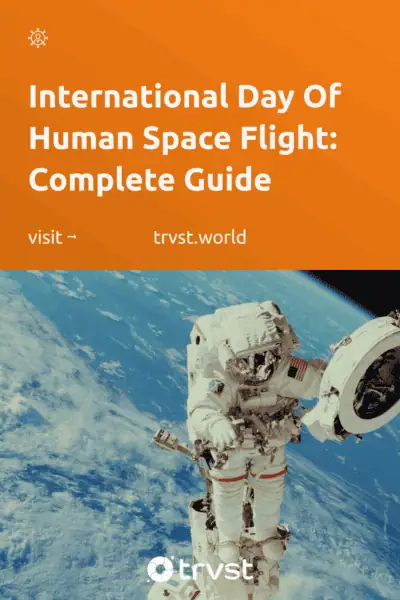
International Day Of Human Space Flight: Complete Guide

April 12 marks the International Day of Human Space Flight each year. The UN General Assembly created this observance in 2011 through Resolution A/RES/65/271. The date honors Yuri Gagarin's first human spaceflight on April 12, 1961.
This UN observance connects space exploration to the Sustainable Development Goals. It's different from Russia's Cosmonautics Day and grassroots Yuri's Night celebrations, both of which focus on cultural memory.
The UN framework ties space achievements to broader cooperation between nations.
Key Info: International Day of Human Space Flight
- When is International Day of Human Space Flight?
Occurs annually on the 12th of April - This Year (2026):
Sunday, April 12, 2026 (date has passed) - Official Website: United Nations IDHSF
-
Future Dates
- Monday, April 12, 2027
- Wednesday, April 12, 2028
- Thursday, April 12, 2029
- Friday, April 12, 2030
-
Additional Details
- Observed By: Space agencies, scientific institutions, educational organizations, and general public worldwide
- Where Is It Observed: International
- Primary Theme: Space Exploration and Scientific Achievement
- Hashtags: #InternationalDayOfHumanSpaceFlight #SpaceExploration #HumanSpaceFlight #YuriGagarin #SpaceScience
Quick Links: International Day of Human Space Flight
Why This Day Was Established

The UN created this day to highlight how space exploration helps sustainable development. International cooperation drives peaceful use of space under the Outer Space Treaty framework.
Beyond this, space diplomacy advances the UN's peacekeeping mission through shared science rather than national competition. The observance promotes STEM education while inspiring young people toward scientific careers.
Educational programs reach developing nations often left out of space stories. This positioning shapes how we view future Mars missions and lunar settlements as humanity's shared achievement, not superpower rivalry.
Timeline: From Milestone to Global Observance
Yuri Gagarin completes first human spaceflight (April 12)
USSR establishes Cosmonautics Day as a national holiday
Yuri's Night grassroots celebrations begin globally
UN General Assembly adopts Resolution A/RES/65/271 (April 7)
First official International Day of Human Space Flight observance
How Different Observers Mark This Day

Space Agencies run educational webinars and historical exhibitions. ESA hosts virtual field trips to mission control. NASA coordinates social media takeovers with astronaut interviews.
Roscosmos organizes museum displays celebrating Soviet heritage alongside international partnerships.
Educational Institutions build specialized activities during Space Week. Schools coordinate student rocket competitions with local aerospace companies. Universities partner with planetariums for viewing events and guest lectures.
UN Member States issue proclamations from heads of state emphasizing peaceful cooperation. Embassies organize diplomatic receptions showcasing national contributions to space. Cultural centers highlight diverse astronaut backgrounds across participating nations.
Advocacy Organizations show remarkable reach through coordinated celebrations. Yuri's Night parties take place in 75+ countries, with locally adapted themes.
Participation Guide for Individuals and Groups
Zero-Barrier Virtual participation includes ISS livestreams and space agency social media events. The UN Outer Space Office provides year-round detailed materials in multiple languages.
What aspects of space exploration resonate most with your audience?
Local Community activities cover planetarium shows and aerospace museum special exhibitions. Astronomy clubs organize ISS viewing parties using apps to track orbital passes. Public libraries often host space-themed programming during April.
Medium-Effort Organizing involves coordinating classroom presentations with local STEM professionals. Community groups can arrange viewing parties combined with educational activities.
Virtual participation removes barriers while local events build lasting connections.
Official hashtags connect global celebrations. Participants share experiences across continents while keeping their own distinctive local character.
Core Themes and Messages
International Cooperation shows remarkable scientific collaboration between nations. According to NASA, more than 4,000 investigations conducted on the ISS have produced over 4,400 research publications; approximately 40% involve collaboration between multiple countries.
These partnerships transcend political boundaries through shared scientific goals. Trust builds through collaborative research.
Peaceful Exploration follows Outer Space Treaty principles, emphasizing research over competition. The Artemis Accords reached 50 signatory countries by 2024, establishing civil exploration frameworks for Moon and Mars missions.
This relates directly to maintaining space as humanity's shared frontier.
Universal Inspiration emerges from astronaut role models representing diverse backgrounds. Space careers become accessible through educational programs connecting everyday people to cosmic achievements.
Species-Level Achievement represents humanity overcoming technical barriers and expanding knowledge frontiers. These milestones belong to our entire civilization rather than individual nations.
Each theme appears in observable celebration elements worldwide. Creates shared messaging across cultures.
Conclusion
April 12 provides our fixed annual opportunity to celebrate human spaceflight achievements. The UN Outer Space Office offers detailed materials for deeper engagement throughout the year. Space agency event calendars detail celebration opportunities globally.
Local Yuri's Night chapters create community connections, bridging space enthusiasm with educational outreach. The museum displays are particularly worth visiting.
Individual participation strengthens the broader mission of maintaining public support for peaceful space exploration and international scientific cooperation that benefits all humanity.
Resources:
FAQs (Frequently Asked Questions)
Math teachers have students calculate how fast the ISS travels - that's 17,500 miles per hour. History classes dig into why the US and Russia went from space race rivals to partners on the space station. Students love researching astronauts from their own countries. What surprises them most? Learning that 15 nations work together 250 miles above Earth. The UN Office for Outer Space Affairs ships free lesson plans to any school that asks. Many space agencies schedule video calls with actual astronauts during April. One teacher told me her students still talk about their ISS astronaut call months later.
Russia's Cosmonautics Day celebrates their space program victories. Yuri's Night throws parties worldwide - think space-themed block parties with rockets and stargazing. But the UN day focuses on something different. It highlights how countries that disagree on Earth still work together in space. The International Space Station proves this works. Russian rockets launch American astronauts. European labs conduct experiments with Japanese equipment. This relates to bigger questions about cooperation versus competition in space exploration.
Satellites already help farmers in Kenya track rainfall patterns. Weather data from space saves lives during hurricanes in the Philippines. GPS guides fishing boats off the coast of Peru. These countries don't launch rockets, but they benefit from space technology daily. Beyond this practical impact, the observance builds excitement for science careers among young people. Rwanda launched its first satellite in 2019 through a partnership program. Today, many space agencies actively seek developing nation partners for satellite projects and training exchanges.
Download an ISS tracking app tonight. The space station looks like a bright star moving across the sky - kids love spotting it. Try simple rocket experiments using baking soda and vinegar in plastic bottles. Make "astronaut ice cream" together while talking about what people actually eat in space. Video call grandparents and explain how satellites make the connection possible. Plant seeds and discuss the vegetable experiments growing on the ISS right now. Many space agencies host free family events online during April - NASA's are particularly good for younger kids.
The UN Office for Outer Space Affairs coordinates photo exhibitions at headquarters in New York and Vienna. Space agencies host astronaut panels where crews share stories from recent missions. Commemorative stamps get released at UN offices worldwide - collectors snap these up quickly. This suggests growing public interest in space cooperation themes. In practice, the formal events blend with grassroots celebrations like Yuri's Night parties happening in over 75 countries. The combination creates both official recognition and genuine public engagement with space exploration achievements.
Barbara is a former journalist who is passionate about translating important causes into engaging narratives. She combines communication expertise with an environmental science background to create accessible, fact-driven content.