
13 Famous Marine Biologists and Their Impact

Marine biologists play an essential role in protecting underwater organisms and their homes. They research various aspects of marine life and discover new ways to interact with the ocean. Marine biology is crucial because it promotes marine conservation: we learn the threats facing aquatic life and find solutions to these problems.
This article explores famous marine biologists and their impacts on the world’s oceans. We will discuss the impacts of American marine biologists like Sylvia Earle and Rachel Carson, the creator of an underwater-themed cartoon.
What is a marine biologist?
A marine biologist studies organisms and their behaviors concerning their marine environment. They often study marine biology at universities and colleges around the world. Marine biology is a broad study area, requiring marine biologists to specialize in a specific area.
Some of the specialized areas of marine biology are oceanography, aquatic ecology, molecular biology, taxonomy, morphology, anthropology, and the geographical distribution of marine organisms. Marine biologists conduct extensive research to understand the ocean's chemical and physical properties, including its movements, currents, and light availability at various depths.
Marine biology also includes the study of the various surfaces that make up the ocean floor. A marine biologist can focus on a specific species, behavioral pattern, or ecosystem. Marine biology is essential to the survival of the human race. It helps us learn more about the ocean and how it can help us with our basic needs.
Most Famous Marine Biologists In The World
In no particular order, here’s a list of individuals with significant contributions to marine science and research:
Quick Links:
1. Ruth Gates (1962-2018)

At the top of our list of famous marine biologists is Ruth Gates. She got her bachelor’s degree in biology at Newcastle University in 1984. She furthered her studies by getting a Ph.D. in cnidarian-algal symbiosis in 1989.
Her PhD study greatly impacted the scientific community and marine ecosystems, particularly coral reefs. She discovered the effects of bleaching corals caused by increasing sea temperatures1, which led her to spend 13 years refining her molecular genetics, cellular biology, and evolutionary biology skills as a researcher at the University of California.
She focused on preserving coral reef ecosystems, founding the Gates Coral Lab at the Hawaii Institute of Marine Biology. The foundation focuses on research that helps increase conservation efforts and stabilize coral ecosystems.
Ruth Gates was the first woman elected president of the International Society for Reef Studies in 2015. In 2017, she also participated in the Emmy-winning Netflix documentary Chasing Coral. Unfortunately, she died on October 25, 2018, from surgical complications. Her foundation continues to study ways to protect coral reefs in her absence.
2. Charles Wyville Thompson (1830-1882)

Charles Wyville Thompson was born on March 5, 1830. He is a Scottish marine biologist who contributed significantly to marine research. Charles studied medicine at Edinburgh University and became a botany lecturer at the University of Aberdeen from 1850 to 1851. He also lectured at Marischal College from 1851 to 1852.
In 1870, he became a professor of natural history at Edinburgh. During this period, he developed an interest in marine invertebrates. He loved deep-sea exploration and partook in several deep-sea explorations, the most notable being the Challenger expedition.
Charles Wyville Thompson discovered an immense biodiversity of invertebrates at depths of 4,000 ft during his expeditions in North Scotland and the Atlantic Ocean on board HMS Lightning and Porcupine from 1868 to 1870.
He also learned about the inconsistencies of deep sea temperatures. His undersea discoveries led to the publication of his book, The Depths of the Sea, in 1873.
After his return from the Challenger expedition in 1876, he became a knight. In 1877, he wrote a general account of the Challenger undersea discovery in the Voyage of the Challenger. To this day, we use some of the data from the expedition. He died in 1882.
3. Rachel Carson (1907-1964)
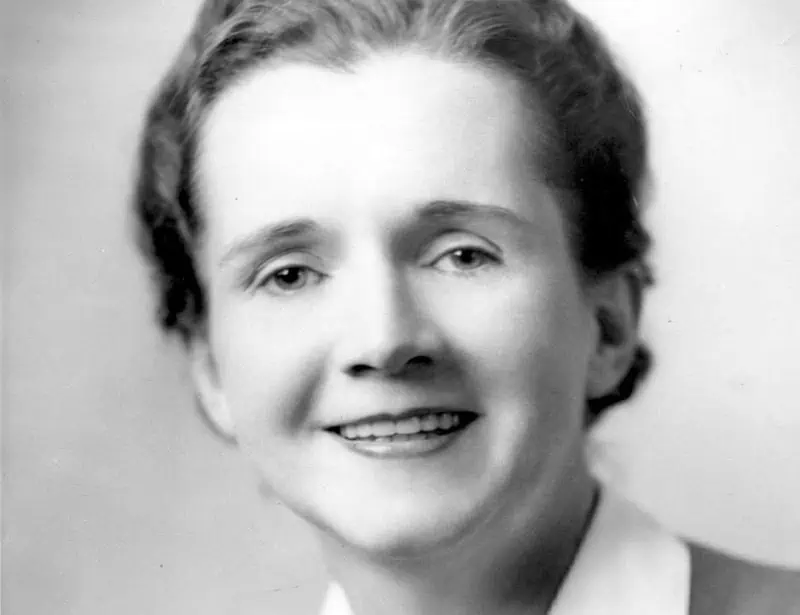
Next on our list of famous marine biologists is Rachel Carson. Rachel Carson was born a nature lover on May 27, 1907. The American marine biologist is well-known for authoring books on the ocean, environmental pollution, and climate change.
She initially studied English to become a writer at the Pennsylvania College for Women but switched to biology. She got a master’s degree at Johns Hopkins University in 1932 before teaching at the University of Maryland for five years. Rachel started working as a marine biologist at the U.S. Fisheries and Wildlife Service (formerly the U.S. Bureau of Fisheries) from 1936 to 1952.
During this period, she published Under the Sea-Wind in 1941, The Sea Around Us in 1951, and The Edge of Sea in 1955. Her books showed her excellent writing skills and understanding of marine science.
Under the Sea-Wind discusses the interactions and behaviors of shared marine life between a fish, an eel, and a seabird. The Edge of the Sea explores the marine ecosystems of the eastern coast from Maine to Florida.
Her most notable work is Silent Spring, published in three parts in the New York Times before she published it as a single book. It warned Americans about the harmful effects of chemical pesticides like Dichlorodiphenyltrichloroethane (DDT).
She released it during the early periods of environmental advocacy, questioning the government and private science on the need to control nature instead of protecting it. She spoke up about the consequences of pesticides on wildlife despite the threats of lawsuits from the chemical industry.
Unfortunately, Rachel Carson died in 1964 from breast cancer without seeing any of the significant changes she pursued. However, her writing served its purpose.
It raised awareness about environmental issues worldwide and established the Environmental Protection Agency in the United States. It also led to celebrating the first Earth Day in 1970, and her book Silent Spring influenced the ban on DDT in 1972.
4. Anton Fredrick Bruun (1901-1961)
Next on our list of renowned marine biologists is Anton Fredrick Bruun. He was a Danish marine biologist and oceanographer born on 14th December 1901. He got a Ph.D in zoology in 1926 and started working for the Danish Fishery Research Institute2, where he learned from other ocean scientists.
Anton participated in Dana’s Expedition around the world from 1928 to 1930. He later published his treatise on the flying fishes of the Atlantic. Shortly after, Anton became a curator at the Zoological Museum of the University of Copenhagen in 1938. He led the Atlantide Expedition from 1945 to 1946 and the Galathea Expedition from 1950 to 1952.
The Galathea Expedition first explored deep-ocean trenches, focusing on benthic fauna below 3,000 m. Anton discovered a unique fauna named Hadal. He dedicated the last ten years of his life to international oceanography, participating in the establishment of various bodies like IABO, IACOMS, SCOR, and the IOC.
5. Nicole Dubilier (1957-Present)
Nicole Dublier is a famous marine biologist who majors in the diversity, ecology, and evolution of symbioses between microorganisms and marine invertebrates from deep-sea hydrothermal vents, cold seeps, seagrass meadows, and shallow-water coral reefs.
She is also the director of the symbioses department at the Max Planck Institute for Marine Microbiology in Bremen, Germany.
She and her team of scientists used various methods to show the benefits of the interactions between microorganisms that allow animals to thrive in nutrient-poor environments. These methods include single gene analyses, omics, whole organism physiology, and in-situ experimental work.
Nicole has received many awards for her groundbreaking research, including Germany’s most prestigious research prize, the Leibniz Prize, a Gordon and Betty Moore Marine Microbial Initiative Investigator Award, and a European Research Council Advanced Grant.
6. Sylvia Earle (1935-Present)

Another famous marine biologist is Sylvia Earle. She’s an American marine biologist and oceanographer best known for researching aquatic algae. She is also an environmental activist who raises awareness through her books and documentaries on the consequences of overfishing and pollution of the world's oceans.
Sylvia Earle is a scuba diving pioneer. She became a scuba diver at Florida State University. She pioneered modern self-contained underwater breathing instruments and the development of deep-ocean submersibles. Sylvia also holds a record for the deepest untethered dive in human history, diving 381 m beneath the Pacific Ocean.
In 1969, she collected over 20,000 algae samples for her dissertation, Phaeophyta of the Eastern Gulf of Mexico. Sylvia Earle discovered undersea dunes off the coast of the Bahamas in 1968 after becoming a research fellow at the Farlow Herbarium of Harvard University. During her career, she led many deep-ocean expeditions.
She founded an association with the National Geographic Society to produce media on ocean life. In 1990, Sylvia Earle was also the first woman to become the chief scientist of the National Oceanic and Atmospheric Administration (NOAA).
7. Eugenie Clark (1922-2015)
Dr. Eugenie Clark, known as the Shark Lady, is an American marine biologist and the founding director of Marine Laboratory & Aquarium. She majored in ichthyology, a marine biology branch focusing on fish. In 1950, she received her postgraduate degree from New York University, where she researched the live-bearing reproduction of platys and swordtail fish.
Later, in 1950, she explored the waters of the Red Sea from the Al-Ghardaqah Marine Biological Station in Egypt. Eugenie Clark discovered many fish species there, like the Red Sea sand diver and Moses sole. However, her research and her life’s work were primarily focused on learning about sharks and their behavior.
She wanted to clear the misconceptions and myths about shark behavior. Clark discovered that some sharks don’t have to swim continuously to breathe. Her work with the sleeping sharks of Mexico contributed to our understanding of shark biology today.
She worked with the New York Zoological Society (now the Wildlife Conservation Society) and Woods Hole Oceanographic Institution in Massachusetts. Eugenie retired after teaching marine biology at the University of Maryland for about 15 years.
8. Jacques Cousteau (1910-1997)

Another famous marine biologist on our list is Jacques Cousteau. Jacques Cousteau is a French naval officer, ocean explorer, and co-inventor of aqua-lung. He didn’t have formal academic training in marine science and biology, but ocean exploration because of his interest in scuba diving.
Cousteau and Emile Gagnan created the first automatic scuba equipment, Aqua Lung, which allows divers to stay underwater for an extended period. He also contributed to inventing other oceanography equipment, such as the diving saucer and underwater cameras.
He founded several marketing, engineering, manufacturing, and research organizations, which formed the Cousteau group in 1973. Jacques Cousteau produced films, documentaries, and books to promote the environmental movement, such as The Silent World.
9. Nancy Knowlton
Next on our list of famous marine biologists is Nancy Knowlton, an American marine biologist specializing in coral reef science. She got her Ph.D. from the University of California before becoming the former Sant Chair for Marine Science at the Smithsonian’s National Museum of Natural History.
Nancy founded the Center for Marine Biodiversity and Conservation at the Scripps Institution of Oceanography. She spent most of her life promoting ocean conservation and protecting marine life.
10. Stephen Hillenburg (1961-2018)

Stephen Hillenburg is an American marine biologist, producer, writer, and voice actor. He is also an animator, best known for creating SpongeBob SquarePants. The American animator earned a bachelor's in marine resource planning and interpretation in 1984.
Shortly after, he taught marine biology and started a career in animation. His creation led to Operation Sea Change, a global initiative to conserve the ocean.
11. Leanne Cullen
Leanne Cullen is a British marine biologist who obtained her postgraduate degree in Biological Sciences in 2007. She pioneered research into seagrass systems and their ecosystems among scientists worldwide.
12. Anna Thynne (1806-1866)

Anna Thynne, born in 1806, is a British marine zoologist. She invented the first sustained marine aquarium, which maintained corals and sponges for over three years. She also built the first balanced aquarium, which added marine plants.
13. Leanne Armand (1968-2022)

Leanne Armand is an esteemed Australian marine scientist based at the Australian National University3. She dedicated her career to climate research, using Southern Ocean diatoms to construct climate records spanning 250,000 years. Unfortunately, she passed away in January 2022 after a courageous fight against cancer.
Conclusion
These famous marine biologists tremendously helped us with marine conservation. Their work taught us about the aquatic ecosystem and its organisms. These people can inspire the next generations of marine scientists and biologists worldwide.
Glossary Terms:
| 1 | Gates, R. D., Baghdasarian, G., & Muscatine, L. (1992). Temperature stress causes host cell detachment in symbiotic cnidarians: Implications for coral bleaching. the Biological Bulletin/Biological Bulletin, 182(3), 324–332. |
| 2 | IOC Bruun Memorial Lectures, 2001. Operational Oceanography — A Perspective from the Private Sector. IOC Technical Series 58, UNESCO 2003. (English only). |
| 3 | Armand, L. K., Crosta, X., Romero, O., & Pichon, J. (2005). The biogeography of major diatom taxa in Southern Ocean sediments. Palaeogeography, Palaeoclimatology, Palaeoecology, 223(1–2), 93–126. |
Jen’s a passionate environmentalist and sustainability expert. With a science degree from Babcock University Jen loves applying her research skills to craft editorial that connects with our global changemaker and readership audiences centered around topics including zero waste, sustainability, climate change, and biodiversity.
Elsewhere Jen’s interests include the role that future technology and data have in helping us solve some of the planet’s biggest challenges.
Fact Checked By:
Isabela Sedano, BEng.
