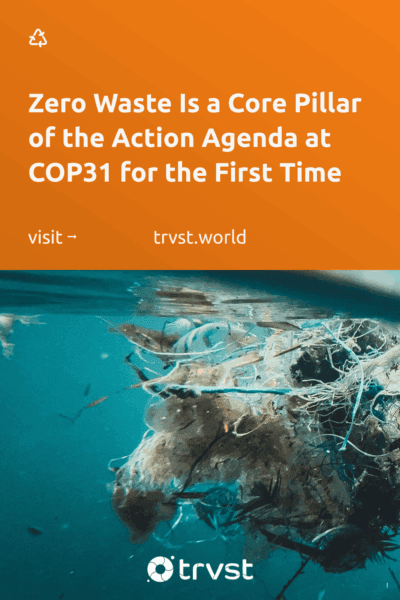
Zero Waste Is a Core Pillar of the Action Agenda at COP31 for the First Time
Turkish First Lady Emine Erdoğan delivered a prominent keynote address at the opening ceremony of Climate Week NYC 2026 in New York City. Serving as the Chair of the UN High-Level Advisory Board on Zero Waste, she used the platform to share Türkiye's domestic progress and expand its zero-waste vision to a global scale.
Erdoğan detailed how the Turkish Sıfır Atık (Zero Waste) movement, spearheaded by her, serves as the foundational cornerstone for Türkiye's primary focus within the COP31 Action Agenda, which includes:
Elevating Waste to the Top Priority: A draft of the COP31 Action Agenda positions the rapid reduction of waste-derived methane emissions as the conference's number-one real-world priority.
The Zero Waste Foundation, under her honorary presidency, frequently bridges global policy with academic research, engaging with institutions such as Columbia University to align systems-level engineering—including circular economies, biodiversity protections, and waste recovery—with real-world deployment frameworks. Dr. Roisin Commane, Associate Professor of Earth and Environmental Sciences at Columbia University,[1] whose research serves as the foundation for my Atmosphere Flag CCL painting on exhibit at the Lamont-Doherty Earth Observatory of Columbia University (LDEO), which is included in the “Legacy/ Kalit/ Legado” art show for COP31, said,
“My current research is focused on understanding the sources of methane in cities. We see a lot of methane from natural gas in New York City, and much of it has not been burned fully. The pollution that is released from the incomplete combustion of natural gas can be quite toxic, so we need to know where it’s coming from so we can reduce it.”
Empowering Civic and Local Actors: The framework treats circular economy practices—such as preventing, reducing, and recycling materials—as shared cultural and operational duties, turning everyday citizens into climate problem-solvers.
The unique partnership between Australia and Türkiye for COP31 in November 2026 has brought Australia into close collaboration with the Zero Waste Foundation, where "Zero Waste and Methane Reduction" has become a leading priority.
A Unified Diplomatic Bridge: Coordinated alongside the Ministry of Environment, Urbanization and Climate Change, the initiative is promoted internationally under the banner "From 0 to COP31: Together for the World", directly connecting municipal zero-waste execution with international decarbonization goals.
Turkish First Lady Emine Erdoğan, along with Türkiye's Minister of Environment, Urbanization and Climate Change, Murat Kurum, placed the national Zero Waste Project movement for the upcoming 31st UN Climate Change Conference (COP31) priorities at the heart of the UN agenda, supported by the strategic engagements of COP31 Champion and President of Zero Waste Foundation Samed Ağırbaş.
COP31, with the theme “From Göbeklitepe to the Global Net Zero Emissions Goal,” will run from Monday, November 9 through Friday, November 20, 2026. This theme explicitly connects archaeology, heritage conservation, and historic preservation directly to modern global decarbonization, zero waste, and climate adaptation to position COP31 as a literal and symbolic "bridge between civilizations, cultures, and eras.”
Prominent scientists, climate activists and representatives of international public institutions are expected to gather at the Antalya Expo Center, located in the Soğucaksu district.
Legacy/ Kalit/ Legado Art Exhibition for COP31
Eight award-winning artists from four different countries: Turkiye, Australia, Spain, and the USA, who have been collaborating in art shows for the COPs since COP26, bring three environmental exhibitions to COP31 under the title “Legacy/ Kalit/ Legado” that complement the conference's core narrative of sustainable culture “Zero Waste”, Climate Adaptation and Heritage.
1. Statue of Liberty by Hunt Slonem[2]& Selva Ozelli for the National Lighthouse Museum, honors the 140th anniversary of the Statue of Liberty's dedication, American 250th milestones and environmental sustainability;
2. Flags of Science CCL by Selva Ozelli for Columbia University's Lamont-Doherty Earth Observatory (LDEO), honors the 250th anniversary of U.S. independence, the groundbreaking earth and space science research conducted by LDEO scientists and environmental sustainability;
3. America at 250 by Semine Hazar[3], Ian Hutton[4], Fatma Kadir[5], Selva Ozelli, Alfons Rodriguez[6], Ilhan Sayin[7], Mary Tiegreen[8] for the Havre de Grace Maritime Museum, honors the 250th anniversary of U.S. independence and global environmental sustainability.
1. Statue of Liberty as a Symbol of Zero Waste and Sustainability
While the Statue of Liberty, gifted to the USA by France 140 years ago, was originally designed to symbolize freedom and democracy, it has become a powerful symbol of zero waste and sustainability through both its natural chemistry and its modern day-to-day operations.
It is very unfortunate that the USA is the biggest waste producer in the world. It produces 12% of the world's municipal solid waste despite having only 4% of the global population, making it the most wasteful country per capita. However, multiple major cities across the United States run official zero waste campaigns and initiatives with specific landfill diversion goals.
Ten years ago, New York City's Zero Waste Challenge (February–June 2016) dared local businesses to divert at least 50% of their waste from landfills. The official commercial concessionaire for the Statue of Liberty, Evelyn Hill Inc., participated in this challenge and radically transformed operations at Liberty Island by implementing mass composting, replacing single-use condiment packets with bulk dispensers, and switching to biodegradable corn-starch cups—eventually hitting a 96% recycling and composting diversion rate in running the monument. As a result, our lovely Lady Liberty, constructed from copper that is 100% reusable, became a symbol of “Zero Waste.”
The Statue of Liberty Art Show by Hunt Slonem and Selva Ozelli, hosted at the National Lighthouse Museum, and the America at 250 exhibit at the Havre de Grace Maritime Museum with a Statue of Liberty painting by Semine Hazar are included in the “Legacy/ Kalit/ Legado “ exhibition for COP31 for these reasons.
2. Connecting Geology/Archeology to Modern Science Technology, Climate Adaptation, and Heritage
The Science of Flags CCL series by Selva Ozelli, which is part of the “Legacy/ Kalit/ Legado” art show for COP31, is made up of four flag oil paintings, three of which highlight Türkiye as one of the world's most geologically unique nations, sitting at the direct crossroads of Europe, Asia, and Africa. Its landscape is shaped by intense tectonic forces that have directly influenced its diverse ecosystems, rich biodiversity, and thousands of years of human history/archeology complimenting the COP31's core narrative of sustainable culture “Zero Waste”, Climate Adaptation, and Heritage.
The Atmosphere Flag CCL, as mentioned above, draws attention to Turkiye as a host to three of the world’s 36 biodiversity hotspots (the Caucasus, the Irano-Anatolian, and the Mediterranean Basin), featuring over 11,000 plant species including Tulips—nearly a third of which are endemic. And it’s role as a vital bottleneck for bird migration.
This theme is also captured elegantly in the “Legacy/ Kalit /Legado” art show by Hunt Slonem via his Bird, Butterfly and Bunny series on exhibit at the Statue of Liberty art show.
Two of the flags connect modern science to archeological and geological sites in Turkiye:
The Ocean Lovers – To the Core Flag CCL honors LDEO’s groundbreaking core research and foundational contributions to marine and Earth science. Specifically, it is inspired by the work of:
Dr. Dorothy Peteet[9], who utilizes sediment cores to study past climates and carbon sequestration in wetlands.
Drs. William Ryan[11], Walter Pitman, and Petko Dimitrov, who used deep core marine samples to propose the theory of a catastrophic Mediterranean flood called the Black Sea deluge hypothesis, a widely debated scientific theory that links a real prehistoric cataclysm to the biblical narrative of Noah’s Ark --purportedly located at the Durupinar Heritage site on Mount Ararat of Turkiye -- that created the modern Black Sea.
The Tree of Life/Tectonic Flag CCL bridges the gap between ancient mythology and modern earth science by incorporating the Tree of Life symbol and the Bull of Heaven narrative from the ancient Mesopotamian Epic of Gilgamesh (ca. 2700 BCE). The Epic of Gilgamesh — fragments of which were found at the ancient archaeological site of Hattusa near modern-day Boğazkale, Turkiye, a WORLD UNESCO HERITAGE SITE — accidentally mirrors the birth of modern plate tectonics theory. While the epic of Gilgamesh explained seismic rifts through the lens of gods and monsters, it correctly identified the tree of life found in the ocean depths and the shaking earth as places of profound transformation and creation, which we now understand through geology, plate tectonics, as well as LDEO’s tree rings Lab headed by Dr. Edward R. Cook[11].
The Space Solar Flag CCL[12] is designed based on LDEO scientists Steven L. Goldstein’s and Dr. Kerstin Lehnert’ research, to bridge the gap between environmental sustainability and frontier science and technologies developed by Turkish scientists such as 5G (Dr. Erdal Arıkan is globally recognized as the "Father of Polar Codes), blockchain (Dr Emin Gün Sirer is a pioneer of internet currency and tokens co-creating the first Karma coin), AI (Refik Anadol is a world-renowned AI artist, and pioneer in the aesthetics of data sculptures), and space-solarized orbital data centers which moved from theoretical to initial implementation in late 2025, with several companies and research institutions launching or planning to launch the first prototypes of orbital data centers and computing nodes in low Earth orbit (LEO) satellites that are powered by space solar energy.
3. From 0 to COP31: Together for the World
COP31 features a first-of-its-kind unique split leadership model between Türkiye and Australia. As part of the “Legacy/ Kalit /Legado” exhibition, the America at 250 art show presents the Paradise Flag CCL by me and Ian Hutton, who is a renowned Australian naturalist, author, and curator of the Lord Howe Island Museum. Ian has played a pivotal role in exposing the catastrophic impact of marine plastic pollution on seabirds. Operating from Lord Howe Island, a UNESCO World Heritage site in the Tasman Sea, Hutton's decades-long field research and advocacy have provided foundational scientific evidence to the global plastic pollution movement, which ties in to the Zero Waste theme of COP31[13].
This art show also features The Iceberg Flag by Alfons Rodriguez and Fatma Kadir, as well The Hydrangea & Rose Flag CCL by award-winning botanical artist Ilan Sayin, photographer Mary Tiegreen, and me, featuring roses of Isparta, Turkiye, which produce roughly 65% of the world's rose oil, functioning as a premier sustainable global hub for Rosa damascena cultivation and sustainable perfumery supply chains for the past 200 years. Isparta is also home to significant archaeological treasures such as Pisidian Antioch (Antiocheia ad Pisidiam), an ancient Roman and Hellenistic site on the UNESCO World Heritage Tentative List that is famous for its ancient theater, aqueducts, and early Christian history linked to Saint Paul.
Alba Cedó Guivernau, Cultural Affairs Office, Consulate General of Spain in New York, explained,
“The America at 250 exhibition that is featured as part of Legacy/ Kalit /Legado for COP31 2026 hosts collaborative work among participating award-winning international artists and institutions [that collaborate with the Zero Waste Foundation]. It is encouraging to see initiatives that bring together artistic practice, environmental awareness, and public engagement, particularly at a time when reflections on sustainability, collective responsibility, and cultural dialogue are increasingly relevant. We would also like to commend the coordination of this project and the continued efforts to connect artists across different backgrounds and disciplines through shared environmental, historical, and cultural themes.”
References:
[1] https://www.trvst.world/environment/interview-roisin-commane/
[2] https://www.trvst.world/biodiversity/interview-hunt-slonem/
[3] https://www.trvst.world/environment/interview-semine-hazar/
[4] https://www.trvst.world/biodiversity/interview-ian-hutton-the-sustainable-lord-howe-island-museum/
[5] https://www.trvst.world/environment/interview-fatma-kadir/
[6] https://www.trvst.world/environment/interview-alfons-rodriguez/
[7] https://www.trvst.world/climate-change/interview-ilhan-sayin/
[8] https://irishtechnews.ie/mary-tiegreen-at-london-climate-action-week/
[9] https://www.trvst.world/climate-change/interview-dr-dorothy-peteet/
[10] https://www.trvst.world/environment/interview-dr-william-ryan/
[11] https://www.trvst.world/environment/interview-dr-edward-r-cook/
[12] https://www.trvst.world/environment/ldeo-international-asteroid-day/
[13] https://www.trvst.world/waste-recycling/plastic-pollution/plastic-free-july-art/
Glossary Terms:
Selva Ozelli Esq, CPA is a legal and finance executive with diversified experience dealing with highly complex issues in the field of international taxation and related matters within the banking, securities, Fintech, alternative and traditional investment funds. Her first of its kind legal analyses involving tax laws, Foreign Corrupt Practices Act (FCPA), blockchain technology, solar technology and the environment and have been published in journals, books and by the OECD. Her writings have been translated into 15 languages.