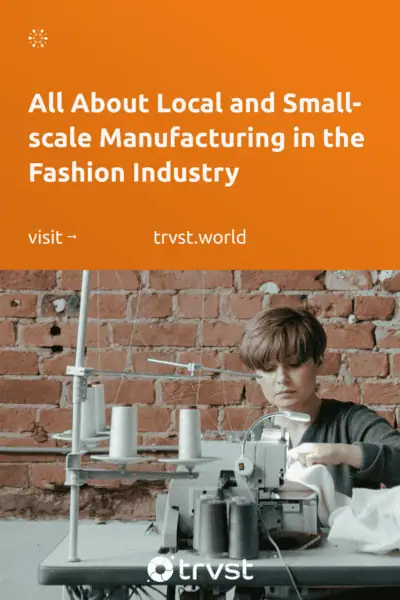
All About Local and Small-scale Manufacturing in the Fashion Industry

If a brand in the fashion industry utilizes local or small-scale manufacturing to optimize its supply chain so you can get high-quality garments with the smallest carbon footprint possible, would you support it? Yes! Many others agree, and that's why there's a growing demand for homegrown ethical fashion.
Going small and local is emerging as a potential solution to the environmental and social ills that plague the industry. It also promises a solid boost to local economies. This article discusses the benefits and challenges. And we have also added some relevant brands you can support immediately.
TABLE OF CONTENTS:
First, let's be clear

First and foremost, we say a product is locally manufactured when it is made entirely or modified significantly in the same country as the buyer. It doesn't have to be in your immediate local area.
According to the Federal Trade Commission, a product may only be labeled “made in the United States” if it contains no or negligible foreign content and a significant portion of its production process occurs there.
A brand that sources its raw materials, such as fiber, from a foreign country but manufactures in the US can still use a made-in-the-USA label. However, if a textile or wool product has been manufactured partially in the US and a foreign country, the label must indicate that. Second…
Local manufacturing doesn't automatically mean sustainable fashion.
When a clothing line carries a “locally made” label, it is not a definite guarantee of sustainability.
Sustainable fashion brands go beyond local sourcing and manufacturing. They use eco-friendly materials, have transparent supply chains, support local economies, and adhere to ethical production practices.
Don't be swept away by a brand’s reputation; always examine its production methods closely and critically.
Microfactories: an emerging global trend

Digital transformation in the manufacturing sector has led to the emergence of microfactories. These small—to medium-scale production facilities leverage state-of-the-art technology like automation, machine learning, big data, and AI to optimize operations.
Microfactories are modular and specialized, unlike the complex traditional factory assembly lines, which helps them work faster and more efficiently. They are also more flexible than conventional factories, as they accept smaller MOQs and can respond to changes in client specs quickly.
These micro-factories are situated in urban areas near consumption markets, eliminating much of the transportation emissions. By using new technologies, they consume less energy and water and generate less waste. Micro-factories also require fewer workers than traditional factories, so monitoring and enforcing fair labor practices should be easier.
Micro-factories are an environmentally friendly alternative to traditional mass production. They are essential for local and small-scale manufacturing in the fashion industry to thrive. However, micro-factories face challenges such as high overhead costs, low production volume, and lack of investment.
Why local manufacturing matters in the fashion industry

Local manufacturing can significantly contribute to making sustainable fashion a reality. It has advantages for the brand, the consumer, the economy, and the environment.
1. Lesser environmental impact
The fashion industry is easily one of the most polluting industries on the planet. Its lengthy international supply chains and energy-intensive manufacturing contribute 8–10% of global carbon emissions1.
Local sourcing and manufacturing reduce the distance apparel travels to reach the final consumer. A shorter supply chain lessens the carbon footprint of clothing manufacturing. However, brands need to optimize their logistics systems to get the most out of local production.
Other factors, such as chemical use, resource consumption, energy use, and waste management, contribute to the overall environmental impact of local manufacturing.
Most importantly, because the environmental impacts are closer to home, it will encourage consumers and brands to consume more responsibly.
2. Boosts the local economy
Clothing manufacturing provides 94 million jobs worldwide. However, in the US, the number of people employed in the apparel manufacturing industry has significantly declined from about 900,000 in 1990 to barely 90,000 in 2024. In search of lower labor and production costs, countries like the US shifted fabrication and manufacturing overseas.
Local manufacturing can bring significant economic growth to local communities by providing jobs and supporting local businesses. Sourcing locally also enriches raw material producers like organic cotton farmers.
Local communities can even establish their micro-factories, producing locally with local materials. Of course, the benefit to the local economy can only be realized if consumers support local businesses rather than opting for foreign fashion.
3. Encourages ethical fashion practices
The fashion industry is notorious for prioritizing profit over the well-being of people and the environment. In many developing countries, the industry is rife with child labor, modern slavery, poor wages, exploitation, harassment, and life-threatening work environments. Most brands escape accountability as they cannot adequately monitor their offshore partners.
Local manufacturing allows brands to monitor their production partners closely to ensure they adhere to ethical labor practices. Government agencies, consumer associations, and independent bodies will also find it easier to investigate whether workers are treated fairly.
Unfortunately, the U.S. garment industry fell victim to poor sustainable fashion practices. For example, the Department of Labor found Southern California contractors and manufacturers engaging in wage theft.
4. Better quality control
Fast fashion is about keeping up with microtrends, some lasting as little as a month. It uses cheap materials, overworked employees, and a rushed manufacturing process, which results in low-quality garments that last only a few wears.
One of the most important principles of sustainable fashion is product longevity. Consumers should use sustainable products long enough to offset the associated carbon costs.
Brands manufacturing locally can exercise greater control over the materials and processes, allowing them to produce high-quality garments. Additionally, creating high-quality products is more straightforward for U.S. manufacturers because the country has strict quality standards enforced by various agencies. Such standards are almost nonexistent or ignored in most developing countries without consequences.
Related Read: How Long Do Clothes Last?
5. It supports artisans
The globalized fashion industry doesn't consider preserving traditional techniques and crafts. It focuses on the fastest and cheapest methods to satisfy the mass market.
In local manufacturing, there are opportunities for brands and manufacturers to collaborate with local artisans. Local communities can sustain valuable cultural traditions while creating one-of-a-kind fashion items. Such collaborations can help preserve and share our cultural heritage even as fashion becomes more globalized.
Many brands would argue that artisans are too slow-paced to meet consumer demand. However, recognizing and rewarding artisanal work provides an essential incentive for artisans to embrace technology.
6. Slow fashion
Local manufacturers typically don't produce garments in huge quantities all at once like their overseas counterparts. Their small batch production method is more flexible and sustainable.
Mass production in the fast fashion industry usually leads to dead stock inventory that goes to waste. Producing on a smaller scale nearby allows brands to stock goods based on customer demand. If customer preferences change, it is easier to pivot while minimizing waste.
Also, new entrants into the apparel market can take advantage of low MOQs that local companies offer to test their products or launch on a budget.
Slow fashion doesn't mean slow production. Local manufacturers often fulfill orders quickly, leveraging shorter distances and better communication.
Challenges of local and small-scale manufacturing in the fashion industry

Supporting sustainable fashion through local production comes with some challenges.
1. Finding the right manufacturer
Local, sustainable fashion brands sometimes have trouble finding local manufacturers that meet their exact expectations. These manufacturers may not have the equipment or skilled workers required for a specific type of garment production.
Manufacturers in local communities can fix this by collaborating to purchase equipment and train employees.
2. Limited capacity
Unfortunately, small-scale production means local manufacturers have a limited production capacity. As a local brand grows, local manufacturing might no longer meet its needs in a timely and cost-effective manner.
Local manufacturers can leverage technology to optimize production, increasing capacity at low costs.
3. Higher production costs
Sustainable local clothing manufacturing can be expensive. Manufacturers use high-quality materials, pay fair wages, and take on extra costs to reduce their environmental impact.
Although fashion brands will miss out on lower labor costs, they can get significant cost savings from a shorter supply chain.
4. Limited access to raw materials
Many brands must extend their supply chains beyond local shores even when supporting sustainable practices. That's because they can’t get the supplies they need locally.
Fashion brands that produce locally in the US
Supporting sustainable fashion brands that are manufactured in your country of residence is the best way to reduce your fashion carbon footprint. Here are our top local brands in the USA:
Harvest & Mill

This is one of the few brands in the U.S. sustainable fashion industry able to manufacture entirely in the country. They pride themselves on traceable local sourcing, sustainable practices, and positive influence on the local economy.
Harvest & Mill offers casual clothing and socks for everyone. Their products are entirely dye and bleach-free.
MATE

Almost all of MATE’s supply chain is within a 17-mile radius of its headquarters in Los Angeles. The brand imports organic yarns and works with local clothing manufacturing companies to create casuals for the whole family.
MATE is transparent about its interactions with local communities and efforts to adhere to ethical practices.
American Trench
Based in Philadelphia, American Trench is very proud of its local heritage. They take pride in working with local manufacturers across the USA. The brand gets most of its raw materials from local sources but sometimes uses imported fabric and yarn.
American Trench produces men's clothing, offering anything from briefs to outerwear.
Clothing manufacturing companies in the US
If you want to enter the U.S. sustainable fashion industry, here are some local and small-scale manufacturers to consider. Each recommended company uses an eco-friendly production process and adheres to ethical practices.
Conclusion: Local and Small-scale Manufacturing in the Fashion Industry
Whether you are a consumer, a fashion brand, or an investor, do whatever you can to champion local manufacturing. The planet will be happier, and so will local economies.
Remember that just because something says ‘Made in the USA,’ it does not mean it is sustainable. You must verify its sustainable practices.
Glossary Terms:
| 1 | Filho, W. L., Perry, P., Heim, H., Dinis, M. A. P., Moda, H. M., Ebhuoma, E. E., & Paço, A. D. (2022). An Overview of the Contribution of the Textiles Sector to Climate Change. Frontiers in Environmental Science, 10, 1–5. |
Jen’s a passionate environmentalist and sustainability expert. With a science degree from Babcock University Jen loves applying her research skills to craft editorial that connects with our global changemaker and readership audiences centered around topics including zero waste, sustainability, climate change, and biodiversity.
Elsewhere Jen’s interests include the role that future technology and data have in helping us solve some of the planet’s biggest challenges.
Fact Checked By:
Isabela Sedano, BEng.