
Community Impact Initiatives In Sustainable Fashion

The fashion sector has seen a sharp rise in consumer demand for sustainable practices and products. Environmentally conscious consumers are aware that their purchases impact the environment and vulnerable communities.
But how exactly do sustainable practices translate into better lives for communities along the supply chain?
In this article, we'll look at specific ways sustainable fashion positively impacts global communities. We also highlight sustainable fashion brands for whom sustainability isn't just a trend but an essential for a more sustainable future.
TABLE OF CONTENTS
Environmental and social impacts of the fashion industry
Fashion has far-reaching environmental impacts. In addition to its high energy consumption, the industry accounts for 10% of global carbon emissions.
Unfortunately, despite pledges by the world's top players in the textile industry, the Fashion Industry Charter is on track to miss its main goal.
The local communities around factories are often highly polluted due to improper waste disposal. Additionally, fast fashion generates waste through the overproduction of easily worn-out clothes. The piles of unwanted clothes defacing Ghana's beaches and wetlands are just one of many examples.
There's more.
Beyond its environmental impact, the fashion industry also shapes the socio-economic landscape of communities along its supply chain. Fashion brands manufacture their products in developing countries where labor is cheap, and regulations are not strict.
The fashion industry has been implicated in child labor, forced labor, worker exploitation, unsafe working conditions, and the displacement of traditional artisans.
How sustainable fashion can impact communities [generally]

Sustainable practices include using renewable energy, eliminating toxic materials, reducing waste, paying fair wages, conserving resources, recycling, and so on.
Sustainable and ethical practices are critical because, while fashion manufacturing can bring economic benefits to local communities, it can also cause harm.
Below are some of the directions sustainable fashion initiatives can take.
1. Fair labor initiatives
Garment workers are often paid too little to live on while expected to work long hours, sometimes without breaks. That's how fast fashion products are so cheap.
Fair labor practices ensure that people in marginalized communities get a share of the wealth generated by fashion brands using their labor and resources.
Initiatives such as the Fair Labor Association (FLA), the Fair Wear Foundation (FWF), and the Action, Collaboration, Transformation (ACT) exist to ensure that garment workers earn a living wage. Brands that pay fair wages should have certifications from Fairtrade, Social Accountability Standard (SA8000), and so on.
2. Conservation initiatives
If current consumption trends continue unchecked, the not-too-distant future generations will be born into a dystopian-like era of scarcity. Seems far-fetched? The Aral Sea begs to differ.
Conservation initiatives in the fashion industry focus on regulating the industry’s consumption of natural resources. They also ensure that renewable resources are actually allowed to renew.
The Forest Stewardship Council, Better Cotton Initiative, and The Textile Exchange encourage sustainable consumption of natural resources in the fashion industry.
3. Circular economy initiatives
The core of the circular economy concept is the reuse of material resources until they have no known use. Here, brands prioritize designing for durability, reusability, and recyclability.
Communities in developing countries often bear the brunt of textile waste, be it manufacturing waste or discarded products. Circularity reduces the weight of dealing with textile waste in local communities.
Take-back programs, repair services, and resale schemes help conserve community resources through reuse.
Government agencies like the United Nations Economic Commission for Europe also promote sustainable fashion through initiatives such as the Circular Fashion Partnership.
4. Local economy support initiatives
The fashion industry is worth billions of USD, but a lot of communities that power that billion-dollar industry live in extreme poverty.
Factories pollute the environment, thereby reducing agricultural and related occupational productivity. The industry is also characterized by mass production of low-cost imitations of traditional artisanal textiles and apparel.
Even sustainable practices like carbon offset through reforestation have become opportunities to dispossess locals of their lands and livelihoods.
Local economy support involves sourcing materials locally, empowering local artisans, investing in local small businesses, and capacity-building projects that stimulate economic growth.
Examples of community impact initiatives in the sustainable fashion industry
Sustainable and ethical fashion brands around the globe have various community impact initiatives. Let's look at some of the best ones.
1. Patagonia
Patagonia is one of the best-known sustainable brands in the fashion industry.
It's common knowledge that they follow fair labor practices and work with manufacturers that do the same. Beyond fair wages, they have measures in place to prevent predatory labor brokers from exploiting migrant workers.
Through their Regenerative Organic Certified programs for cotton and food, they're promoting sustainable farming.
The brand also funds projects that address the root causes of the environmental crisis.
2. Reformation
Known for innovative sustainable materials, Reformation is on its way to using 100% recycled, regenerative, or renewable materials by 2030.
The brand is also vocal about its other sustainable fashion practices—non-toxic chemicals, water conservation, low waste, and fairness to garment workers.
Reformation gives back to the Los Angeles community, where more than half of its products are produced. The brand contributed to relief efforts during the January 2025 wildfires that rocked Los Angeles. They also donated Personal Protective Equipment (PPE) to hospitals and shelters during the COVID-19 pandemic.
3. Parker Clay
Based in Ethiopia, Parker Clay is a leather goods brand using local materials and labour. Besides sustainable manufacturing, the brand invests in local economic development through women's empowerment.
The brand primarily hires young women rescued from or at risk of prostitution, trafficking, or modern slavery. They provide these women with gainful employment, skills training, and financial literacy education.
Parker Clay works with a local NGO, Ellilta Women at Risk (EWAR) organization. Together, they have put over 1,000 women through their program.
4. Anchal
Anchal is a not-for-profit sustainable fashion retailer that specializes in garments made by Rajasthani craftswomen. The brand works with women in marginalized communities, partnering with a trusted local NGO.
They have a train-to-employ program. It trains women to blend artisanal techniques with contemporary aesthetics and eco-friendly production processes to create unique modern products.
The program also offers educational resources, health services, and community interventions.
5. People Tree
The People Tree brand is one of the pioneer sustainable clothing brands. It leads the way in environmental sustainability and ethical practices.
The brand works with and through its production partners in India, Bangladesh, and Nepal to invest in community development. They help fund schools, healthcare, vocational training, community infrastructure, and so on.
For example, People Tree supports Swallows, an NGO empowering underprivileged people in Thanapara, Bangladesh. They also partner with the Kumbeshwar Technical School in Nepal. The school helps marginalized folks like the so-called ‘untouchable’ caste (Pode people)
6. Lemlem
Best known for unique Tibeb aesthetics, Lemlem is an eco-friendly brand based in Africa. They work with local traditional weavers, honoring the cultural heritage of their local communities.
Through the Lemlem Foundation, the brand executes its community impact initiatives.
In Morocco, they fund Project SOAR, which cares for the menstrual health of teen girls.
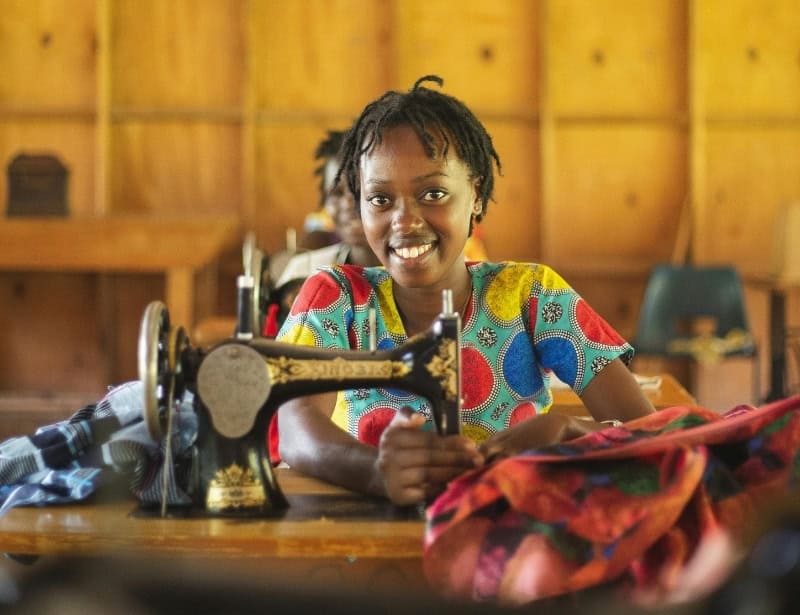
They support the Soko Stitching Academy in Kenya, which teaches young women to sew. Through Muya Atelier in Ethiopia, they offer training on artisanal weaving, upcycling, and financial literacy.
7. Knowledge Cotton
Knowledge Cotton only uses cotton certified by the Global Organic Textile Standard (GOTS). As it relies completely on organic cotton, Knowledge Cotton invests heavily in enabling eco-friendly farming.
Through the Chetna Organic initiative, the organization empowers small farmers in central and eastern India. They do this by buying from local farmers at a fair price and advocating for workers' safety.
Knowledge Cotton Apparel has supported 397 cotton farms in the Adilabad district of India in achieving the Regenerative Organic Certified standard.
8. Everlane
Everlane is one of the most sustainable brands in the United States. They have an impeccable reputation for low environmental impact throughout their supply chain.
The eco-friendly brand is also a huge advocate of social justice for minority and marginalized communities. Since 2014, they have donated more than USD 1.5 million to the American Civil Liberties Union. They also donate to the Equal Justice Initiative.
Everlane promotes sustainable practices among its production partners. Recently, they began supporting the New Zealand Merino Company to scale regenerative grazing.
9. Ninety Percent
Some sustainable brands go beyond fair wages; they actually share profits with the factory workers who make their products.
Ninety Percent allocates 90% of its profits: 80% to charitable causes and 10% to garment workers across its supply chain.
The brand is quite transparent about its sustainable practices. They use sustainable materials and work with one of the top eco-friendly manufacturers in Bangladesh.
10. ABLE
Beyond eco-friendly production processes, ABLE puts a lot of effort into encouraging consumers to choose slow, sustainable fashion.
The brand’s community impact initiatives focus on improving women's lives. In their Nashville headquarters, the staff is 98% women. They are particular about only working with manufacturers that empower the women they employ.
ABLE, by itself and through its partners, provides skill and career development opportunities for the women along its supply chain.
What makes initiatives effective?

Effective community impact initiatives are those that create long-lasting, sustainable change. Such initiatives have some common threads that contribute to their effectiveness.
1. Avoid saviour complex
Saviour complex is a common pitfall of community intervention efforts.
If sustainable brands act like they are doing the people a favor rather than taking responsibility as members of the community, their initiatives could come off as condescending. Such initiatives may be shunned by the locals.
2. Collaboration is essential
Promoting sustainable community development is a collective movement.
Sustainable fashion brands need to work with local and online communities to design innovative solutions.
They can also seek government support and join associations such as Cascle (formerly the Sustainable Apparel Coalition) to benefit from knowledge sharing.
3. Think big picture
To create positive change with community impact, projects must address root causes rather than just surface problems. They must also ensure their initiatives do not inadvertently create new problems in the community.
This means that sustainable brands cannot just throw money at problems. They must work with experts and locals to identify the most impactful solutions.
4. Good for business
While community impact projects are altruistic, they can and should add to the bottom line. Sustainable brands need to make a profit, too.
The key is to view the projects as long-term investments for sustainable business models. For example, funding a community school will eventually produce advanced, technically skilled workers.
Greenwashing vs real difference

Many brands are unwilling to adhere to sustainable fashion practices. They just want to lay claim to sustainability for marketing purposes. It's quite easy for brands to use community impact initiatives as greenwashing schemes.
Here's how to distinguish between greenwashing efforts and initiatives that make meaningful impacts.
1. Action-oriented
Unfortunately, many brands engage in performative actions. They make highly publicized pledges to address environmental and social impacts, but barely take action.
For example, the Action, Collaboration, Transformation (ACT), popular living wage pledge amongst top players in the fashion industry, has no benchmark for what a living wage should be.
2. Verifiable reports
One of the tenets of sustainable fashion is transparency. A transparent process allows independent third parties to verify claims of community impact.
When brands that aren't transparent about their supply chains make claims about community impact, it's most likely a greenwashing tactic.
3. All-round sustainability
Effective community initiatives come from sustainable fashion brands, whose commitment to sustainability is not merely a trend. They are wholly committed to sustainable fashion.
It's not unusual to find fast fashion brands donating to charities while ignoring ethical labor practices and polluting the environment.
Conclusion: Community Impact Initiatives in Sustainable Fashion
Your purchasing decisions have environmental and social consequences for manufacturing communities. Promoting sustainable fashion brands committed to community development is the most effective way to ensure a more sustainable future for those communities.
Keep in mind that the brands you support must also be eco-friendly, practicing sustainable water and energy consumption, as well as eliminating toxins and waste.
Glossary Terms:
Jen’s a passionate environmentalist and sustainability expert. With a science degree from Babcock University Jen loves applying her research skills to craft editorial that connects with our global changemaker and readership audiences centered around topics including zero waste, sustainability, climate change, and biodiversity.
Elsewhere Jen’s interests include the role that future technology and data have in helping us solve some of the planet’s biggest challenges.
