12 Tallest Mountains In The US That You Should See

Even though the United States is vast, only less than 4% of the population is urbanized. Aside from over 400 national parks, it is also home to several tall and rocky mountains. Although no mountain is above 28,000 feet, the country has several exciting mountains. Most of America’s tallest mountains are in Alaska, from Mount Sanford to Mount Hubbard to the Sierra Nevada mountains.
Ace your quizzes or impress your friends as you familiarize the 12 highest mountains in America.
12 Tallest Mountains in the United States
Here are America’s impressive mountains, starting from the highest summit:
1. Mount McKinley or Denali (20,310 ft, Alaska)

Only 9,000 feet short of Mount Everest, Mount McKinley, also known as Denali, is North America’s tallest mountain and third highest summit worldwide. It is located in Denali National Park and Preserve, close to the center of the Alaska Range, and measures 6,190 meters. McKinely’s original name was Denali, a traditional Native Alaskan Language meaning "the tall one."
Early researchers called the mountain Denali until William A. Dickey started calling it Mount McKinley in 1896. He named it after a presidential candidate in the 1890s, William McKinley. The Congress formally recognized the name in 1917 after William McKinley’s assassination.
The mountain geologists measured the mountain three times to get an accurate figure. The first measurement, which occurred in the 1950s, yielded a result of 6,194 meters. The second attempt, which used advanced radar technology to measure its elevation in 2010, yielded a result of 6,168 meters.
The third and official measurement of the mountain’s height was September 2015. The United States Geological Survey measured the mountain’s elevation, getting the final figure of 6,190 meters.
Summits are the highest mountain peaks in the world. There are Seven Summits, which refer to the tallest mountain peaks on all seven continents. Mount McKinley is the third-highest peak of all the highest major summits.
Mount McKinley is tough for mountaineering because of its extreme weather and rugged terrain. Hudson Tuck, Harry Karstens, and their climbers have only succeeded in climbing to the peak. They achieved this record in 1913.
2. Mount Saint Elias (18,009 ft, Alaska)
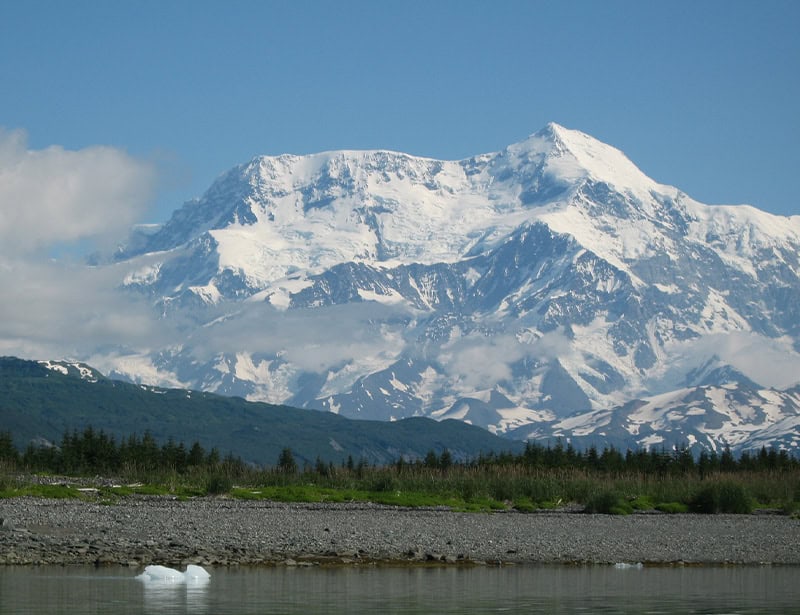
Mount Saint Elias is one of the primary mountains located in the Saint Elias Mountains. It is the second-highest mountain, with an elevation of 5,489 meters, and is 20 miles northwest of Yakutata, Alaska.
Vitus Bering, a Danish explorer, led the group that discovered Mount Saint Elias on July 16, 1741. Because of its location and climate, no major discovery was attempted until 1897. However, Mount Saint Elias was an essential landmark for the Indigenous people of Tlingt. It served as a guide down the Copper River and neighboring areas.
Mount Saint Elias is northwest of Malasppina Glacier and 26 miles southwest of Mount Logan. It is also part of Kluane National Park and Preserve and Wrangell-St. Elias National Park and Preserve. It is close to the Alaskan Gulf and the North Pacific Ocean.
An Expedition led by Prince Luigi Amadeo di Savoia started on July 31 and was the first successful attempt to reach the top of the mountain. Few climbing attempts have been made because of the rough mountains, extreme weather conditions, and the absence of a human population nearby.
Mount Saint Elias has varying climates depending on the mountain region being observed. The climate at lower elevations is subarctic, and the climate at higher elevations has frigid winters and cold summers. In winter, the temperature can be as low as 11.3 degrees Fahrenheit, while the summer temperature is 50 degrees Fahrenheit.
3. Mount Foraker (17,400 ft, Alaska)

Mount Foraker is the third-highest peak in the United States. It is in Denali National Park, central Alaska Range. Rising above the base of Mount Denali, it has a northern summit, 17,400 feet high, and a southern summit that is 18,810 feet high.
The Indigenous people of the northeast Alaska range, the Koyukon people, called Mount Foraker Sultana and Menale, which means The Woman and Denali’s Wife. Some Russian American Trading Company members renamed the mountains in Tenada while exploring Alaska in the 1830s.
Teneda included Denali, the massif Tschigmit, Sultana, and other mountains. However, an American named Joseph Herron of the 8th US Calvary changed the name to Foraker to honor Ohio Senator Joseph Foraker after America bought Alaska from Russia in 1867.
You gain access to Mount Foraker through a flight going out of Talkeetna. The flight will drop you at the Denali Base Camp on the southeast fork of the Kahiltna Glacier. You will then walk from the fork, across the glacier, up the southeast ridge of Mount Crosson Ridge.
Climbing Mount Foraker can be dangerous because its climbing routes have steep slopes and snow. In 1934, American climber Charles Snead Houston led the first climbing expedition on Mount Foraker. They reached the northern and southern summits in 8 weeks before returning to the national park.
4. Mount Bona (16,550 ft, Alaska)

Prince Luigi Amedeo di Savoia, the Duke of the Abruzzi, named the mountain Mount Bona after his racing yacht. Mount Bona is about 5,005 meters tall and is located in the Wrangell and Saint Elias mountains. It is at the top of the Russell Glacier and on the northern slope toward Hawkins Glacier.
Mount Bona is the fourth-highest mountain in Alaska and the United States. Allen Carpe, Andrew Taylor, and Terris Moore made the first-ever ascent on Mount Bona on July 2, 1930, through the west from Russell Glacier.
5. Mount Blackburn (16,390 ft, Alaska)

Mount Blackburn is the highest peak in the Wrangell Mountains range. It is also the 12th tallest mountain in North America and the fifth tallest mountain in the United States. Mount Blackburn is the second-highest volcano in the United States and the fifth-highest in North America.
It is 5,000 meters high and has two summits: West Peak and East Blackburn/ Kennedy Peak. Its west side is about 11,000 feet across four horizontal miles, while the other is about 8,000 to 10,00 feet across 8 miles.
A large portion of Mount Blackburn is covered in glaciers and ice fields. The snow on the mountain drains into Nabesna, Kennicott, and is a part of the Kuskulana glacier system. Given the proximity of the Wrangell Mountains to the Gulf of Alaska, the climate on Mount Blackburn is quite severe. The average snowfall is 76 inches, and rainfall is 91 inches annually.
The mountain's highest temperature is about 64 degrees Fahrenheit in July, and its lowest is about 28 degrees Fahrenheit in January. Mount Blackburn also has its wildlife, which includes mountain goats, caribou, Dall sheep, black bears, moose, and various bird species.
The west peak is the highest point of the mountain. George Handy and Dora Keen first climbed Mount Blackburn in 1912. They used the East Face and Kennicott Glacier. However, this path became unclimbable because of the glaciers and ice flows in many parts of the mountain. A second attempt to climb East Blackburn was in 1977.
The first ascent of the West Peak was in 1968. Adolf Bitterlich, Bruce Gilbert, Dick Wahlstrom, Hans Gmoser, and Leon Blumer climbed the west peak using the Northwest Ridge.
6. Mount Sanford (16,237 ft, Alaska)

Next on our list of awe-inspiring mountains is Mount Sanford, the third-highest volcano and the sixth-highest mountain in the United States. Mount Sanford is part of the Wrangell Mountains in Alaska. It has an elevation of 4,925 meters and a large dissected shield. Its last eruption was about 320,000 years ago.
Lieutenant Allen named Mount Sanford in 1885 for his great-grandfather, Reuben Sanford. The first ascent on Mount Sanford occurred on July 21, 1928. Terris Moore and Bradford Washburn climbed the mountain via the North Ramp route up the Sheep Glacier.
7. Mount Fairweather (15,325 ft, Alaska)

Mount Fairweather is the highest mountain peak in British Columbia, Canada and the seventh-highest elevation in the United States. It is 4,663 meters above ocean level. Captain James Cook named the mountain Fairweather in 1778 because he navigated the area during fair weather.
Mount Fairweather is on the border of Alaska, in the Saint Elias Mountains mountain range, at the southern end of Tatshenshini-Alsek Wilderness Provincial Park in British Columbia, and in western Glacier Bay National Park and Preserve, Alaska.
A group of climbers first climbed this awe-inspiring mountain in 1931. The team members were Allen Carpe, W.S. Ladd, Terry Moore, and Andy Taylor. The second attempt was in 1958, when Paul Binkert, Fips Broda, David Blair, Paddy Sherman, Joe Hutton, Russell Yard, and Dennis Moore successfully reached the peak of Mount Fairweather.
The best seasons to climb Mount Fairweather are May and June. It takes about 12 days to reach the mountain’s major summit.
8. Mount Hubbard (14,951 ft, Alaska)

Mount Hubbard is one of the tallest mountains in the United States. It is among the Saint Elias mountains, located on the Alaska-Yukon border. Mount Hubbard is 58 miles off Yakutat, in Kluane National Park and Reserve in its Canadian area, and the Wrangell-Saint Elias National Park in America.
Israel Russell named the mountain after Gardiner Greene Hubbard in 1890. Gardiner Greene Hubbard was the first president of the National Geographic Society and contributed to Russell’s mountaineering expedition.
Mount Hubbard is one of the highest peaks, with an elevation of 4,541 meters. It ranks the 8th highest peak in Alaska and the United States and 19th in North America. The mountain's west face rises 2,300 meters above Alverstone Glacier, and the peak rises 3,350 meters above Hubbard Glacier, one of Alaska’s most popular glaciers.
9. Mount Bear (14,831 ft, Alaska)
Next on our list of the tallest mountains in the United States is Mount Bear, which is the ninth-highest peak in Alaska and the United States. It is in the Wrangell-Saint Elias National Park, on the east fork of Barnard Glacier, 9 miles north of Mount Anderson and 60 miles east of McCarthy, in the Saint Elias Mountains, 4.7 miles west of the Canadian border.
It is 4520 meters above the ocean. Because climbers don't frequent it, it has no popular climbing routes. The mountain is remote and has rough terrain. People who visit Mount Bear are new climbers and experienced ski climbers.
Alaska-Canada boundary surveyors named Mount Bear the 9th tallest mountain in America around 1912 and 1913. Mount Bear is surrounded by three drainage basins: Copper, the Gulf of Alaska, and the Pacific Ocean. It is also surrounded by the Anderson, Klutlan, and Tittmann Glaciers.
10. Mount Hunter (14,573 ft, Alaska)

Before we move from Alaska, Mount Hunter is within the Denali National Park. Native Alaskans called it Begguya, which means Denali’s Child.
Robert Dun, a New York Commercial Advertiser reporter, and F.A. Cook named the mountain Mount Hunter to honor his aunt, Anna Falconnet Hunter. She sponsored his trip to the Alaska Range.
Mount Hunter is the most challenging of the three great peaks in the national park. It is 7,000 feet above the Kahiltna Glacier, with north and south peaks. The north summit is 14,573 feet, while the south summit is 13,996 feet.
The mountain is icy at the bottom because it connects with the longest glacier in the Alaska Range, Kahiltna Glacier. Most climbers set up their tents in this area. Mount Hunter’s steep and rugged terrain makes it a challenging climbing experience.
11. Mount Whitney (14,505 ft, California/ Nevada)

Mount Whitney is the tallest mountain in the contiguous United States. Named after the geologist Josiah Dwight Whitney, Mount Whitney is 4,418 meters above sea level. The mountain is on the border of Sequoia National Park and Inyo National Forest in the Sierra Nevada range, East-Central California.
Mount Whitney has two primary trails: Whitney Portal and High Sierra Trail, with the former being the shortest climbing route. Whitney Portal is a 10.7-mile trail to the mountain’s peak and 13 miles west of Lone Pine, east of Sierra Nevada, while the High Sierra Trail, starting from the Giant Forest, is 60 miles from the summit.
The first climbers of Mount Whitney are Albert Johnson, Charles Begole, and John Lucas. They climbed the dome-shaped mountain in 1873. Scientists listed the mountain’s climate as an alpine tundra under the Koppen climate classification. To access the climbing routes at Mount Whitney, you need to get a Mount Whitney permit from Inyo National Forest or a wilderness permit from Sequoia and Kings Canyon National Parks.
12. Mount Wrangell (14,163 ft, Alaska)

Next on our list is a high mountain range in Eastern Alaska. Mount Wrangell is a part of the Wrangell Mountains, a part of the Pacific mountain system named after Ferdinand P. Wrangel, a 19th-century Russian explorer. The mountains are 100 km wide and extend from the Copper River to the Saint Elias Mountains near the Yukon border in Canada.
Mount Wrangell is 4,317 meters high and was the last shield volcano to become dormant. It is distinguished by its rugged terrain and perennial snow cover. The dormant shield volcano erupted five times, with the last eruption in 1902. It has a West crate, Wrangell caldera, North crater, chetaslina vent, and east crater.
The collapsed caldera on the mountain's highest point is about 2,000 years old and has three craters on its rim. It is 2.5 miles wide and 0.6 miles deep and is covered with ice despite releasing heat from inside the earth.
Jen’s a passionate environmentalist and sustainability expert. With a science degree from Babcock University Jen loves applying her research skills to craft editorial that connects with our global changemaker and readership audiences centered around topics including zero waste, sustainability, climate change, and biodiversity.
Elsewhere Jen’s interests include the role that future technology and data have in helping us solve some of the planet’s biggest challenges.
Fact Checked By:
Isabela Sedano, BEng.