Interview: Karen Michel, Audio Anthropologist - What Matters?
1. Tell us what led you to become a cultural and environmental documentarian?
I grew up going to museums and galleries from infancy. My mother was brought up that way, immersed in the arts, and as much as she could, she did that with me. By high school I'd decided to become an art critic and enrolled in a studio-heavy Art History major at San Francisco State. Turned out I loved making art more than studying ABOUT it and changed to Photography, then finally Sculpture and Ceramics as my major.
Subsequently I taught art in an Inupiaq (Northern Eskimo) village above the Arctic Circle in Alaska and went to graduate school in anthropology. That led to a job at the public radio station at the University of Alaska in Fairbanks and a series of documentaries on the village where I'd lived. From there, more more more involvement in public radio, a gig with the UN to do a series of radio docs on the environment, more art making and reporting.
2. Tell us about your career awards and achievements:
It's difficult to make a list of awards as I don't keep good records. But here's a sample, in nonchronological order: 2 Peabodys, Corporation for Public Broadcasting and National Association of Community Radio awards for Best Documentary, Clarion Award for "Dropping In" podcast for Omega Institute, Fulbright to India, Japan Foundation, NEA Media Fellowships and Fellowship to Japan, Arts Mid-Hudson Individual Artist Fellowships (twice), and more. Which overall hasn't amounted to much, if any, changes in my life, the important time spent in Japan and India notwithstanding.
3. How have living in different parts of the US, such as New York’s Hudson Valley, California, and Alaska, shaped your cultural and environmental views?
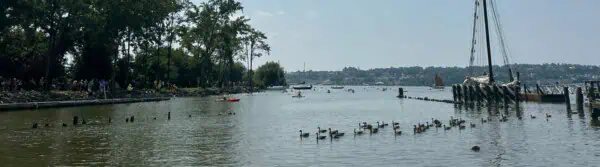
San Francisco and rural Alaska shaped me. Washington Heights is where I learned to walk and talk. Los Angeles showed me the importance of the superficial, that being blonde and a small nose mattered. The Hudson Valley, where I've lived for more than 20 years, is a place of incredible beauty and is now very much home. I'm happy here. Beacon's spot on the river, the fog over the mountain, the vibrant arts and community involvement, the mix: it's home.
4. You now live in Beacon, NY, the highest point of the Hudson Valley with sweeping views of the Hudson River and three important art centers: Dia Musuem of Art, KuBe Art Center, and Howland Cultural Center, which is across the street from a waterfall visible from Main Street. It sounds idyllic, but please tell us why you chose to live in Beacon, NY?
The biggest chunk of my time, proportionally, is spent with artists and art, whether making or viewing/listening. The beauty of What Matters? in part is that respondents are free to express themselves however they wish: verbally, articulate or not, movement, image, sounds both musical and "not," perhaps scent, too.
Artists are always having something they're saying, so long as they're working. A natural talent pool for me and have given some unexpected answers: The need to go to Google to check if an idea is original, hasn't been done by someone else and the subsequent skepticism at what's found out, whether it's for "real" or not.
5. You have interviewed, written about, and prepared documentaries on many important artists of our time, including folk musician and environmental activist Pete Seeger, a Beacon, NY resident like yourself. What role do art and music play in articulating “What Matters,” a project you are currently working on?

"What Matters?" falls under the category of socially engaged art. As such, there is not art without the public. I'm asking folks to tell me what matters to them in these changed, fraught times and teasing out their answers. I'm interested if responses are very personal or more global in scope and why.
So far, it's been largely generational, that me or us division: me for younger, us past 40.
Part of the development of the project has been to start public forums, the first held during Upstate Art Weekend. The Mayor, a gallerist, a painter, a dancer-choreographer/cannabis dispensary owner, and a community activist/Broadway performer were the guests.
The audience was also invited to weigh in. I'll be doing more of these, again at the Ethan Cohen Gallery at KuBe Art Center in Beacon. The project is hyperlocal, as I'm only recording Beacon residents and occasional visitors and may serve as a model for other communities to find out the values of their residents and, perhaps, what to do about them.
6. Which environmental artists, musicians do you like and why?
I'm an admirer of many land artists: Mary Miss, Jackie Brookner, Robert Smithson, Michael Heizer among them.
7. Tells us about “What Matters” to you?
What matters to me is asking questions, always has. As the only child of a mother who didn't want kids, I was raised to interact from infancy; questioning, wondering, was always encouraged. Later, in school, that got me into trouble and also got me excused on occasion from having to come to class or take an exam.
Questioning is a perfect fit for finding what Buddhists call "right livelihood." As journalist and artist I'm an explorer; as an anthropologist I'm always looking at how people see themselves and that means really looking, listening, inquiring.
8. How can people get in touch with you?
Folks who would like to be part of this--or help fund it, oh please (there's been 1 small grant from Arts Mid-Hudson in 2023, otherwise it's self-funded and I'm a freelancer…)-may reach me at kmichelpv@gmail.com.
Selva Ozelli Esq, CPA is a legal and finance executive with diversified experience dealing with highly complex issues in the field of international taxation and related matters within the banking, securities, Fintech, alternative and traditional investment funds. Her first of its kind legal analyses involving tax laws, Foreign Corrupt Practices Act (FCPA), blockchain technology, solar technology and the environment and have been published in journals, books and by the OECD. Her writings have been translated into 15 languages.
