
Interview: Cassie Ward, Putnam History Museum

1. What was the vision and mission of establishing the Putnam History Museum
The mission of the Putnam History Museum (PHM) is to collect, preserve, interpret, and present the history of Putnam County, Philipstown, the West Point Foundry, and the Hudson Highlands. Through exhibitions, programs, and events, the museum uses its collections to engage the community with the vibrant history of our region, and to foster greater understanding of the role it has played in the growth of our nation.
2. The Museum offers an interactive multimedia exhibition that showcases valuable collections, important information, events, campaigns, ecotours, fairs, and educational classes. Tell us more about these programs.

The PHM offers a wide range of interactive and multimedia programs that generate excitement and curiosity surrounding the history, heritage, and culture of Putnam County and the Hudson Valley. We offer everything from exhibitions like "Indigenous Peoples in Putnam County, “Healing Hudson,” and “The West Point Foundry," to a robust lecture series, hands on workshops, and history-themed trivia nights. We strive to ensure there is something for everyone at the PHM.
Additionally, we create NY State curriculum-aligned lesson plans and tours and host a popular guided history hike series. Tours and history hikes cover everything from geological and Indigenous history to the American Revolution, the Industrial Revolution, and the 20th century Environmental Movement. It is important to us that we meet people where they are – whether it’s here at the museum, out on the trails for a history hike, or in the comfort of their homes while we live-stream talks. Many of our hikes are also available as self-guided brochures here.
3. Tell us about the Museum's West Point Foundry Exhibition

Our museum is located in the former West Point Foundry schoolhouse, built c. 1828. The West Point Foundry had been established about 10 years prior in 1817. It was located behind the museum, immediately next to Foundry Cove and the Hudson River. With access to the Hudson River, the WPF could ship products south to New York Harbor, and north to the Erie Canal.
The WPF played a pivotal role in 19th century American history. Following the War of 1812, President James Madison called for an increase in cannon manufacturing to protect the country in future conflicts. The West Point Foundry was one of four ironworks built to fill this need, and the only one that was privately owned. Strategically located diagonally across from the United States Military Academy at West Point and with access to the Hudson River, the WPF at Cold Spring was poised to usher in a new era of American military and industrial capability.
Chosen for its proximity to vital resources—such as iron ore, hardwood forests for charcoal, and the waters of Foundry Brook—the WPF was founded in 1817 (incorporated by 1818) by members of the West Point Foundry Association, led by Governor Kemble.
The WPF was a masterpiece of vertical integration, controlling all aspects of production from raw materials to finished goods, thereby significantly enhancing efficiency and output. In addition to creating various types of cannons, howitzers, mortars, and projectiles, the WPF also produced the first American steam locomotives, marine engines, and boilers, the first American iron-hulled ship, New York City’s aqueduct pipes, and beam engine and cane mills for Caribbean sugarcane plantations. The foundry's most famous product was the Parrott rifled cannon or gun.
There is a permanent WPF exhibition on display at PHM. It includes photographs, artifacts, paintings, maps, and videos highlighting the Foundry related objects within the PHM collection, including a fully restored 10-pounder Parrott Rifle. Today, visitors may also tour the actual site of the WPF, now a National Historic Landmark, which has been preserved by Scenic Hudson.
4. Tell us about your museum's vintage postcard tour of the Hudson Highlands
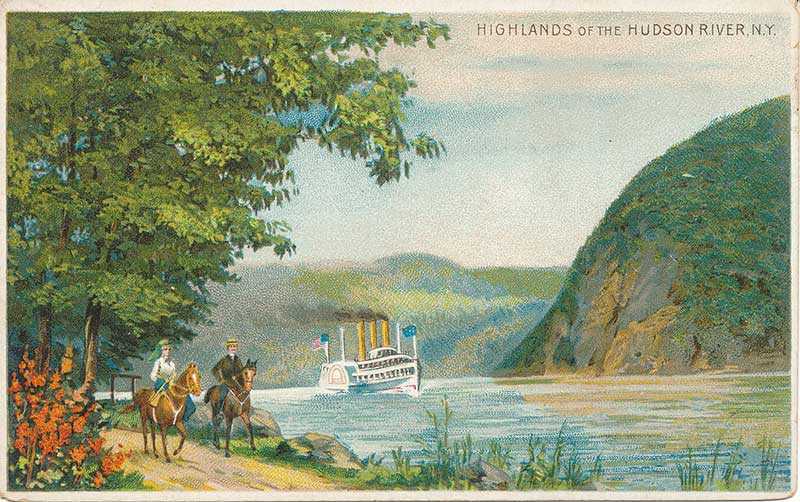
We developed this tour during the early days of the Covid pandemic. We wanted to share the history and beauty of the Hudson River Valley – encouraging people to explore from the safety and comfort of their homes at that time. We worked with PHM Members Barry and MJ Ross on selecting specific postcards to feature.
About two years after the publication of this vintage postcard tour, the Ross’ generously donated a 250+ piece collection of Hudson River Valley postcards. These postcards are available for public enjoyment and research here.
More about the collection: Held at the Putnam History Museum, The Barry C. and Mary Jean (MJ) Ross Hudson River Postcard Collection creates a trip up the Hudson River from New York Harbor to the river’s source in the Adirondacks – with an emphasis on the river’s passage through the Hudson Highlands.
The Ross’ followed one simple rule in choosing a postcard: it had to prominently show the Hudson River, although the river did not need to be the focus of the card. The Ross’ focused on the Hudson River for its incredible place in America’s history, art, culture, and industry. The Hudson was a key to the success or failure of the American Revolution; the Hudson Valley was the birthplace of the first great American School of painting – the Hudson River School; the Hudson was central to the first burst of American tourism – facilitated by the steamships that plied the river and the railroads that traveled on its banks; and the Hudson – together with the Erie Canal – mightily contributed to New York’s becoming a commercial powerhouse.
The Ross’ recommend viewing the collection south to north – starting with views in New York Harbor to the river’s source in the Adirondacks.
5. This year, the theme of International Museum Day on May 18, 2024, was “Museums for Education and Research. " This underscores the pivotal role of cultural institutions in providing a holistic educational experience. Tell us about your museum's education programs/initiatives.
Here at the PHM, we focus a lot on our public programming for we find that it is one of the best to engage with visitors, students, and researchers. We strive for our programs to create curiosity, excitement, and introspection. A recent project that exemplifies this was the creation of a community quilt with the Mid-Hudson Antislavery History Project. The quilt features the stories, names, and places associated with abolition and slavery in the Hudson Valley region. Participants had a chance to learn from us regarding the history, and then put their personal experiences, perspectives, and creativity into the creation of the quilt squares.
Moreover, over the past several years, we’ve expanded our historical interpretation and developed some really incredible educational resources accessible on our website. These resources include our BIPOC Educational Resource Portal, and a series of online lesson plans that explore themes such as the American Revolution, the Industrial Revolution, and the Environmental Movement.
Additionally, we created a student companion guide for the Indigenous Peoples in Putnam County exhibition. The guide provides students with a quick overview of Indigenous history in our area, with educational activity prompts to further contribute to their holistic learning experience.
We strive to make our programming relevant and relatable, encouraging connections between the historic material and our visitors’ modern lives.
6. What partnerships have your museum developed?
We are fortunate to have many great partnerships and collaborators here at the PHM. The PHM has had long-standing collaborations with the following environmentally focused organizations: Scenic Hudson, Hudson Highlands Land Trust, Open Space Institute, Hudson River Valley Greenway, and the New York State Department of Parks, Recreation, and Historic Preservation, and Hudson River Expeditions.
7. Tell us about your museum's World Oceans Day activities in partnership with the United Nations, Oceanic Global, and Scenic Hudson.

On World Oceans Day, we opened Selva Ozelli’s “Healing Hudson” art exhibition at the PHM. The exhibition, presented in the PHM’s public community room, explores the Hudson Valley’s importance in sparking the environmental movement in the U.S., which took off worldwide. The art on display features Darter Fish, which live in highly oxygenated fresh waters and received their name for their tendency to move in short bursts of motion. They are highlighted as an endangered species that once darted around the Hudson watershed, and Selva imagines that they may one day return to their home. The exhibition also features seals and a portrait of Peter Seeger, founder of the Hudson River Sloop Clearwater organization.
Selva met with visitors throughout the opening to share with them the history of the environmental movement, aspects of Climate Change advocacy today, and her creative process as an artist.
8. Tell us about your museum’s Climate Week NYC program for the first year. Climate Week NYC is celebrated state-wide on World Maritime Day.
We are proud to present Selva Ozelli’s “Healing Hudson” exhibition during the entire Climate Week NYC. The museum is open Wednesdays through Sundays, from 12 pm – 4 pm. Selva’s exhibition will be on display through September 29, 2024.
During that week, on September 26th, we will hold a special hybrid speaking event by Selva Ozelli about her “Healing Hudson” art show that addresses how the Hudson Valley Environmental movement was implemented around the world. Visitors may attend the event in-person or tune-in online.
In addition, we encourage visitors to use our self-guided history brochure of Little Stony Point in Cold Spring, New York, during Climate Week NYC. This brochure details the birth of the environmental movement in the Hudson Valley, with stunning views of the Hudson River and Storm King Mountain throughout the 45-minute walk:
9. Does your museum have digital exhibits, libraries, and educational information accessible from around the world?
We do! The Putnam History Museum is proud to share many virtual resources so that our collections may be utilized and accessed around the world! The museum was established in 1906, and we’ve been collecting ever since – and we are thrilled to share that collection with the wider community! Here are a few key places on our website to explore:
- The Archival Collection of the PHM: The online database includes finding aids, photographs, paintings, postcards, archival documents, maps, books, and more.
- PHM’s Education Portal: Discover educational videos, lesson plans, virtual exhibitions, and other activities here. In particular, be sure to check-out the PHM’s lesson plans on the birth of the Environmental Movement in the Hudson Valley.
10. Where can visitors find the latest developments in climate change and sustainable development issues as they relate to the Hudson Valley, such as the Fjord Trail, so that they can get involved in living a green and sustainable lifestyle?
The Hudson Valley is home to several incredible land and water conservation organizations. To learn more, I recommend checking out these organizations and their websites:
- Scenic Hudson
- Hudson River Sloop Clearwater
- RiverKeeper
- Hudson Highlands Land Trust
- Hudson River Valley Greenway
- Hudson Fjord Trail
- New York New Jersey Trail Conference
- Open Space Institute
11. Anything else you would like to add?
It has been a joy working with Environmental Artist Selva Ozelli over the past year. Selva’s enthusiasm, grace, and knowledge has fostered a deeper understanding of Climate Change and climate related activities for our museum visitors.
Our local history in inextricably tied to the natural environment, particularly with our proximity to the Hudson River; and this has been a great opportunity for us to dive deeper into our area’s role in the birth of the 20th century Environmental Movement, as well as an opportunity to learn more about climate-related projects today.
12. How can people reach you?
Putnam History Museum
info@putnamhistorymuseum.org
845-265-4010
www.putnamhistorymuseum.org
Glossary Terms:
Selva Ozelli Esq, CPA is a legal and finance executive with diversified experience dealing with highly complex issues in the field of international taxation and related matters within the banking, securities, Fintech, alternative and traditional investment funds. Her first of its kind legal analyses involving tax laws, Foreign Corrupt Practices Act (FCPA), blockchain technology, solar technology and the environment and have been published in journals, books and by the OECD. Her writings have been translated into 15 languages.
