
International Asteroid Day: Knowing Our Place in the Cosmos
Every June 30, International Asteroid Day highlights the celestial bodies that present potential risks and opportunities to learn about our universe. Promoting global cooperation, this day is more than just science fiction!
Key Info: International Asteroid Day
- When is International Asteroid Day?
Occurs annually on the 30th of June - This Year (2026):
Tuesday, June 30, 2026 (date has passed) - Official Website: Asteroid Day
-
Future Dates
- Wednesday, June 30, 2027
- Friday, June 30, 2028
- Saturday, June 30, 2029
- Sunday, June 30, 2030
-
Additional Details
- Observed By: Scientists, astronomers, educators, space agencies, museums, and the general public worldwide
- Where Is It Observed: International
- Primary Theme: Space Science and Planetary Defense
- Hashtags: #AsteroidDay #SpaceScience #PlanetaryDefense #AsteroidWatch #Space
Quick links: International Asteroid Day
Why International Asteroid Day Matters

In 2016, the UN officially recognized International Asteroid Day to educate the public about asteroids and promote awareness about how to detect, track, and deflect them. This is key to defending the planet against impact.
The day was co-founded by Dr. Brian May, member of the rock group Queen, Apollo 9 astronaut Rusty Schweickart, filmmaker Grig Richters, and Danica Remy, President of the B612 Foundation.
Asteroids get less attention than earthbound issues, so the day aims to inspire more space science and investment.
Data and Statistics
For an asteroid to be considered a Near-Earth Object, it should be less than 1.3 times the distance between the Sun and Earth, about 93 million miles. For an asteroid to be potentially dangerous, it should be roughly twice the size of the Statue of Liberty.
In our solar system, the asteroid belt is located in between Jupiter. Estimates suggest that a million of these space rocks can collide with our planet. However, only a tiny fraction of these asteroids have been identified and tracked. As of writing, NASA’s Jet Propulsion Laboratory has already discovered almost 36,000 Near-Earth Asteroids.
Notable Asteroid Impacts
- The Chicxulub Impact: It occurred approximately 66 million years ago near what is now the Yucatán Peninsula in Mexico and is widely believed to have caused the extinction of the dinosaurs.
- The Vredefort Impact: Occurring around 2 billion years ago in what is now South Africa, this impact is the largest verified impact crater on Earth. It may have contributed to a shift in its tectonic plates.
- The Event: In 1908, it was the largest impact event on Earth in recorded history. Although no crater was left behind, the explosion over the sparsely populated Eastern Siberian Taiga flattened 2,000 square kilometers of forest.
- The Chelyabinsk Meteor: Exploding over Russia in 2013 was the most significant asteroid impact of the 21st century. The shock wave injured over 1,200 people and caused considerable property damage.
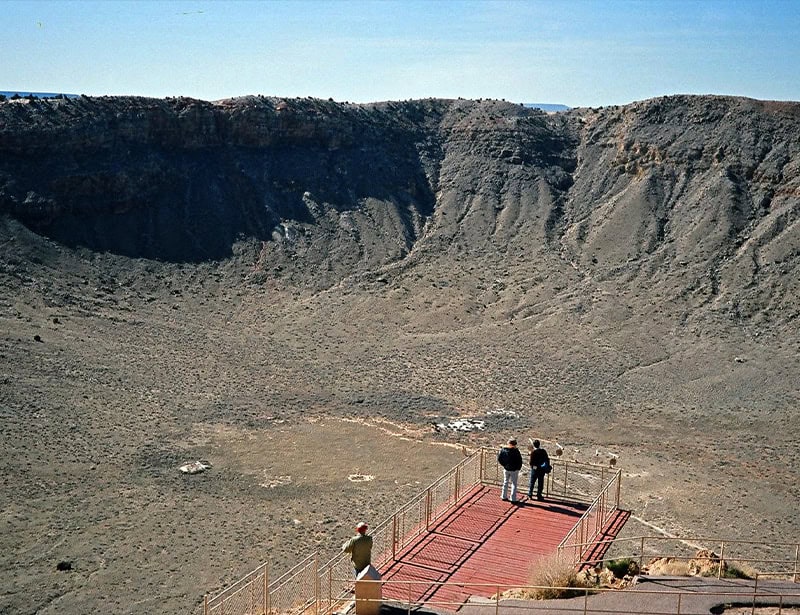
- The Barringer Meteor Crater (pictured above) is a well-preserved meteorite impact site in Arizona, United States. About 50,000 years ago, the impact created a crater nearly 1.2 kilometers in diameter and 170 meters deep.
Brief Timeline of International Asteroid Day
The Tunguska event in Siberia, the Earth’s largest asteroid impact in recorded history, occurred. This event later inspired International Asteroid Day.
The Alvarez hypothesis proposed that an asteroid impact led to the extinction of dinosaurs, increasing public interest in asteroid impacts.
The United Nations established the International Strategy for Disaster Reduction, which includes the threat of near-Earth asteroids (NEAs).
Leading scientists and astronauts launched the first International Asteroid Day. Astrophysicist Martin Rees has also read the 100X Declaration, calling for increased detection and tracking of NEAs to 100,000 annually within the next ten years.
NASA established Planetary Defense Coordination Office to focus on detecting, tracking, and characterizing potentially hazardous asteroids and comets.
The United Nations General Assembly passed A/RES/71/90, formally declaring International Asteroid Day. This day aims to raise public awareness among United Nations member states about the hazards of asteroid impacts. The Association of Space Explorers (ASE) headed efforts to establish the event.
The UN Office for Outer Space Affairs and the Space Mission Planning Advisory Group began planning a Hypothetical Asteroid Impact Scenario.
International Asteroid Day Themes and Hashtags
| June 30, 2020 | Asteroid Risks and Opportunities |
| June 30, 2021 | Awareness on Asteroid Impact Hazard |
| June 30, 2022 | Small Is Beautiful |
| June 30, 2023 | Defence, Discovery, and Driven Resources |
| June 30, 2024 | Guardians of Our Planet |
- #AsteroidDay
- #AsteroidAwareness
- #AsteroidWatch
- #SpaceScience
- #ProtectOurPlanet
Conclusion
Asteroid Day events on June 30 increase awareness about asteroids and their possible risks and opportunities. The day promotes using science to shield our planet from potential asteroid dangers.
By advocating for space science in our communities, we can all create a safer future for the next generation,
Resources:
FAQs (Frequently Asked Questions)
This global awareness campaign aims to educate people about asteroids and their potential threat to Earth.
It falls on June 30, commemorating the Tunguska event in 1908.
Attend an Asteroid Day event, raise awareness on social media, and support organizations dedicated to asteroid research.
Support efforts to monitor and track asteroids, advocate for increased funding for asteroid research, and educate others about the potential risks asteroids pose to our planet.
Asteroids, rocky planetary objects, primarily reside between Mars and Jupiter's orbit. In contrast, comets are composed of ice and dust, appearing fuzzy or with a tail when near the Sun.
Mike is a degree-qualified researcher and writer passionate about increasing global awareness about climate change and encouraging people to act collectively in resolving these issues.
Fact Checked By:
Isabela Sedano, BEng.
