The Fires, Floods, and Exhibitions of July
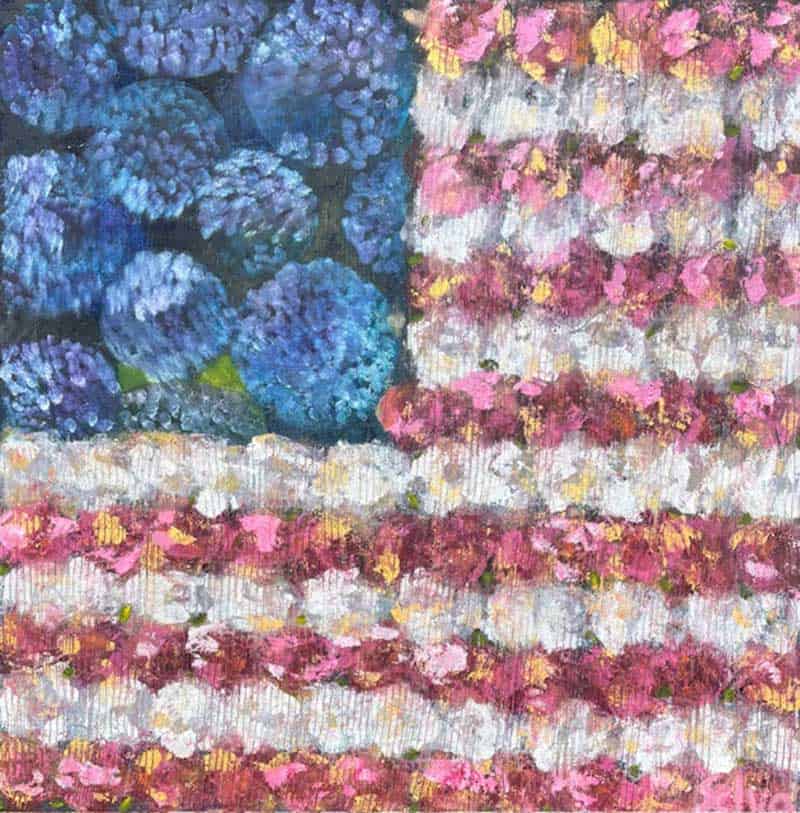
As the United States of America is preparing to celebrate the 250th anniversary of its independence next year. This year, on the 4th of July, environmental artists began exhibiting their USA 250-themed artwork while most of the country experienced a disproportionate number of extreme weather events. These included those labeled a major disaster caused by global warming according to the National Oceanic and Atmospheric Administration (NOAA), which forecasted a hotter-than-average summer for most of the U.S., with suggestions that this warming trend would continue into the fall. The increase in temperatures causes more wildfires and precipitation.
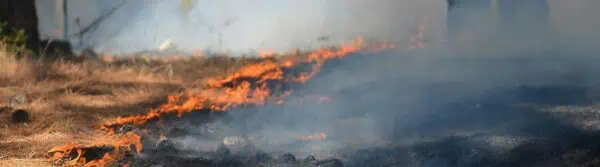
The National Interagency Coordination Center (NICC) reports a significant increase in the severity and intensity of wildfires across several U.S. regions, particularly in the Western part, attributed to global warming. So far, nationally, there have been 37,878 wildfires reported in 2025, burning a total of 2,570,619 acres. But, twice as many of these wildfires are recorded annually on the 4th of July as on other days in the Western part of the U.S., according to a study.
For example, in California, the “Wolf Fire” roared, the “Madre Fire” in San Luis Obispo burned 80,786 acres, and the “Green Fire” in Shasta started on July 4th. As of July 13, 2025, a total of 4,195 fires had burned 201,295 acres across California.
Arizona was also engulfed in an inferno created by the ”Dragon Bravo Fire,” triggered by lightning, potentially associated with monsoon activity, which burned uncontrollably with the help of strong winds and high temperatures. By July 13th, 19 wildfires were consuming a total of 57,972 acres, destroying more than 80 structures, including the historic Grand Canyon Lodge on the North Rim of Grand Canyon National Park, according to the U.S. Department of Agriculture’s Forest Service.
Global warming has also contributed to increases in the frequency and intensity of the heaviest precipitation events across nearly 70% of the U.S., according to the U.S. government's Fifth National Climate Assessment. On 4th of July severe flash floods from storms due to increased moisture in the atmosphere; slowed-down storm movement; and tropical systems like the “Tropical Storm Chantal” and the “Tropical Storm Barry” caused catastrophic flooding with winds exceeding 60 mph that killed three people in the State of New Jersey and 129 people in Texas's Hill Country which earned the nickname "Flash Flood Alley" as reported on July 12th the City of Water Day.
What is City of Water Day?
Now in its 18th year, City of Water Day — which took place this year on Saturday, July 12 — is a region-wide day organized by Waterfront Alliance and New York–New Jersey Harbor & Estuary Program (HEP), to champion a climate-resilient New York and New Jersey harbor.
Dozens of communities across all five boroughs, Westchester, and Rockland counties, as well as New Jersey, hosted events with a theme of unity in the face of climate change, as extreme weather events are becoming increasingly deadly. These City of Water Day activities were held near the water in shared waterfront community spaces in New York and New Jersey to create opportunities for meaningful connections that are key to developing a climate-resilient future. From free kayaking to rowing and hands-on workshops, as well as films about whales and seals, these events offered community members opportunities for fun, education, and access to their local waterfront.

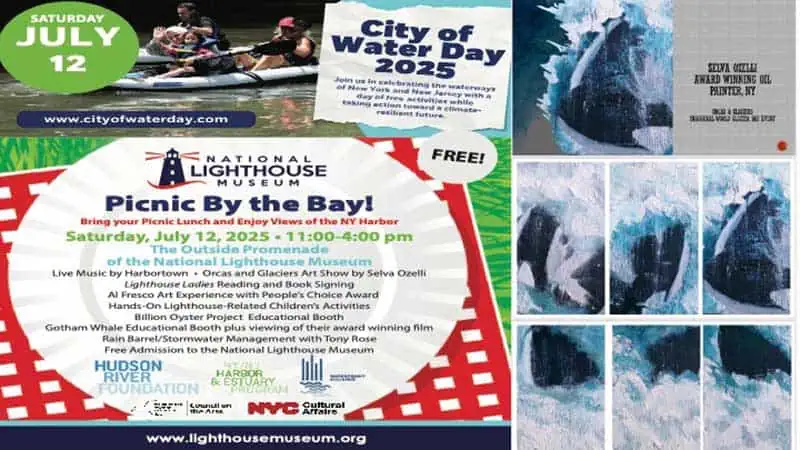
The celebrations for a green future for generations continued with art exhibitions and events, a day later on the National Green Amendment Day, celebrated nationwide on July 13th.
What is National Green Amendment Day?
The National Green Amendment Day is celebrated nationwide annually on July 13th to recognize and advocate for the constitutional right to a clean and healthy environment, often through the adoption of Green Amendments at the state level constitutions. According to the National Caucus of Environmental Legislators, green amendments recognize a healthy environment as an inherent right of all citizens, even though currently the U.S. Constitution doesn’t afford its citizens this right.
“Green Amendments For The Generations” is a movement founded by environmental advocate and attorney Maya van Rossum to promote state-by-state adoption of a “Green Amendment” in the Bill of Rights section of every state constitution — and eventually the U.S. Constitution — to advance Green Amendment movement to secure a constitutional right to pure water, clean air, a stable climate & healthy environments, for all people, including future generations, regardless of race, ethnicity, or socioeconomics. Van Rossum launched the national movement following a landmark 2013 legal victory that utilized Pennsylvania’s green amendment to defeat a pro-fracking law passed by the state legislature.
See: https://www.trvst.world/climate-change/states-tackle-environmental-matters/
Van Rossum explains,
“Today, as written, state and federal environmental laws are on the side of big industry, big tech, and the political cronies who fail to recognize a healthy environment as a critical issue. If you get the right reviews and the right permits from the right agencies, polluters are often legally empowered to release devastating levels of pollution and inflict devastating environmental harm. But Green Amendments For the Generations is changing this by giving power back to the people.”
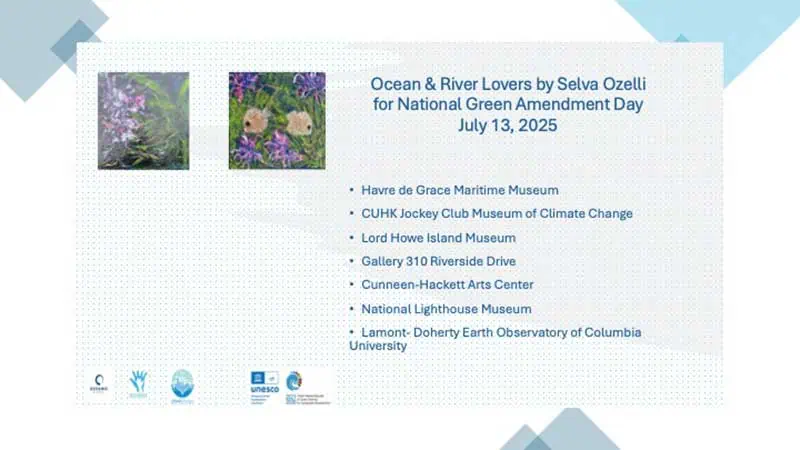
More art shows for National Green Amendment Day can be found here.
So far, only three states, Pennsylvania, Montana, and New York, in the United States have adopted such a constitutional provision.
The state of New York which has annually celebrated the City of Water Day for the past 18 years and has hosted Climate Week NY starting in 2009 launched by The Climate Group to coincide with the United Nations General Assembly adopted the green amendment to its state constitution, after New Yorkers voted to add Article I, Section 19 to the state's Bill of Rights, which established a right to clean air and water, and a healthful environment on November 2021. This green amendment went into effect on January 1, 2022, after a five-year-long legislative process, with the proposal first being introduced in 2017 and finally passing by both the Senate and Assembly to be placed on the ballot in 2021. A statewide referendum saw over 70% of voters approving the green amendment.
The State of New York’s City of Water Day partner New Jersey on the other hand has made significant progress in the state legislature to advance a proposed green amendment (SCR43), moving it closer to a potential vote by the full legislature that would guarantee New Jersey residents a constitutional right to a clean and healthy environment, including pure water, clean air, and a safe climate. It would also establish the state's duty to protect natural resources for present and future generations. This amendment has gained bipartisan support, with numerous sponsors in both the Senate and Assembly. If approved by the legislature, it would go to the voters for ratification at the next general election.
The state of California is highly prone to longer, frequent, severe, and more intense wildfire seasons due to several factors, including global warming and its climate, which features dry summers and abundant dry vegetation. By the 4th of July this year, there were 30 confirmed fatalities attributed to the Eaton and Palisades wildfires, which were the second-deadliest in the state's history.
In response, California is currently considering ACA 16, a proposed constitutional green amendment that would recognize the right to clean air, water, and a healthy environment for all Californians. The amendment has passed through the Natural Resources and Appropriations Committees and is now awaiting further action. The proposal requires approval by a two-thirds majority in both the California Assembly and Senate to be placed on the ballot for voters, which has not yet passed the Assembly or moved to the Senate.
The State of Arizona is prone to wildfires due to arid climate, hot temperatures, and dry vegetation, which create conditions that make it susceptible to wildfires, especially during the summer. The state experienced at least 291 wildfires between January 1 to 4th of July.
Regardless of this fact, the State of Arizona has seen multiple unsuccessful attempts to introduce a green amendment to recognize the right to a clean and healthy environment as a fundamental right with the state's public natural resources, like water, air, and public lands, being declared common property of all the people, with the state and its subdivisions serving as trustees, according to the Arizona Legislature (.gov). While the amendment has not progressed far in the constitutional amendment process, it has been re-proposed each year since 2022, demonstrating continued interest and energy for constitutional environmental rights protection in the state, according to azgreenamendment.org.
Similarly, a green Amendment known as the “Texas Stewardship Amendment,” a bill aiming to recognize and protect the rights of all Texans to a clean and healthy environment, including clean air, water, and a stable climate with minimal flash floods in Texas, has not been approved, even though Texas is highly prone to flash flooding.
Glossary Terms:
Selva Ozelli Esq, CPA is a legal and finance executive with diversified experience dealing with highly complex issues in the field of international taxation and related matters within the banking, securities, Fintech, alternative and traditional investment funds. Her first of its kind legal analyses involving tax laws, Foreign Corrupt Practices Act (FCPA), blockchain technology, solar technology and the environment and have been published in journals, books and by the OECD. Her writings have been translated into 15 languages.