International Day Of Acceptance: Celebrate Inclusion

Over 1.3 billion people worldwide live with significant disabilities. That's 16 percent of our global population. Acceptance though? That's still a work in progress. International Day of Acceptance, observed every January 20, tackles this through action instead of just another awareness campaign.
Stevie Hopkins established this day in 2010 through his organization 3E Love. The date honors his sister Annie Hopkins, who died on January 20, 2009. Annie created the International Symbol of Acceptance: a heart replacing the wheel of a wheelchair symbol.
This day champions genuine acceptance over mere awareness. Annie and Stevie Hopkins, both living with Spinal Muscular Atrophy Type II, founded 3E Love in 2007. Their mission was clear: Embrace, Educate, Empower.
What started as a dorm room t-shirt design became an international movement celebrating abilities rather than limitations.
Key Info: International Day of Acceptance
- When is International Day of Acceptance?
Occurs annually on the 20th of January - This Year (2026):
Tuesday, January 20, 2026 (date has passed) -
Future Dates
- Wednesday, January 20, 2027
- Thursday, January 20, 2028
- Saturday, January 20, 2029
- Sunday, January 20, 2030
-
Additional Details
- Observed By: Schools, universities, government agencies, companies, and individuals worldwide
- Where Is It Observed: International
- Primary Theme: Disability Acceptance and Social Inclusion
- Hashtags: #InternationalDayOfAcceptance #DayOfAcceptance #3ELove #DisabilityAcceptance #Inclusion #Acceptance #InternationalSymbolOfAcceptance
Quick Links: International Day of Acceptance
The Story Behind International Day of Acceptance
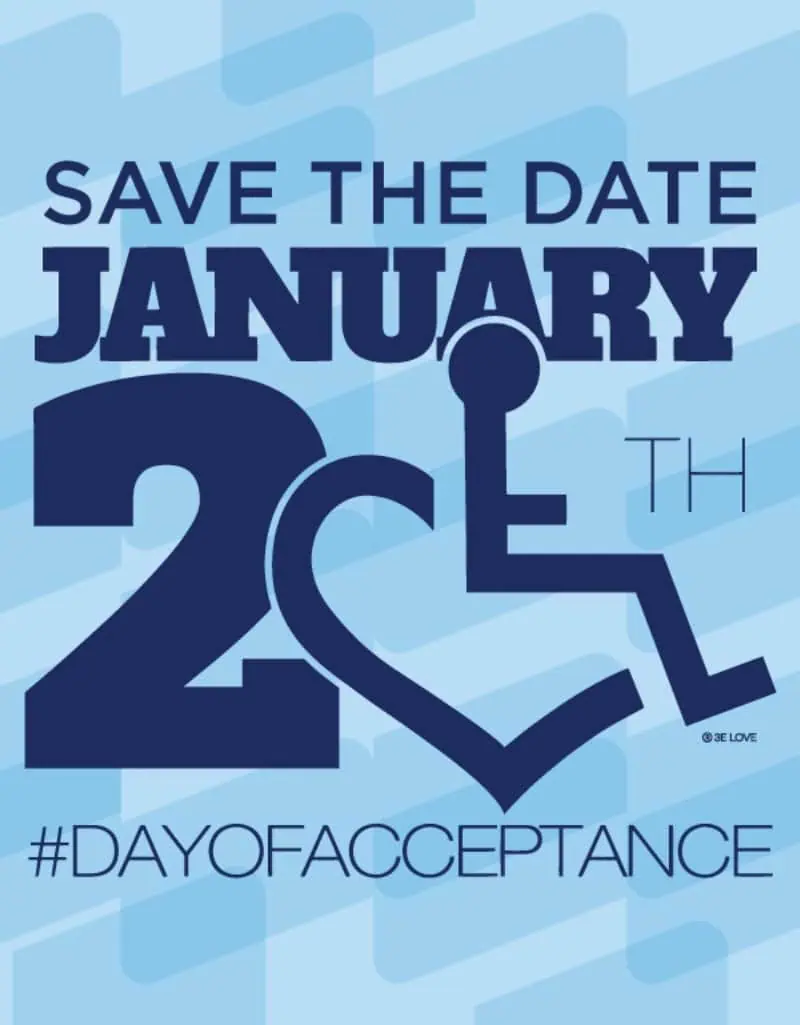
Annie Hopkins sparked something in 2004 that nobody saw coming. As an undergraduate at the University of Illinois, she designed a wheelchair symbol with a heart replacing the wheel for a dorm t-shirt. The design hit immediately. Friends tattooed the symbol on their bodies after seeing hers.
"By replacing the wheel with a heart, the stigma of the wheelchair is also removed, and it can be a symbol for people with any disability," Annie explained. Her creation deliberately rejected charity associations; she feared her symbol might become "related to charity, or the quest for a cure."
Annie and Stevie co-founded 3E Love in 2007. Their philosophy was revolutionary: "3E Love is more than living disabled but is simply about living."
When Annie passed on January 20, 2009, Stevie transformed his grief into purpose. He established the International Day of Acceptance exactly one year later.
Today, the heart-wheelchair symbol represents people breaking through society's assumptions worldwide.
Timeline
Annie Hopkins creates the International Symbol of Acceptance as undergraduate t-shirt design at University of Illinois
3E Love co-founded by Annie Hopkins and Stevie Hopkins with mission to Embrace, Educate, Empower
Annie Hopkins passes away on January 20, creating the symbolic date for future observance
Stevie Hopkins establishes International Day of Acceptance on January 20 as tribute to Annie's legacy
Global adoption spreads across schools, organizations, and communities worldwide
Practical Ways to Participate in the International Day of Acceptance
Individual Actions
- Display the International Symbol of Acceptance on social media profiles
- Read and share authentic stories about disability experiences or allyship
- Support businesses owned by people with disabilities
- Learn inclusive language to incorporate in daily conversations
Workplace & Educational Initiatives
- Host accommodation awareness sessions.
- Audit facilities for accessibility barriers.
- Create employee or student resource groups for disability inclusion.
- Invite disability advocates as guest speakers.
Community Engagement
- Partner with local disability advocacy organizations.
- Host inclusive gatherings in accessible venues.
- Organize community accessibility improvement projects.
- Create art celebrating diverse abilities using the heart-wheelchair symbol.
Core Themes and Lasting Effect
International Day of Acceptance emphasizes acceptance over awareness. Awareness campaigns spotlight what's missing; acceptance celebrates the whole person. This distinction reshapes how communities approach disability inclusion year-round.
The day promotes recognizing ability over inspirational narratives that reduce people to their conditions. True inclusion means seeing contributions, achievements, and full participation in society, not just overcoming odds.
In practice, change requires daily commitment. Annie's symbol specifically avoided temporary charity associations because lasting progress demands ongoing accessibility efforts in all community spaces.
The disability rights movement advances through steady action, not single-day observances.
Organizations implementing inclusive practices see measurable culture shifts. Yet accommodation implementation lags. Nearly half cost nothing to provide, yet rejection rates remain high due to unfounded cost concerns.
Taking Action Beyond January 20
Visit the 3E Love website for toolkits supporting year-round inclusion initiatives. Connect with local disability advocacy organizations offering volunteer opportunities and educational programs.
Transform daily interactions through person-first language. Make meeting spaces accessible. Amplify disability community voices instead of speaking for them.
Become a steady champion for acceptance in your workplace and community.
Fight for the same advocacy by joining the International Day of Persons with Disabilities every December 3.
Resources:
FAQs (Frequently Asked Questions)
The UN doesn't officially recognize International Day of Acceptance. It started in 2010 when Stevie Hopkins created it through his 3E Love organization. He wanted to honor his sister Annie Hopkins and her vision for disability acceptance. Today the day connects communities worldwide, but it remains grassroots rather than government-backed. That grassroots nature actually gives it more authentic energy than many official observances.
The symbol keeps it simple - a wheelchair with a heart replacing the wheel. Annie Hopkins designed this to show empowerment, not charity. You can draw it on hands with washable markers or add it to social media profiles. When organizations use it? Their actual accessibility practices need to match their symbolic commitment. The heart-wheelchair combo should stay intact, but creative interpretation works well. Skip the charity-focused messaging though - this symbol points to strength and inclusion.
**RESEARCH NEEDED** - No specific data provided in original FAQ
The day doesn't create new legal requirements. Instead, it highlights what already exists under laws like the ADA. Smart organizations use January 20 as audit time - they review current accessibility measures and spot gaps in their policies. Beyond this, the day sparks conversations about reasonable accommodations that employers already must provide. This approach helps translate dry legal requirements into real cultural understanding. Companies that get this right use acceptance initiatives to exceed minimum standards while building genuine inclusive cultures.
Small teams work best with personal approaches. Leadership can share disability experiences or host lunch sessions with local advocates. Medium companies might launch employee resource groups or bring in community panels for discussions. Large organizations often coordinate multi-site events and partner with advocacy groups for training programs. But here's what matters most - skip the inspiration porn that reduces people to their disabilities. Focus on skill-building instead. The most effective programs use January 20 as a starting point, not an endpoint.
Barbara is a former journalist who is passionate about translating important causes into engaging narratives. She combines communication expertise with an environmental science background to create accessible, fact-driven content.