
15 Coolest Animal Defense Mechanisms

What makes most creatures unique is how they defend themselves from predators. Most animals have evolved past the traditional methods. Some take advantage of their bodily fluids while others explode! Keep reading as we explore 15 of the coolest animal defense mechanisms.
What animals have the coolest defense mechanism?
Quick links to the coolest defense mechanism of various animals:
1. Some ants sacrifice themselves by exploding.

Ants are famous for their relentless and hard-working characteristics. However, they easily fall prey to many predators. Various species of ants have their own defense strategy that helps them evade predators. Today, we focus on brownish-red ants living in Borneo's treetops.
Alice Laciny and her team discovered and named the exploding ants Colobopsis explodens. They are the first species of their kind to be discovered since 1935. In this species, only the sterile females, who are minor workers, explode.
They attach themselves to the predator and flex their abdomens until they blow up into pieces. As they blow up, they release a yellow substance. Unfortunately, the ant that bows up doesn't survive. It sacrifices itself for the colony's safety because the group's needs are superior to an individual's.
2. Hairy frogs use their finger bones as claws.

The hairy frog (Astylosternus robustus), also known as the horror frog and wolverine frog, is a unique animal with unique defense mechanisms. The 'hair,' the papillae, only grows during the mating season. They grow because of the increase in oxygen demand during the breeding period. Normally, frogs breathe through their skin.
However, the papillae increase the frog's surface area, increasing its oxygen intake capacity. Only male frogs become hairy. Hairy frogs protect themselves from danger by snapping their finger bones. The broken bones pierce through the flesh on the toe pads to form claws, like a switchblade.
You can liken this to Marvel's Wolverine character, who has metal claws piercing his knuckles when he fights. The hairy frog's claws are as sharp as a cat's, sharp enough to inflict pain.
You might wonder if the claws stay out or retract. Yes, hairy frogs retract their claw bones. The claws return to place and heal over time until a predator attacks them again.
3. The Texas Horned lizard squirts blood from its eyes.

Texas horned lizards (Phrynosoma cornutum) have multiple defense mechanisms as they have many predators. Some of the lizards' predators include diamond-backed rattlesnakes, Sonoran whipsnakes, prairie falcons, red-shouldered hawks, American kestrels, roadrunners, loggerhead shrikes, and many other lizards.
These mechanisms include camouflage, sharp horns, flattening bodies, and squirting blood from their eyes. A Texas horned lizard's skin color patterns blend into its surrounding environment. It can switch between light and dark color tones, often pretending to be a rock in hopes of deterring predators.
It flattens its body, playing dead to evade predators. Furthermore, it can control the horns on its head to move backward and forward. These skills ensure that predators experience difficulty before consuming it. The horned lizard's most crucial defense mechanism is shooting blood from its eyelids.
It can engorge its eyelids with blood until a blood vessel bursts, forming a stream into the conjunctival sac. It then squirts a thin stream of blood up to 6 feet away. Horned lizards mostly use this as a last resort against canids.
4. Slow lorises copy the cobra's defense mechanisms to evade potential predators.
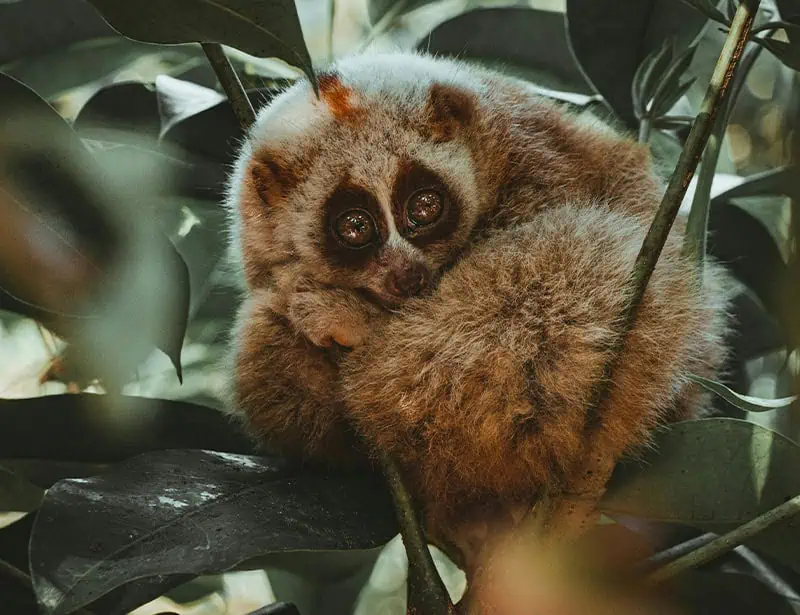
As innocent as they look, don't be fooled. The slow loris is among seven mammal species that use venom as a defense mechanism. Scientists have proposed that the slow loris' defense system evolved to mimic cobra snakes.
Slow loris are predominantly found in southeast Asia. They are the only primate species with venomous glands. The gland system is in its armpits. When threatened, a slow loris enters a defensive posture, raising its hands above its head, mimicking cobra snakes' movements.
It releases fluid from its brachial gland and quickly moves its mouth to combine it with saliva. It then applies the mixture to the top of its head or keeps the substance in the mouth to transfer it to predators with a bite.
Slow Loris's bites are mighty. It causes edema, which takes weeks to heal, and causes scarring. Other times, victims might enter anaphylactic shock, which might lead to death.
5. Iberian ribbed newts use their ribs as spikes.

The Iberian ribbed newt (Pleurodeles waltl) is next on our list of animals with unique defense mechanisms. When it senses danger, the salamander swings its ribs forward, raising the angle of the spine to 50 degrees. It stays still as the tips of the ribs pierce through the skin and stick outside its body.
Predators that try to bite or swallow the Iberian newt in this state will experience severe pain or possibly death because the bones contain a poisonous milky liquid released from its skin. The Iberian newt's defense mechanism is similar to that of hairy frogs. The process of forcing its ribs out of its body doesn't cause long-term damage. It can reconstruct damaged tissues and regenerate lost limbs, brain, spinal cord, intestine, optical, and heart tissues.
6. Pygmy Sperm Whales create clouds of poo as a weapon to deter predators.
Pygmy sperm whales, also known as short-headed sperm whales, weigh about 450 kg and grow up to 3.8 meters long. They live in temperate subtropical and tropical seas. Humans, great white sharks, and killer whales often hunt pygmy sperm whales.
Pygmy sperm whales' defense mechanism is similar to squids and octopuses. They produce ink-like substances from their anuses to protect themselves from predators. A sac filled with liquid is in a pygmy sperm whale's intestine. When threatened, it can squirt three gallons of dark brown liquid from the sac.
The liquid forms a dark cloud in the water, obstructing the predator's view and increasing the whale's chances of escape. The dark liquid cloud does not affect them because they navigate underwater through sound.
Scientists believe the brown liquid is some form of defecation because it contains amino acids and bacteria in the digestive system. The liquid overwhelms the predator's senses, allowing a pygmy sperm whale to evade capture and possibly death.
7. Bombardier Beetle sprays boiling poison.

Bombardier beetles are not your typical insects with chemical defenses. These small beetles live under stones and in leaf litter in grasslands and woodlands. They use chemicals because they smell and taste horribly, an excellent way to evade potential predators.
Bombardier beetles release a chemical substance called benzoquinone from their abdomen. Almost all insects can produce benzoquinone to defend themselves. However, bombardier beetles have the unique ability to boil the liquid and release it in a stream.
They mix the chemicals in two protective sacs in their hindquarters, generating intense heat that brings the liquid to a boiling point. The larger sac stores hydroquinones, while the smaller sac, which is the reaction chamber, holds catalases and peroxidase enzymes that activate the spray.
This process gives the bombardier beetles enough pressure to release the hot poison in a jet stream toward potential predators. A bombardier beetle can release the hot poison up to 20 times consecutively. It deters predators like spiders, carabids, ants, and mantids before they can attack the beetle.
8. Northern Fulmar's defense mechanism uses vomit to trap predators.

Not all expert evaders in the animal kingdom have bright colors or scary looks. While poison dart frogs produce toxins, our next white, innocent-looking animal uses a more natural excretion, which isn't deadly but disgusting.
The northern fulmar is a gray and white bird that resembles a gull. These birds are commonly found in the Northern Atlantic, Pacific, and Arctic oceans. Northern fulmar's defense mechanism includes a series of warning signals before they attack.
They produce sounds like mews, grunting, and spitting to alert the predator of the incoming attack. These birds deter predators by spitting regurgitated foul-smelling liquid on them. The liquid is an oily substance produced in their stomachs.
Their defense mechanism works well against winged predators. It sticks to the predator's feathers, mating them and making them unable to fly. Northern fulmar's other predators include red foxes, rats, ground squirrels, and Arctic foxes.
9. Hagfish's defense mechanism uses slime to choke predators.

Sharks and bony fish are some marine animals that prey on hagfish, so they must always be watchful of their environment. Luckily, nature has given them a working defense mechanism. Hagfishes have large slime glands and about 200 slime pores running along the entire length of their bodies on both sides.
When attacked or stressed, they release significant amounts of slime from their pores. The slime's chemical composition contains mucins joined together by protein threads. The slime expands when it interacts with seawater, becoming three times more diluted than regular mucous secretions.
When bitten, the glands release slime in less than a second, rapidly filling their predators' mouths and gills. Predators visibly choke and move away from this 300 million-year-old fish. This strategy protects not only the fish but also their catch, which can be draped in slime. Watch the video below from the 2011 study which observed this defense strategy.
10. Boxer crabs make pompoms of sea anemones.
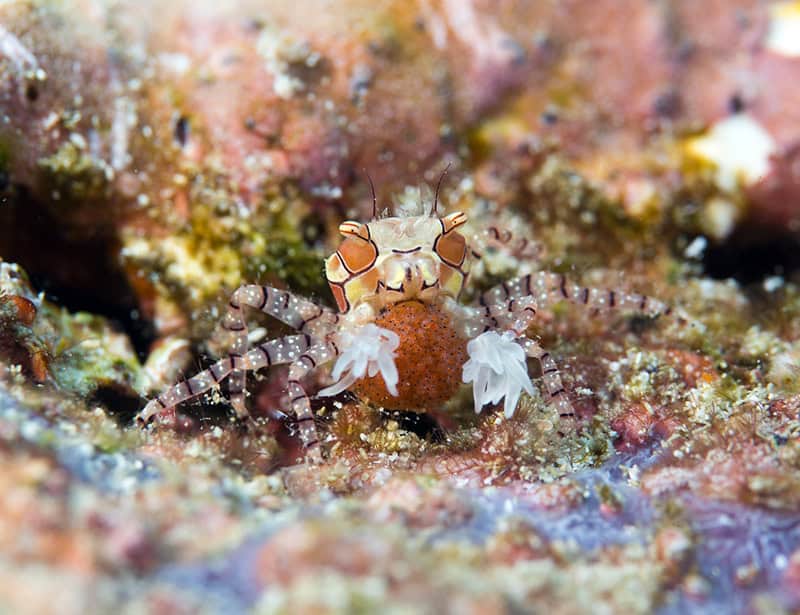
Boxer or cheerleader crabs (Lybia tessellata) have a symbiotic relationship with sea anemones. They carry anemones at the tip of the front claws all the time. When threatened, the crab enters a boxing defense position by dragging the makeshift gloves across the ocean floor.
The crab uses anemones' stinging features to protect itself from predators. It also takes advantage of the food captured by the anemones to increase the weight of its punch. Boxer crabs take their anemone pompoms with them throughout their lifecycle. They only drop it when they are molting, and then they pick them up again.
What happens when a boxer crab loses an anemones? It rips the remaining one in half and waits for it to regenerate into two in a few days. Sometimes, the crab fights other crabs and steals their sea anemones.
11. Sea cucumbers push their internal organs out of their anuses.

Sea cucumbers are soft, cylindrical creatures with high regeneration qualities. About 1,500 species are native to salt waters worldwide. The sea cucumber species' defense mechanism, called self-evisceration, is an example of the extreme lengths nature would go to to protect itself.
Although a sea cucumber has no brain or eyes, it can protect itself just fine. Sea cucumbers shoot out a silky and sticky substance out of their anus. This substance is actually the sea cucumber's intestines.
The sticky intestines stop predators like starfish, crabs, and fish. Fortunately, the sea cucumber species can regenerate their missing organs in a few weeks.
Other sea cucumbers release sticky white threads known as cuvierian tubules. These white threads act like glue, entangling the predator in a web.
12. Porcupine quills protect it from harm.

Porcupines are covered by modified hairs known as quills. These quills are made from keratin, which is removable, unlike hedgehog spines. Whenever they sense danger, the quills on their body stand erect, ready to discharge. They release the quills in all directions because of their poor eyesight. They can't see the direction of their assailant.
The piloerector muscle at the base of the quills releases them, and they penetrate the predator's skin tissues by deforming them until they form a crack. The quill penetrates through the crack and increases its width, inflicting great pain.
13. Skunks release a foul liquid from their anal glands.

Skunk's defense mechanism, a well-known animal behaviour, utilizes a foul-smelling liquid from their anal glands to chase away potential predators. They can spray attackers up to 15 feet away. However, they can only release the liquid once. So they use it as a last resort after warning signals, including feet stomping, hissing, growling, and raising their tails.
Their foul liquid, primarily sulfur compounds, can cause temporary blindness and severe discomfort. The skunk spray is so effective that you can smell it a mile away.
14. Mimic octopuses are master shapeshifters.

The mimic octopus (Thaumoctopus mimicus) showcases a unique defense strategy that differentiates it from other cephalopods. Not only can it change color using chromatophores, but it also mimics certain species.
This harmless but intelligent creature skillfully imitates sea snakes, lionfish, and even flatfish. Adopting the form and behavior of these deadly creatures scares their predators. This is called Batesian mimicry, which other animals, from butterflies to frogs, also use.
Check this master shapeshifters on play in the video below.
15. Three-lined potato beetles cover themselves with their feces.

The last bizarre defense mechanism in the animal kingdom is from a tiny garden pest feeding on tomatillos, not potatoes, as its name initially suggests. The larvae of three-lined potato beetles (Lema daturaphila) have a rather peculiar defense strategy. They create a protective fecal shield on their backs. This unorthodox armor, rich in toxic compounds from their diet, effectively deters hungry predators.
Conclusion: Defense Mechanisms in the Animal Kingdom
Humans undergo self-defense training to protect themselves from danger. It is only fitting that animals do it, too. Common types are present across all species, from avoiding detection to producing toxins. After reading this article capturing the most shocking, disgusting, creative, and weird defense mechanisms, what animals have the coolest defense mechanisms?
Glossary Terms:
Jen’s a passionate environmentalist and sustainability expert. With a science degree from Babcock University Jen loves applying her research skills to craft editorial that connects with our global changemaker and readership audiences centered around topics including zero waste, sustainability, climate change, and biodiversity.
Elsewhere Jen’s interests include the role that future technology and data have in helping us solve some of the planet’s biggest challenges.
Fact Checked By:
Isabela Sedano, BEng.
