
20 Types of Wildflowers to Grow or Search

Wildflowers, nature's unspoiled gems, are untouched by human hands. Found in rocky mountains, meadows, and woodland gardens, they transform landscapes with vibrant colors. And when the different types of wildflowers bloom, they become a lifeline for bees, birds, and other pollinators.
In this article, we will discuss 20 of them, including their distribution, characteristics, and light requirements. Add them to your backyard gardens or search for them during your nature walks.
20 Top Wildflowers To Grow In A Wildflower Garden
Explore the following wildflowers and add them to your gardening list:
1. Black-eyed Susan (Rudbeckia hirta)

Black-eyed Susan is an Asteraceae plant native to North American prairies and open woodlands. It is a short-lived perennial used as an ornamental garden decoration and in flower bouquets.
Its rough and hairy stem grows up to 4 feet high and has oval leaves. Rudbeckia hirta flowers in late summer and early autumn, producing deep yellow-orange flowers with dark conical centers of tubular flowers.
The wildflower prefers moist and well-drained clay, loamy or sandy soil. Black-eyed Susan grows well in full sun but also under partial shade. As a wildflower, the coarse hairs on the stem and leaves provide some protection against deer.
2. Coneflower (Echinacea)

Next on our list of wildflower types is the coneflower, a native to the central and eastern United States. It is also known as the eastern purple coneflower and purple rudbeckia. Purple coneflower is an herbaceous perennial that blooms with pinkish-purple flowers from early summer to mid-summer.
It grows up to 5 feet tall in well-drained loamy soil and is resistant to deer, heat, humidity, and salt. The coneflower propagates and reseeds itself. It attracts butterflies and other essential pollinators. It is also drought-tolerant and can survive in shaded areas.
3. Bee Balm (Monarda)

Bee balm, also known as Monarda or Bergamot, is a wildflower in the mint family, Lamiaceae. It is native to North America and can grow to 4 feet tall. Its flowers are shades of red, purple, and pink, and they bloom from mid-summer for up to 6 weeks.
Its tubular and two-lipped petals repel deer and rabbits. The strong scent of this plant attracts bees, birds, and butterflies.
Bergamot grows in clay, chalk, loamy, and sandy soils as long as they are moist but well-drained. It fits right into a wildflower garden as a border or accent plant. It is also a great addition to pollinator gardens, wildflower meadows, cottage gardens, color-themed gardens, and water gardens.
4. Common Milkweed (Asclepias syriaca)

Next on our list of wildflowers is the common milkweed, Asclepias syriaca. This perennial plant is native to the eastern United States and southern Canada. It grows up to 5 feet tall, with leaves 6-8 inches long and 3-3.6 inches wide. Milkweed's broken leaves and branches release milky latex.
Its flowers bloom in spherical clusters at the top of the plant. Each plant has about 2 to 5 clusters. The milkweed's flowers are about 0.75 inches long and 0.4 inches wide, ranging from greenish-pink to rosy pink to purplish-pink.
Its genus is Asclepias, named after the Greek god of medicine, Asklepios. This type of wildflower can be used for wart removal and lung diseases. It is also a food source for about 450 insects, including bees, wasps, ants, beetles, flies, and butterflies. It requires full sun to grow properly but can tolerate partial sun coverage.
5. California Poppy (Eschscholzia californica)

California poppy is a native species of the Pacific slope of North America, from western Oregon to Baja California. It is the state flower of California. California poppy flowers range from cream to pale yellow and orange in the wild. The wildflowers only open in full sun exposure and close in rainy or cloudy weather at night.
California poppy's stems are about 12 inches long. They grow in grassland, flats, slopes, juniper and pinyon woodlands. You can plant California poppies in rock gardens, garden beds, or in your apartment gardens. It is an annual plant that grows via self-seeding.
6. Cardinal Flower (Lobelia cardinalis)

Another flower you will find in a wildflower garden is the cardinal flower, Lobelia cardinalis. It is a native wildflower plant in North and Central America. Cardinal flowers bloom scarlet, pink-lipped, or white petals on stems reaching up to 5 feet tall. They are often used as ornamental plants in gardens.
It thrives in moist soil, growing clumps of basal and lanceolate leaves about 6 inches long with toothed margins. The bright flowers bloom in late summer, attracting birds and bees. Cardinal flowers are better suited for rain gardens and the front borders of streams and ponds.
7. Ironweed (Vernonia)

Ironweed is a genus of about 500 species of perennial wildflowers. Seventeen of the 500 available species are North American native plants. Individual wildflower species are about 3 to 9 feet tall, with lance-shaped toothed leaves alternating along the stem. They bloom in clusters of flowers in varying colors, such as white, purple, and pink.
Ironweed flowers are shaped like flared tubes, with each tube having five petals joined at the button but separated at the top. It prefers acidic, moist soil but also grows in regular moist to wet soil under full sun exposure. The flowers bloom from July to September.
8. Virginia Bluebells (Mertensia virginica)

Next on our list are spring wildflowers called Virginia bluebells. This perennial plant has delicate flowers and oval leaves. It blooms one-inch long pink flowers shaped like a pendulous bell for 3 weeks. The leaves are about 3 to 6 inches long with bluish-green to grayish-green colors.
Virginia Bluebell is a native wildflower in eastern Canada and the central and eastern United States. It grows in nutrient-rich, moist soil in thickets and floodplain forests. Planting it in a garden adds a unique splash of color and delicate fragrance. It grows better in rich soil under partial shade.
It can be difficult to propagate. However, the wildflower seeds self-seed and colonized the surrounding area. Virginia bluebells form dense colonies in well-draining soil under partial sun exposure. The flowers are pollinated by bumblebees, butterflies., flower flies, hummingbird moths, bee flies, and hummingbirds.
9. Dogtooth Violet (Erythronium dens-canis)

Dogtooth violet is a native type of wildflower plant in the United States. It has many names, including snow lily, fawn lily, trout lily, adders tongue, and easter lily. Dogtooth violet blooms in early spring and becomes dormant until the left cycle. It produces six bright yellow petals swept back and six stamens poking from the center.
You will find fawn lily-shaded wooden subalpine meadows along the streambank. You can also plant it in partial shade or full shade. It grows up to 6 inches high. A dogtooth violet takes a while to bloom, especially when planted via seeds. Propagation done by wildflower seeds takes up to 4 to 5 years before it blooms profusely.
10. Columbine (Aquilegia)
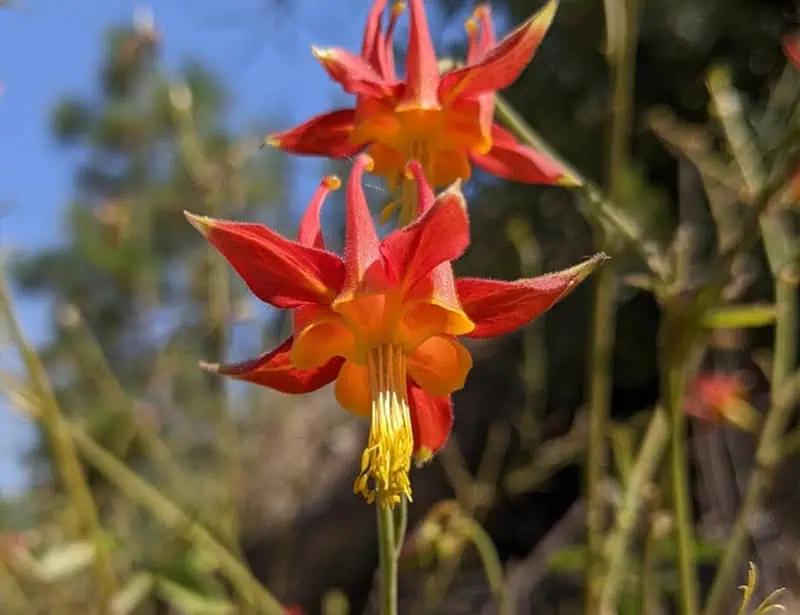
Columbine is a perennial plant from the buttercup family, Ranunculacae. There are about 100 species of these native plants in Europe and North America. Columbine wildflowers have five swept-back petals with distinctive colors, as the flowers are always two-colored.
The most common species, Aquilegia canadensis, has red and bright yellow petals, while other species have orange, pink, white, and blue flowers. Most columbine wildflower species grow along stream beds, rocky ledges, mountain areas, and temperate woodlands.
It can survive under full sun exposure or partial shade, growing up to 3 feet tall. Columbine's blooming season is from mid-May to mid-June, and it starts in the second to third year when grown from its own seed.
11. Liverleaf (Hepatica nobilis)

The liverleaf, also known as liverwort, is a type of wildflower plant native to eastern North America, Europe, and Asia. It blooms from early to late spring and grows about 4 inches tall and 5 inches wide. A liverleaf plant can grow up to seven stems and has three-lobed leaves.
In early spring, liverleaf produces violet, purple, and blue flowers with white stamens. It is well suited as an edging plant for cottage, city, and rock gardens. As a semi-evergreen perennial plant, it thrives under partial sun exposure.
12.Sweet Joe Pye Weed (Eutrochium purpureum)

Next on our list of wildflowers is Sweet Joe-Pye weed, also known as Indian sage, marsh milkweed, and Pride of the Meadow. It is native to Southeast Canada and the Central and Eastern United States along riverbanks, thickets, woodland borders, roadsides, and prairies.
This wildflower grows 5 to 7 feet tall and 2 to 4 feet wide. Its pinkish-purple tube-shaped flowers bloom in clusters from the start of summer to early fall. The petals have a light vanilla scent. The lance-shaped leaves are about 12 inches long. The wildflower prefers partial sun to full sun exposure.
It grows via seed and stem propagation. Wildflower seeds need three months of cold and various moisture levels, so they should be planted during fall. Stem propagation should occur in late spring. Germination is more guaranteed via stem-cutting propagation than planting seeds.
13. New England Aster (Symphyotrichum novae-angliae)

New England aster is an herbaceous perennial wildflower with large purple flowers. The plant grows between 3 and 7 feet tall and has alternating fuzzy leaves on either side of the stem. The flowers develop yellow centers during the growing season, which lasts from August to October.
New England aster doesn't require full sun exposure and thrives in acidic, well-drained soil. It is a nectar source for monarch butterflies and bumble bees. You can grow New England aster by planting its seeds in the fall or using a cold stratification method for germination. The flowers bloom from late summer to late fall and fruit from late fall to late winter.
14. Wake-Robin (Trillium erectum)

Our nest type of wildflowers is the wake-robin, which blooms in spring. It has many names, including stinking Benjamin, purple trillium, purple wakerobin, red trillium, and wet dog wakerobin. The name wake-robin refers to the flower appearing simultaneously as the first robin.
Wake robin is native to North America. It typically grows on acidic soil in dry and arid areas. You will find it in slope forests, upland hardwood forests, and hammocks. Individual wildflower species have three sepals and three petals ranging between maroon, purple, and greenish-yellow with purple colors.
It grows to about 8 to 12 inches tall, but the height varies by species. Wake robin leaves grow in a set of three whorly arrangements. They are green, mottled, and veiny. It thrives well under partial or full sun exposure.
15. Dutchman's Breeches (Dicentra cucullaria)

Dutchman's Breeches is an herbaceous plant from the poppy family native to the eastern United States. It blooms from March to April, producing white and pink flowers similar to those of a pair of Pantaloons.
You'll likely find this spring wildflower in open woodlands and rocky, deciduous, moist woods. Ants spread their seeds in the wild. Its seeds are difficult to germinate because they require cold stratification.
16. Desert Marigold (Baileya multiradiata)

Next on our list of wildflowers is the Desert Marigold. It grows in sandy or gravelly soil along the roadside, desert plains, washes, and mesas. Desert Marigolds are native to the deserts of the southwestern United States.
Desert marigolds can survive in poor soil and arid conditions with minimal water. They grow as a dense clump of leaves and flowers, reaching 18 inches tall. Desert marigolds bloom bright yellow flowers similar to daisies.
The flowers are 2 inches tall, and each stem holds up to 60 ray florets. The plant's leaves have a silver-gray appearance and a woolly texture. The silver helps reflect sunlight and keep the plant cool in hot conditions.
A single desert marigold plant can produce up to 50 flowers in one blooming season. Under the right conditions, desert marigolds can bloom all year round. They attract beneficial insects like native bees, birds, small mammals, and reptiles.
17. Dwarf Milkwort (Polygala amarella)

Dwarf milkwort is native to northern England and Kent. It grows in limestone grasslands and chalk in small clusters of tiny bluish-pink flowers. The plant can reach up to 10 inches tall. It is an irregular three-lobed flower with stamens in three groups. It also produces a flat capsule fruit with broad membrane edges.
The ancient Greeks referred to the wildflower as having lots of milk because they believed it increased the quantity of milk produced by sheep and cows. They also recommend it to nursing mothers who are experiencing problems breastfeeding their infants.
18. Baby Blue Eyes (Nemophila menziesii)
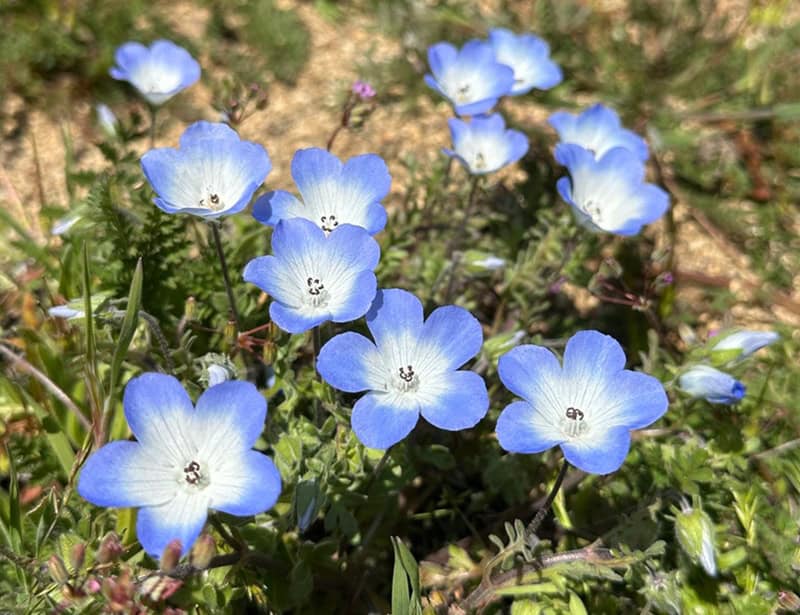
Baby Blue Eyes is an annual wildflower with saucer-shaped bright blue flowers and lobed mid-green leaves. The plant is is less than 3 inches tall and the flower is about an inch wide. The middle part of the flowers is white or yellow, and the petals have dark marks.
It thrives in well-draining soil of any kind, including loan, chalk, sandy, and clay soils. It prefers full sun exposure but can survive under partial shade. This wildflower is suitable for a wildlife garden, flower border and bed, courtyard garden, and garden edging.
19. Prairie Gentian (Eustoma)

Next on our list of wildflowers is the prairie gentian, also known as the bluebell gentian and Texas bluebell. It features large bell-shaped flowers growing on single or branching stems. The flowers have 5-7 blue-purple petals measuring almost 1 inch long.
The prairie gentian is about 3 feet high with smooth stems. Its leaves are oval with pointed tips measuring about 2.5 inches long. The plant usually has multiple flower clusters near the top. The blooming period lasts for about a month. Gardeners also noticed that prairie flowers do not have a noticeable scent.
20. Great White Trillium (Trillium grandiflorum)

The great white trillium is native to eastern North America, from southern Quebec and Ontario to Maine west and northeastern Minnesota through the Appalachian mountains. It can reach up to 3 feet tall. The leaves are dark green and measure 3 to 6 inches long. The great white trillium blooms white flowers from late April to early June. A single flower is about 1 to 3 inches long.
This trillium species hosts larvae and feeds local honeybees. It requires dappled sunlight, deep shade, good drainage, and moist soil.
For more in-depth data on the wildflowers we listed, visit the NC State Extension Plant Toolbox.
Glossary Terms:
Jen’s a passionate environmentalist and sustainability expert. With a science degree from Babcock University Jen loves applying her research skills to craft editorial that connects with our global changemaker and readership audiences centered around topics including zero waste, sustainability, climate change, and biodiversity.
Elsewhere Jen’s interests include the role that future technology and data have in helping us solve some of the planet’s biggest challenges.
Fact Checked By:
Isabela Sedano, BEng.
