
17 Solitary Animals Thriving Solo in the Wild

Do you know how some people love to be alone and will actively avoid interactions? We also have solitary animals that stay away from other animals, including members of their own species. Polar bears, tortoises, and most big cats all live contented solo lifestyles.
Wild animals that spend more than 50% of their time alone may be classified as solitary3. This article teaches about 17 such animals and why they choose isolation.
Table of Contents:
Understanding solitary living in animals

Social organization in the animal kingdom is complex. Some animals live in small family units, others in large colonies, and some spend most of their time alone. Not many species prefer solo living. Only 22% of mammals are solitary animals4.
This lifestyle does not imply antisocial behavior, where individuals actively harm other members of their species. Instead, it is a social structure that allows only purposeful interactions between adult individuals.
For example, even the most solitary animals must seek out members of the opposite sex during mating season. Otherwise, they would be extinct. In some species, a breeding female will live with her young offspring for some time.
In some species, the degree of solitude differs between sexes. For example, in nocturnal lemurs native to Madagascar, males do not associate with other males. The females, however, live in small groups with other females.
Why do some animals adopt a solitary lifestyle?
Understanding which came first on the social evolution timeline can shed more light on animal social behaviors. Studies on natural history indicate that all animals were social before solitary species evolved.
Social organization in any species evolves in response to ecological constraints such as predators, available food resources, the cost of parental investment, etc.
Studies on animal behavior have focused on social animals more than their solitary counterparts.
We know a lot about social animals' advantages, but let's look at some reasons solitary species live such contented solo lifestyles.
Avoiding predators
Most prey animals use the strength of numbers to discourage predators. However, numbers may sometimes be a disadvantage.
Take the folivorous sloth, for instance. It can perfectly camouflage itself in a tree. Now, if many sloths were hanging out in one tree, the sloth would lose the advantage of quiet camouflage.
Competing for food
When food is scarce, solitary animals can keep whatever food resources they find for themselves. Solitary living may have evolved as an adaptation to food scarcity.
For predators, the presence of other predators means securing food resources is highly competitive. Even when prey is plentiful, hunting, which sometimes takes days, requires much effort. So, why share?
No domination
Most social animals live in societies with a dominance hierarchy. Dominant adult males and females enjoy the best privileges, from food to choice of mates.
In some social species, non-dominant individuals may never mate. At least solitary animals have a fair chance of mating.
Lower disease transmission rate
The rapid spread of diseases and parasites is a risk for social animals. One affected individual may wipe out a whole herd.
With minimal contact between individuals, solitary animals can avoid transmission of diseases and parasites. Without care, sick individuals would likely die quickly before the disease could spread.
List of animals that prefer solitary lives
Here are some of the antisocial creatures worthy of attention:
Quick Links:
1. Polar Bear (Ursus maritimus)

The polar bear may look fluffy and cuddly, but this solitary animal prefers to be left alone. Perhaps so it can eat in peace?
A polar bear is a powerful predator that spends more than half its time hunting. However, it usually succeeds in catching prey two out of ten times.
The only time polar bears get together is during breeding season and when a mother bear raises her cubs for almost three years. Also, when a polar bear strikes lucky with a huge kill, it allows others to get close enough to share.
2. Jaguar (Panthera onca)

Big cats, except lions, live a mostly reclusive life. Jaguars, closely resembling African leopards, are native to South America. These swift animals are adept swimmers and love to hunt aquatic prey.
Jaguars are solitary and territorial. They defend their home range against intruders, including other jaguars. However, mating pairs form a temporary partnership until the season is over. In other cases, male jaguars form an alliance to protect territories2, share kills, and mate with the same females.
Male jaguars do not provide any parental care. The cubs live with their mother for about two years before they become independent.
3. Koala (Phascolarctos cinereus)

Koalas likely evolved as a solitary species to make their hard life a little easier. They have only one food source, the eucalyptus, so sharing their food supply is out of the question. They must also stay high in the trees to avoid predators since they're not swift enough to escape a chase.
Each koala's home range consists of one or several eucalyptus trees, so it doesn't have to go far to find food. Their home ranges overlap, so they can easily mate when the time comes.
4. Red Panda (Ailurus fulgens)

Many animals aspire to be as adorable as red pandas. These fluffy mammals are native to southwestern China and the eastern Himalayas. Despite the similar name and bamboo-loving habits, red pandas are not closely related to giant pandas.
People also refer to the red panda as the lesser panda, the Firefox, or the red cat bear. They are primarily vegetarians but occasionally eat small birds and rodents.
Red pandas are solitary animals that pair off during breeding season, lasting only a few days each year. Females raise their cubs alone without any input from the males. She cares for the cubs until they are about 18 months old and then drives them away.
5. Aardvark (Orycteropus afer)

The aardvark is a medium-sized mammal native to Africa. They named the animal for its burrowing habits and its long pig-like snout. Aardvark is an Afrikaans word that translates to “earth pig.”
Aardvarks feed on ants and termites. They usually come out at night to find food. Solitary living, shyness, and nocturnal nature are why aardvark sightings are uncommon.
Of course, males and females get together to mate. After that, the female will care for her offspring until about seven months.
6. Platypus (Ornithorhynchus anatinus)

The platypus, native to Australia, is one of nature's most confounding creatures. It is a venomous mammal that can lay eggs. This adept swimmer can cover a distance of 3 feet in one second. Unfortunately, these unique creatures are an endangered species.
The platypus is a solitary species. Although they swim in the same body of water, they stay away from each other. It does, however, get together to mate when the season comes.
7. Tortoise (Testudinidae)

Tortoises are solitary animals from birth until death, except when they need to mate. They do not even receive parental care like some solitary species do. The female tortoise digs a hole, lays eggs, leaves, and never returns.
The hatchlings begin fending for themselves from birth. Even though hundreds of hatchlings begin life at the same spot, they ignore each other. Tortoises don't mind being neighbors with other animals but will not tolerate another tortoise on their home turf.
Desert tortoises don't mind coming together during summer when the ground temperature gets too hot. They dig long burrows to hide from the sun, and more than 20 desert tortoises can share one burrow.
8. Snow Leopard (Panthera uncia)

Despite their name, snow leopards are closer to tigers than leopards1. They thrive in Central Asia's formidable, cold, and rocky mountains. Known for their elusive nature, these solitary felines typically remain unseen. They are primarily active at dawn and dusk, observing their surroundings from lofty perches.
These cats avoid confrontations, even forfeiting their hard-won prey rather than engaging in a dispute. According to the Snow Leopard Trust, there is no known report of a snow leopard attacking a human.
9. Komodo Dragon (Varanus komodoensis)

If reptiles had royalty, it would be Komodo dragons. These majestic lizards can grow as large as 9 feet and weigh up to 70kg. They are fearsome predators, hunting deer, boars, water buffaloes, horses, and members of their species.
Komodo dragons are solitary animals. They only come together to breed or share a large enough kill. The males may guard the female they have mated with for a while to prevent her from mating with another male.
Female Komodo dragons protect their nests for a while but leave four months before the eggs hatch. The hatchlings begin life alone.
10. Moose (Alces alces)

The moose is the largest member of the deer family. It can be 10 feet tall and weigh 1600 pounds. You can easily recognize the males by their enormous antlers, which are the largest of any mammals. You can find moose in parts of North America and Eurasia.
The moose is a solitary animal and the least social member of the deer family. They are not territorial but stay well away from each other until it’s time to breed. At that time, males would occasionally fight each other over a mate. Offspring typically remain with their mothers for one year and then go off to explore.
11. Wolverine (Gulo gulo)

Wolverines are not related to wolves. Although they look like small bears, they are unrelated to bears. They are weasels. The wolverine is the largest and fiercest member of the weasel family. Its other names are Skunk Bear, Carcajou, and Devil Bear.
A wolverine stays alone until it's time to mate. Therefore, adult individuals of the same sex have no reason to interact. A mother wolverine will remain in the company of her offspring for about a year. Early on, the father will occasionally come to care for the kits.
When young wolverines leave home, males move farther away while females stay close by for up to 3 years.
12. Black Rhinoceros (Diceros bicornis)

The black rhino, also called the hooked-lip rhino, is native to some parts of Africa. It is smaller than the white rhino and has differently shaped lips but the same gray color. The animal is critically endangered because people still poach its horn for its supposed medicinal properties.
Unlike their white counterparts, these rhinoceroses are usually solitary animals. Males stay alone until it's time to mate, and females remain with their young offspring for a while. Sometimes, lone female black rhinos will temporarily get together with other females.
13. Hawaiian Monk Seal (Monachus schauinslandi)

Most seals live in large colonies of up to a thousand individuals. However, the Hawaiian monk seal prefers to live in solitude. Although they are practically close neighbors, Hawaiian monk seals interact only when mating and raising their young. At other times, they are rarely close enough for unintentional physical contact.
You can only find this seal species on the Hawaiian Islands. Its population is endangered, with only about 1,600 individuals. However, hopes are high for a full recovery.
14. Kinkajou (Potos flavus)
The kinkajou is often mistaken for a primate but belongs to the same family as raccoons and olingos. It is also called a honey bear, sugar bear, or cat monkey. Kinkajous are native to South and Latin America.
Kinkajous practice partial solitary living. An individual kinkajou will spend most of their time alone but may join a small group to feed, play, groom, and even sleep. A kinkajou’s social group typically includes one dominant male, a subordinate male, and one female and their offspring.
15. Cottonmouth Snake (Agkistrodon piscivorus)
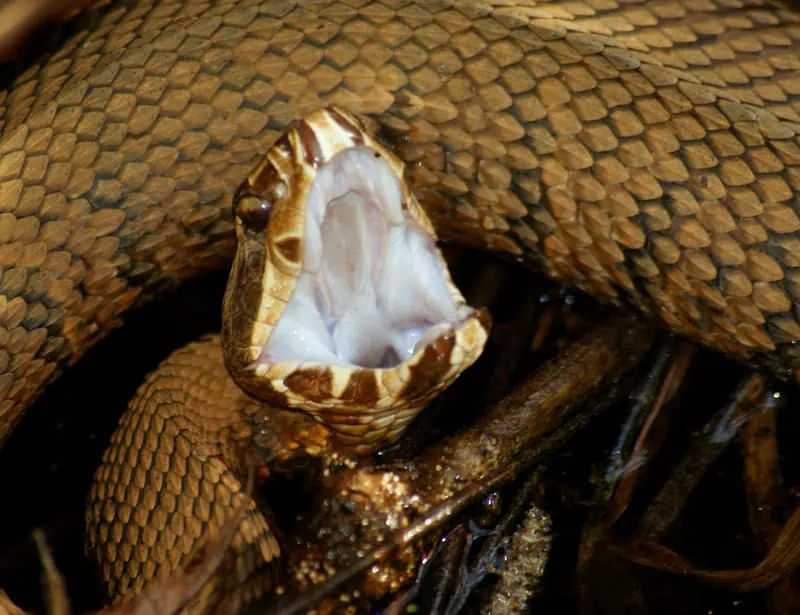
Native to the southeastern United States, cottonmouth snakes are one of the world’s few semiaquatic vipers. You can find them in or near water. They are one of the larger snakes, reaching up to 70 inches in length.
These snake species are called cottonmouths for the white lining of their mouth, which they display when they feel threatened. They are extremely dangerous, and their bite can be fatal to humans. However, they rarely attack humans unless provoked.
Cottonmouths are solitary. They do not form nests and won't leave their home range. They only come together during mating season.
16. Solitary Sandpiper (Tringa solitaria)
Most shorebirds prefer to stick together. They forage and migrate in flocks of more than a hundred individuals.
The solitary sandpiper is aptly named for its preference for a solitary lifestyle. You'll find this North American shorebird foraging and migrating alone. You'll only find solitary sandpipers together when it's breeding season.
After successfully mating, the male solitary sandpiper finds an abandoned songbird nest for his mate. The female adjusts the nest and incubates her eggs for about 24 days. The new hatchlings become independent quickly and may not need parental care.
17. Solitary African Mole Rat Species
At least 14 species of mole rats are native to Africa. These rodents live underground and feed on root crops.
Some species of the African mole-rat family exhibit social behavior, while others tend towards solitary lives. Examples of solitary mole rats include the silvery (Heliophobius argenteocinereus) and cape dune mole rats (Bathyergus suillus).
In solitary mole rats, an individual occupies its burrow alone. Only during the breeding season do these mole rats come together. The adult female lives with her pup for a while before the mother–pup and inter-sibling aggression sparks a dispersal.
Conclusion
Most species in the animal kingdom are social animals. They live in large or small groups, doing everything together. Shared parental responsibilities and using the strength of numbers to scare off predators are advantages of such a lifestyle.
However, many other creatures live contented solo lifestyles. Solitary living has advantages such as less competition for food and mates and a slower spread of diseases. It appeals to various animals, from birds to reptiles and apex predators.
Glossary Terms:
| 1 | Davis, B. W., Li, G., & Murphy, W. J. (2010). Supermatrix and species tree methods resolve phylogenetic relationships within the big cats, Panthera (Carnivora: Felidae). Molecular Phylogenetics and Evolution, 56(1), 64–76. |
| 2 | Jędrzejewski, W., Hoogesteijn, R., Devlin, A. L., Tortato, F., Concone, H. V. B., Azevedo, F., Eriksson, C. E., Fragoso, C. E., Abarca, M., Morato, R. G., Giordano, A. J., Hoogesteijn, A., Rampim, L., Gamarra, G., Carreño, R., Velásquez, G., & Schmidt, K. (2022). Collaborative behaviour and coalitions in male jaguars (Panthera onca)—evidence and comparison with other felids. Behavioral Ecology and Sociobiology, 76(9). |
| 3 | Makuya, L., & Schradin, C. (2024). Costs and benefits of solitary living in mammals. Journal of Zoology, 323(1), 9–18. |
| 4 | Makuya, L., & Schradin, C. (2024). Costs and benefits of solitary living in mammals. Journal of Zoology, 323(1), 9–18. |
Jen’s a passionate environmentalist and sustainability expert. With a science degree from Babcock University Jen loves applying her research skills to craft editorial that connects with our global changemaker and readership audiences centered around topics including zero waste, sustainability, climate change, and biodiversity.
Elsewhere Jen’s interests include the role that future technology and data have in helping us solve some of the planet’s biggest challenges.
Fact Checked By:
Isabela Sedano, BEng.
