
13 Rare Butterflies That Deserve More Attention

All of us have seen and appreciated butterflies with colorful scales covering their wings. They are native to different parts of the world, totaling 19,500 butterfly species. Some of these populations have become possibly extinct because of collectors, food scarcity, habitat destruction, and climate change. Let’s explore 13 rare butterflies, their unique features, and their status.
13 Rare Butterfly Species Worldwide
Quick links to the rarest lepidopteras:
1. Kaiser-i-Hind (Teinopalpus imperialis)

The first rare butterfly we are starting with is the kaiser-i-hind butterfly, also known as the Emperor of India. It is a rare species of swallowtail butterfly native to the Eastern Himalayas- Assam, Meghalaya, Manipur, West Bengal, and Sikkim.
This type of butterfly has wings lined with vibrant green, bright yellow, and black colors. Its wingspan is about 90 to 120 mm wide. The species flies at medium and high elevations ranging from 6,000 to 10,000 feet from April to July. You will mostly find it on treetops, but it also interacts with ground vegetation under the strong morning sunlight.
2. Queen Alexandra’s Birdwing (Ornithoptera alexandrae)
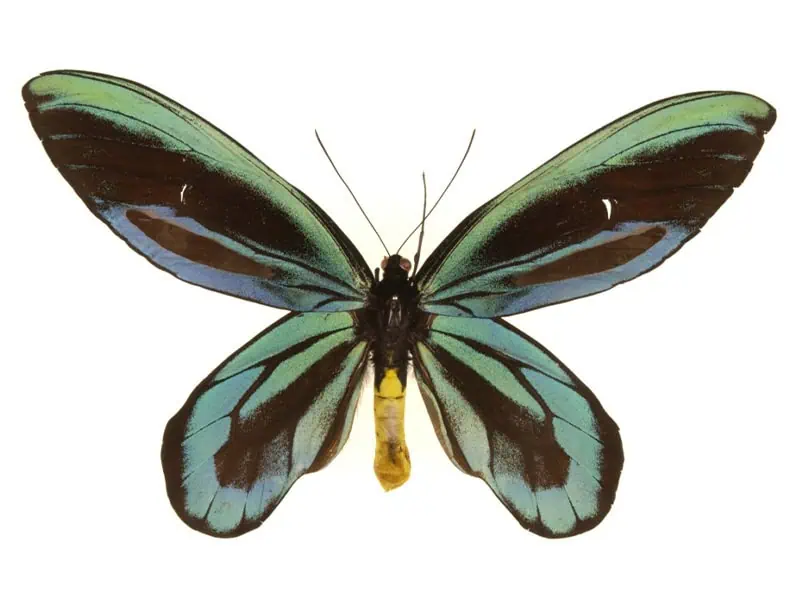
Queen Alexandra’s Birdwing is next on our list of rare butterfly species. Albert S. Meek discovered this species in Papua New Guinea in 1906. He was a naturalist to Walter Rothschild, who named the butterfly after the wife of Edward VII, Queen Alexandra of Denmark.
This beautiful butterfly is native to the open forest in the Popondetta and the remote Managala Plateau in the Northern Province of Papua New Guinea. The female butterflies of this species are larger than their male counterparts.
Male wings are black with large areas of luminous blue or green color and a bright yellow abdomen. Queen Alexandra Birdwing's female forewings are dark brown with seven pale grey and powdered yellow patches.
Queen Alexandra’s Birdwing is an endangered species suffering from habitat loss.
3. Zebra Longwing (Heliconius charithonia)

Zebra Longwing , the state butterfly of Florida, is a neotropical butterfly native to Mexico, Central America, Florida, and some parts of Texas. It has long black wings with bold and narrow yellow stripe and a wingspan of 72 to 100 mm.
It lays eggs on its host plant, the four species of passion flower: yellow passion flower, corkystem passion flower, purple passion flower, and keys passion flower. Zebra Longwing eats flower nectar and pollen, which allows the species to live longer than other species. Most butterfly’s lifespan ends in the second to third week.
Zebra longwing has many unique characteristics. One of these characteristics is that the male mates right before the female when she’s still in her chrysalis. Also, the male butterfly transfers its male repellant to the female butterfly as a warning to other male butterflies to stay away.
4. Lange’s Metalmark (Apodemia mormo langei)

Next on our list of rare butterflies is Lange’s metalmark butterfly. Its flight period starts in early August and goes up until mid or late September. Lange’s metalmark is a small butterfly with a wing length of about 25 mm. Its wing colors are orange and brown, with white spots, while its hindwings are gray-brown.
Lange’s metalmark butterfly is native to a small part of the Sacramento River in the Antioch Dunes National Wildlife Refuge. Its lifecycle, from egg to larvae to adulthood, depends on naked-stemmed buckwheat. The host plants serve as a food source, shelter, and nesting site.
It is a rare species because it is endangered due to habitat destruction. Human activities like mining, construction, and agriculture destroyed the Antioch Sand Dunes and changed its structure from a mosaic of open sand and vegetation to stabilized dunes covered with plants. Lange’s metalmark requires open sand to reproduce well.
5. Bhutan Glory (Bhutanitis lidderdalii)
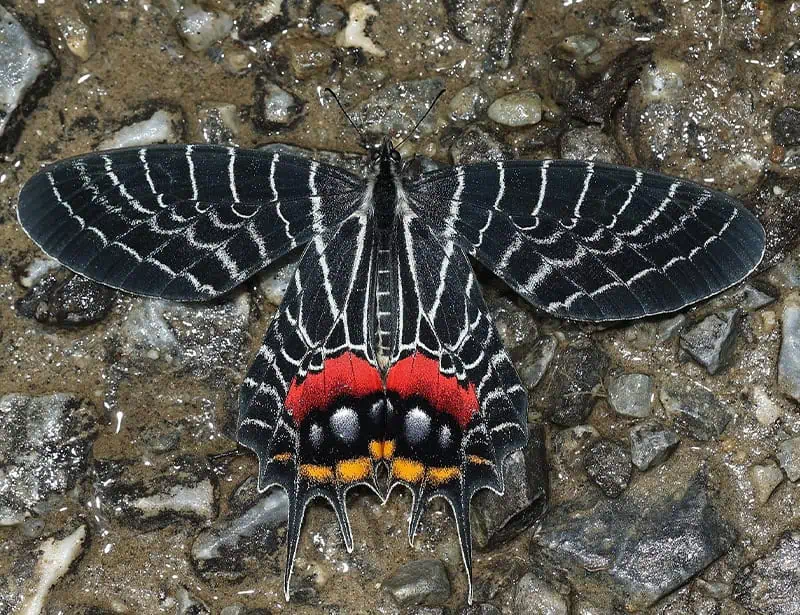
Bhutan Glory is an endangered butterfly native to the eastern Himalayas (north-eastern India and Bhutan) and the Hengduan Mountains (south-western China and Myanmar). There are four subspecies of Bhutan glory: Ludlow’s Bhutan Glory, Mansfield’s Bhutan Glory, and Chinese Bhutan Glory.
Ludlow’s Bhutan Glory population is endangered because of habitat destruction. Fortunately, the Eaglenest Wildlife Sanctuary is taking conservation steps to protect the species from extinction.
6. Luzon Peacock Swallowtail (Papilio chikae)
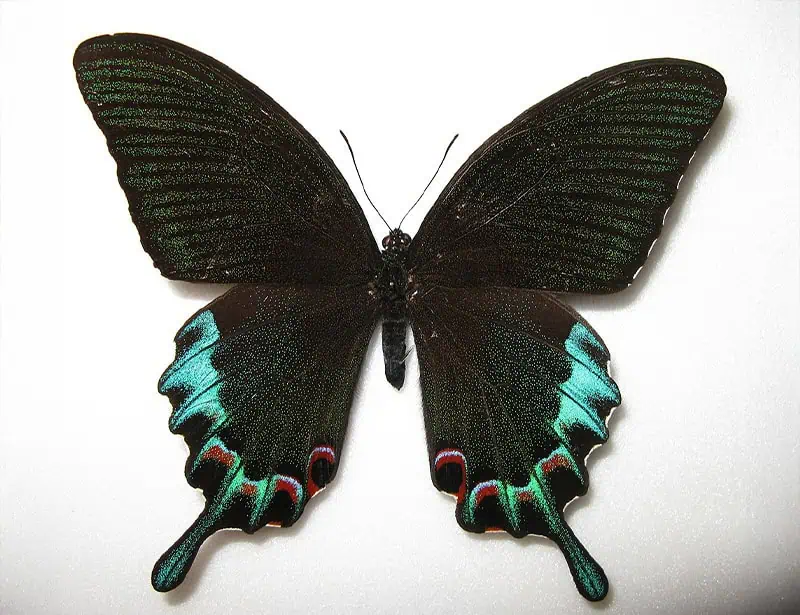
Next on our list of rare butterflies is the Luzon peacock swallowtail. This beautiful long-tailed butterfly is native to Luzon, northern Philippines, and has green-black, red, and purple colors.
It flies at elevations above 1,500 meters. You can see Luzon peacock swallowtails in summer, from mid-April to November, and in spring, from January to early April. They look slightly different in varying seasons. They have brighter colors in spring, while they look larger in summer.
According to the IUCN Red List, the Luzon peacock swallowtail is endangered. Unlike some butterflies, the species flies slowly, making it easy for commercial butterfly collectors to target it. Another cause of its endangered status is habitat loss. The forests do not have legal provisions to protect them from logging.
7. Leona’s Little Blue (Philotiella leona)
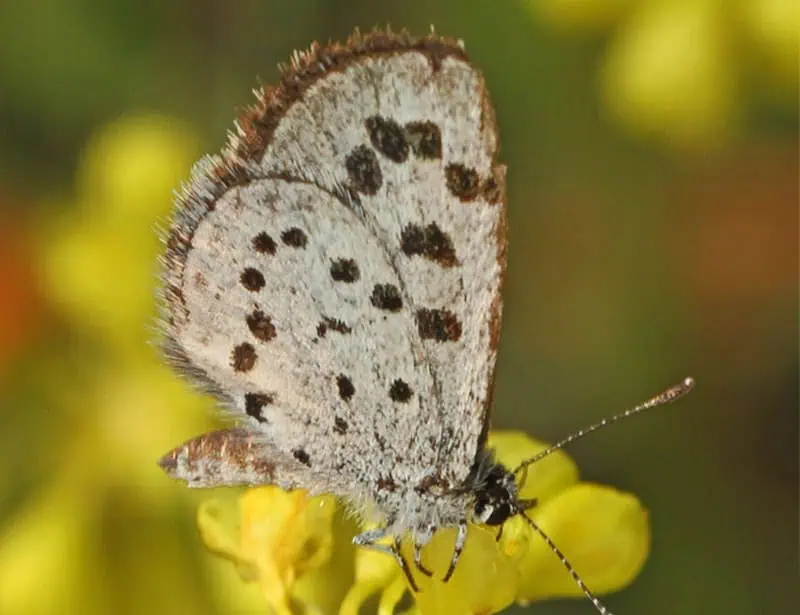
Leona’s little blue butterfly is one of the rarest butterflies in the world. It is a small butterfly with a 0.75-inch wing width. Leona’s Little Blue is native to Klamath County, Oregon, United States, and is the only butterfly endemic to Oregon. You can only find it in a specific area in Oregon: six square miles of ash-pumice habitat southeast of Crater Lake.
Leona’s Little Blue host plant is spurry buckwheat. The females are dark brown with black spots on their off-white dorsal wings. They also have white fringes at the tip of their wings. Conversely, the males have a dusky blue color with darker wing borders.
Despite its small population, the Leona’s Little Blue butterfly is not listed as endangered. In 2015, the U.S. Fish and Wildlife Service started a 12-month petition to list it as endangered or threatened. However, they announced that the listing was unnecessary.
8. Menelaus Blue Morpho (Morpho menelaus)
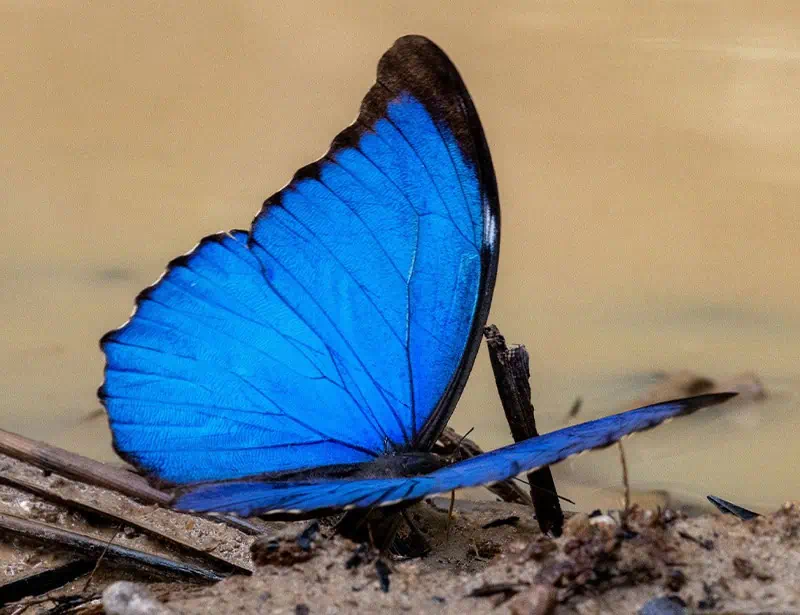
Blue Morpho butterfly is next on our list of rare butterflies worldwide. It is one of the largest butterflies in nature. It is native to the rainforests of Central America, Mexico, and South America. The blue morpho is a beauty with iridescent blue wings and black borders. The underside of their wings is dull brown with black eyespots.
The underside acts as a camouflage and protects them from predators. Their wingspans can reach up to 20 cm. They fly in open areas like trails, forest edges, paths, and river edges. There are over 11 subspecies of these rare butterflies. Blue morpho’s wings comprise a million tiny, overlapping scales arranged in a diamond-like pattern.
Males' wings have a brighter color and are wider than the females. Blue morphos live for 115 days, starting their lives as caterpillars feeding on plants from the pine family. A unique feature of this beautiful species is its cannibalistic nature. Blue morpho’s larvae eat each other.
Scientists believe this blue animal is a way to control the population with limited resources. As adult butterflies, they abandon their cannibalistic ways and consume the juice from rotten fruits, decomposing animals, tree sap, fungi, and wet mud.
9. Palos Verdes Blue (Glaucopsyche lygdamus palosverdesensis)

The Palos Verdes blue butterfly is a subspecies of silvery blue butterfly. It is one of the rarest butterflies native to the Palos Verdes Peninsula in Los Angeles County, California. The IUCN listed it as endangered in 1980 because of habitat destruction, climate change, and non-native plant invasion.
Male Palos Verdes blue butterflies have a silver-blue dorsal wing with a narrow black edge, while females have a brownish-gray upper side wing. They are small butterflies, measuring one inch from one wing tip to the other. They prefer habitats around coastal sage scrub. Furthermore, they have two host plants: locoweed and common deerweed.
10. Miami Blue (Cyclargus thomasi bethunebakeri)
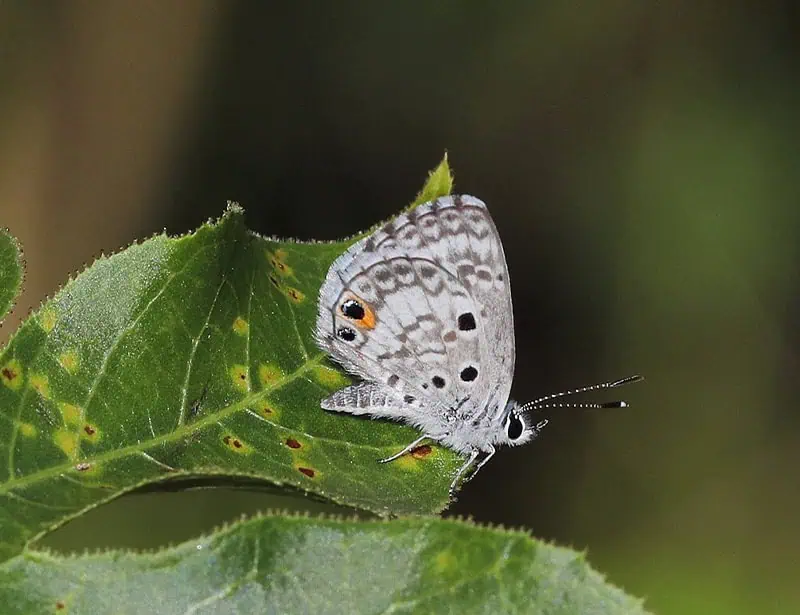
Miami Blue is a rare butterfly native to Florida, particularly the Key West and Great White Heron National Wildlife Refuges in the Florida Keys. It is one of the most endangered butterflies in the United States.
The Florida Keys contain over 1,000 small islands, home to Miami Blue’s host plants: grey nickerbean and keys blackbead. It also needs nectar flowers like the scorpion tail and snow squarestem to survive.
Miami Blue used to be an abundant beauty until Hurricane Andrew hit South Florida in 1992. The butterfly species was not sighted again until 1999. It is the rarest butterfly in North America. Researchers are studying the ecology of Miami Blue to learn how to secure its return to the wild safely.
11. Island Marble Butterfly (Euchloe ausonides insulana)
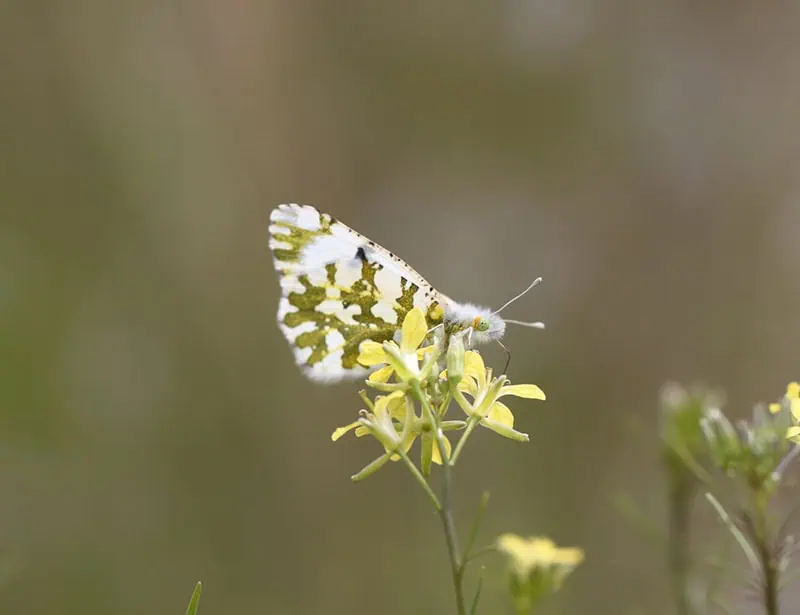
The island marble butterfly is next on our list of rare butterflies. It is native to the San Juan Islands, Washington State. The species' preferred habitats are open grasslands, native prairie, fields, pastures, gravel pits, lagoon margins, marine beaches, and dunes.
Island marble butterflies are about 1.75 inches long. They lay eggs on flowers from filed mustard, tall-tumble mustard, and Menzies pepper-grass plants. Larval survival is about 6% because of predators like deer, human disturbances, and spiders. They spend 300 to 334 days in a chrysalis.
12. Schaus’ Swallowtail (Papilio aristodemus)

Schaus’ swallowtail is among the rarest butterflies in the United States and South Florida. The critically endangered species started going extinct in 1924 because of habitat loss, insecticide use, over-collection, and housing development. A few hundred existed in 1972 until a local mosquito control district sprayed insecticides, Dibrom and Baytex.
The population bounced back to 600 in 1994 after Hurricane Andrew hit the Biscayne National Park in 1992. Reintroduction programs and consistent rainfall increased the Schaus' swallowtail population to 1400 until drought and hurricane George hit South Florida in 1998. Now, we have about 230-190 of them left.
13. Ruddy Daggerwing (Marpesia petreus)

Ruddy Daggeerwing is a rare butterfly native to Florida, Mexico, the West Indies, Central America, and South America. Its upper wings are bright orange with black outlines, while the underside is brown and black.
Its elongated wings measure up to 4 inches from tip to tip. It prefers habitats like hammock edges, swamps, and tropical hammocks. The species lay eggs on short-leaf figs and strangler figs.
Conclusion
Butterflies are unique species highly vulnerable to extinction. We need to begin conservation efforts in earnest, as these species are crucial to our ecosystem.
Glossary Terms:
Jen’s a passionate environmentalist and sustainability expert. With a science degree from Babcock University Jen loves applying her research skills to craft editorial that connects with our global changemaker and readership audiences centered around topics including zero waste, sustainability, climate change, and biodiversity.
Elsewhere Jen’s interests include the role that future technology and data have in helping us solve some of the planet’s biggest challenges.
Fact Checked By:
Isabela Sedano, BEng.
