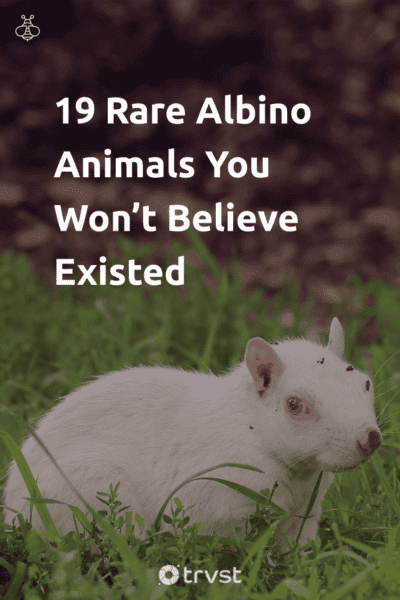
19 Rare Albino Animals You Won’t Believe Existed

Albinism is a genetic condition affecting humans and animals, making them have pale skin, yellow or white hair/fur, and pink eyes. These ghostly-looking creatures are rare, but almost all animal species can have this mutation. In this article, we will show you rare albino animals that have existed.
Table of Contents:
Understanding albinism in animals
But first, what exactly is albinism? It is a hereditary condition parents pass on to their offspring. It is usually a recessive trait, so two non-albino parents carrying the albino gene can produce albino offspring. Albinism causes a lack of the primary biological pigment, melanin, which gives organisms their colors. This genetic disorder affects humans and animals–most mammals, insects, and birds. It also affects plants in the sense of chlorophyll absence1.
That an animal is white, like the Arctic fox, beluga whale, and silkie chicken, doesn't mean it has albinism. That's just their natural coloring.
Some other conditions are commonly confused with albinism. Leucistic animals, for example, can be completely white or have pale yellow coloration. However, a leucistic animal will have dark eyes, while a true albino animal will have pink or red eyes. In humans, the pink eye rule doesn't always apply.
Although there are different types of albinism, partial albinism is still debatable. People sometimes refer to an animal that is unusually lighter than what is typical for its species as a partial albino.
Learn a little about pigmentation in animals.
There are different types of melanin. Pheomelanin produces light reds and blondes, while eumelanin is responsible for dark browns and black pigment. An individual's coloring depends on the type and amount of melanin they possess.
Although most animals, especially mammals, have only melanin, some species have other pigments. Many animals also exhibit structural colors. For example, bluebirds are blue because they have tiny air sacs in their feathers that scatter light; otherwise, they would appear black.
The pink coloration of an albino animal’s skin, eyes, scales, etc., comes from blood vessels showing through the skin. Their hair or fur may be pure white or yellow. If an albino animal has biological pigments other than melanin, it will show some color.
Life for albino animals in the wild
For most animals, color is a functional feature. They use it to hide from predators, hunt, attract a mate, or communicate. An albino animal would likely face challenges in whatever area its species typically relies on body pigment.
Hunting difficulties
For most predators, stealth through camouflage is essential for successful hunting. But the bright color of an albino predator would be a dead giveaway from a mile off, making it hard for such predators to catch prey and feed.
Easy prey
For an albino of the prey species, hiding among their habitat's green or brown environment would be impossible. A herd often abandons albino animals because they put the other animals at risk. However, albino animals are sometimes not recognized as prey because of their strange appearance.
Finding a mate
Vivid colors are the primary qualifications for attracting a mate in some species, like lizards and birds. Animals with albinism may not find a mate easily or at all. Inbreeding is often a factor in animal albinism because, in small populations where choices are limited, albinos are likely to find mates.
Sensitive skin
Albinos in the wild lack melanin to protect them from harmful ultraviolet rays of sunlight. They can quickly develop severe sunburn, heat stress, and skin cancer. Sensitivity to sunlight presents a complex problem for cold-blooded albino animals. They naturally need to bask in the sun to function normally, but the exposure could be fatal.
Poor eyesight
Melanin is important for clear sight; albinos tend to have sight problems. Melanin helps the eye muscles develop properly and absorbs scattered light in the eyeball. Albino eyes struggle to filter light properly, leading to issues with depth perception.
Many albino animals are kept in captivity as they typically have a lower quality of life in the wild than their pigmented counterparts. Albino pets usually have many health problems and need special expert attention.
19 Albino Animal Sightings
Although every species can produce an individual with albinism, they are still rare.
Here are some examples:
1. Albino gorilla

In 1966, an albino Western lowland gorilla named Snowflake was taken from Equatorial Guinea and moved to the Barcelona Zoo in Spain. He is the only known albino gorilla. Sadly, Snowflake was euthanized in 2003 after he developed a rare type of skin cancer.
In 2013, genome sequencing revealed that Snowflake resulted from inbreeding3. The discovery surprised scientists because inbreeding is uncommon among these types of gorillas.
2. Albino alligators
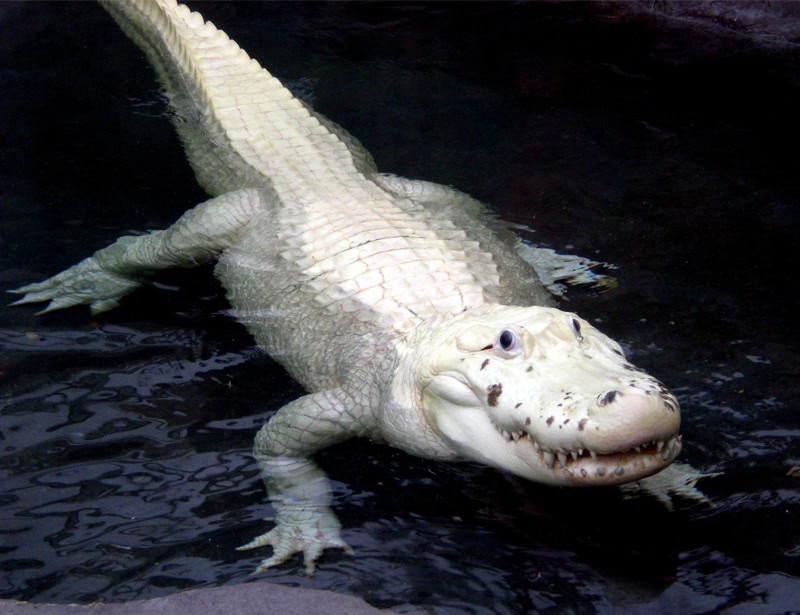
White mutated alligator species are not uncommon; you are more likely to find an albino alligator than a leucistic one. Many experts estimate around 100 to 200 albino gators in the wild. Zoos and wildlife organizations in the United States house a few of them.
The California Academy of Sciences has one named Claude. A family of albino gators lives at Wild Florida and Kenansville, and another lives at the New Orleans Audubon Zoo and Audubon Aquarium.
3. Albino squirrels

Leucistic squirrels are more common than true albino squirrels. Take note that there are also true white squirrel species in some parts of Southeast Asia and other places have white color variants of the local species.
You will find white North American Eastern grey squirrels colonies in Brevard, North Carolina; Marionville, Missouri; Kenton, Tenn; and Exeter, Canada. True albinos are not uncommon in colonies of white-coated squirrels.
4. Albino snakes

It's easy to find records of albino snake sightings on the Internet. Notably, most of them retain some color due to having sources of biological pigment other than melanin.
Arizona State University cared for a Western diamondback rattlesnake named Hector, who died at the age of 25 in 2019. An escaped golden yellow albino python pet made the news after someone recaptured it in Oklahoma recently. There were also sightings of albino boas, keelbacks, and Indian kraits in India.
5. Albino tortoises
There are not many records of albinism in tortoises. There are mentions of Albino Sulcata tortoises, but they have yet to be officially confirmed.
In 2022, an albino Galapagos giant hatched in a zoo in Switzerland, causing a stir worldwide. It was the first time the world had seen such a rare animal. Its body and shell were yellow instead of black, like pigmented Galapagos giants.
6. Albino turtles

In 2016, members of the Coolum and North Shore Coast Care spotted an albino green turtle hatchling making its way to the ocean on a beach in Queensland, Australia. Recently, two wildlife photographers discovered an albino Indian4 flap-shell turtle in southern India.
Experts say albino turtles are so rare that the chances are 1 in about 100,000 turtle eggs. Albino Red-Ear Slider turtles seem more common, as you can find them at several online pet stores.
Related Read: Tortoise vs. Turtle.
7. Albino deer

The white deer is spiritually significant in cultures. People often confuse leucistic or piebald deers as albinos. The Seneca white deer may be pretty difficult for a casual observer to categorize. But a true albino white deer is distinguished by its pink eyes.
Sightings of deer species with this mutation are pretty uncommon. One is a young albino deer discovered by researchers in a conservation area in a deforested region of the Brazilian Amazon jungle2.
8. Albino hedgehog

People have discovered a handful of hedgehog species with albinism over the years. A particularly moving story was when a 6-year-old boy rescued a dying albino hedgehog in Otley, West Yorkshire.
Hedgehogs are one of the few animals whose albinos seem to do well in the wild. Their light-colored coats quickly get dirty, helping them blend in and hide from predators. Also, since these prickly creatures rely more on their sense of smell than sight, the eye problems brought on by albinism aren't much of an inconvenience.
9. Albino monkeys
Albino monkeys are fascinating to observe since the mutation doesn't slow them down; they're just as mischievous and hardy as any other types of monkey. Vision research using an adult albino male capuchin monkey found that the monkey could see as clearly as its pigmented counterparts.
The first report on albinism in Central American spider monkeys came from eastern Honduras in 2016. In 2017 and 2019, observers spotted albino François's langurs monkeys in the mountains of Guangxi, China.
10. Albino birds

If you are not a bird expert, you might have difficulty differentiating an albino bird from any other naturally white bird. Some albino birds might even show some colors from sources other than melanin. You'll need to get close enough to observe the pinkish eyes to know if you're looking at an albino, a leucistic, or a white bird.
Some reported sightings occurred in bird species such as the Chirping Sparrow, the ruby-throated hummingbird, and the blackbird.
11. Albino zebras
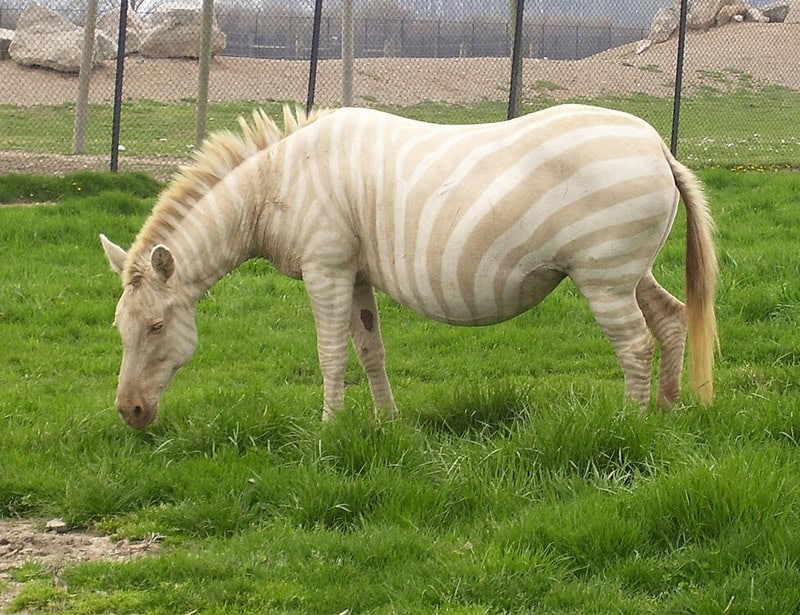
There are many unofficial reports of albino zebra sightings, many of which may not be true albinos. Ndasiata, a zebra at the Serengeti National Park in Tanzania, is regarded as a prime albino zebra specimen. Mutated zebras still have stripes, but they're very faint. Interestingly, Ndasiata's stripes are barely visible.
Unlike other animals, albino zebras may benefit from albinism. Their tan or dusty white bodies can easily fade into the background of their dusty brown environment.
12. Albino raccoon

Experts say only one in every 750,000 raccoons is an albino. So it was an uncommon treat when a Windsor-Essex resident found two of them in his backyard.
Albino raccoons have very slim chances of survival in the wild. The Cleveland Museum of Natural History adopted Meeko, an albino raccoon rejected by its mother. Recently, Game Commission wardens rescued an albino raccoon with its pigmented siblings after maternal abandonment in Somerset County.
13. Albino buffalos
White buffaloes are some of the rarest animals; the chances of one being born are 1 in 10 million. Albino buffalos are even rarer. One albino buffalo in Thailand is so famous that the country's prime minister visited it.
The National Buffalo Museum (now North American Bison Discovery Center), Dakota, cared for White Cloud, a female albino bison, until she died in 2016. While she was alive, White Cloud was something of a celebrity.
14. Albino dolphins
A newlywed couple and their families were on a boat ride in Algoa Bay, South Africa, when they encountered an albino bottlenose dolphin calf. It was swimming alongside its mother with its eyes closed–probably due to light sensitivity,
In 2017, an albino Risso's dolphin was swimming with its mother near Moss Landing, Monterey Bay, California. On the other side of the Pacific Ocean, Angel, an albino bottlenose dolphin displayed at the Taiji Whale Museum, is the world’s only albino dolphin in captivity.
15. Albino ferrets

Ferrets are a popular pet choice because of their playful yet easygoing nature. An albino ferret is no more high maintenance than a regular ferret. They would only need less time in the sun to protect their eyes. They have white to cream fur during infancy that can become more yellow with time. The yellowing is due to the oils that the animal naturally secretes.
16. Albino donkeys
The Asinara is a wild donkey living on the island of Asinara, on the northwest coast of Sardinia, Italy. A sizable percentage of these donkey species are albinos; even a few gray donkeys may carry the albino gene.
Their white coats and pinkish-blue eyes make albino Asinara donkeys irresistibly cute. The albino donkeys of Asinara draw curious visitors from all over the globe, making the island a popular tourist destination.
17. Albino lobsters
Albino crustaceans are extremely rare. But a few individuals have been lucky enough to see them, beating the odds of 1 in 100 million.
Back in 1988, a couple made the news of finding a giant albino lobster in Prince Edward Island, Canada. In 2014, two fishermen in Maine caught not one but two albino lobsters in a single week. In 2021, a lobster company in Boston caught an impressively large albino lobster.
18. Albino guinea pig
It's challenging to identify an albino guinea pig just by looking because some species, like the Himalayan guinea pig, naturally have pink eyes and primarily white coats. Many argue that red, pink-eyed, and lethal white species are indeed albinos, while some say otherwise. The term albino guinea pig is used freely in scientific documentation, so there's reason to believe they exist.
19. Albino skunk

The albino skunk is so famous that they named a South Carolina music festival after it. However, the animal's popularity might end there because it lacks the telltale stripes that signal people and other animals to avoid it. Thus, unassuming passers-by may get skunk-sprayed.
Conclusion
Albinism is a genetic condition that causes a lack of melanin pigment. Not all white animals are albino, and genetic testing is the only way to be sure. However, having pink eyes is a good indication.
Most species in the animal kingdom rely on their colors to escape predators, hunt, and attract a mate. So, life in the wild can be harsh for albino animals. Lack of melanin also leaves their skin vulnerable to harmful UV rays. However, these animals have proved themselves resilient, some living almost their entire lifespan.
Glossary Terms:
| 1 | Silva, L. a. S., Sampaio, V. F., Barbosa, L. C. S., Machado, M., Flores‐Borges, D. N. A., Sales, J. F., De Oliveira, D. C., Mayer, J. L. S., Kuster, V. C., & Rocha, D. I. (2020). Albinism in plants – far beyond the loss of chlorophyll: Structural and physiological aspects of wild‐type and albino royal poinciana (Delonix regia) seedlings. Plant Biology, 22(5), 761–768. |
| 2 | Ribeiro, R., & De Siqueira-Silva, D. H. (2020). First report of complete albinism in Mazama americana (Erxleben, 1777) in the Biological Reserve of Tapirapé, Oriental Amazon, Brazil. Acta Scientiarum. Biological Sciences, 42, e46734. |
| 3 | Prado-Martinez, J., Hernando-Herraez, I., Lorente-Galdos, B., Dabad, M., Ramirez, O., Baeza-Delgado, C., Morcillo-Suarez, C., Alkan, C., Hormozdiari, F., Raineri, E., Estellé, J., Fernandez-Callejo, M., Valles, M., Ritscher, L., Schöneberg, T., De La Calle-Mustienes, E., Casillas, S., Rubio-Acero, R., Melé, M., . . . Marques-Bonet, T. (2013). The genome sequencing of an albino Western lowland gorilla reveals inbreeding in the wild. BMC Genomics, 14(1). |
| 4 | Vittapu, M. K., Poshetty, S. K., Sailu, G., & Narayana, L. (2022). An albino Indian Flap-shelled Turtle, Lissemys punctata (Bonnaterre 1789), from Telangana, India. Reptiles & Amphibians, 29(1), 225–226. |
Jen’s a passionate environmentalist and sustainability expert. With a science degree from Babcock University Jen loves applying her research skills to craft editorial that connects with our global changemaker and readership audiences centered around topics including zero waste, sustainability, climate change, and biodiversity.
Elsewhere Jen’s interests include the role that future technology and data have in helping us solve some of the planet’s biggest challenges.
Fact Checked By:
Isabela Sedano, BEng.