
17 Pygmy Animals From Elephants To Seahorses

Pygmy animals are significantly smaller than any of their relatives within the species group. Even though they lack in size, their condition results from their adaptation to their environment. This article explores 15 pygmy species around the world, from giant elephants to tiny seahorses.
17 Pygmy Species Around The World
Look at these adorable but mighty versions of animals:
1. Borneo Pygmy Elephant (Elephas Maximus Borneensis)

Pygmy elephants are smaller than the elephants we are used to seeing. The Borneo pygmy elephant is the smallest subspecies of the Asian elephant. The pygmy species is also one of the least-studied elephant species in the world.
Borneo pygmy elephants weigh 2,950 kg to 5,000 kg and grow up to 3 m tall. They are native to the island of Borneo. About 300,000 years ago, the species was isolated from its mainland cousins, causing its evolution into pygmy elephants3. They became smaller, growing ears and tails larger than their bodies.
The Borneo pygmy elephant is endangered due to habitat loss. About 60% of the forest habitats have been lost to logging and commercial agriculture (palm oil). There are about 1000 pygmy elephants left4, 400 of which are breeding adults.
2. Pygmy Seahorse
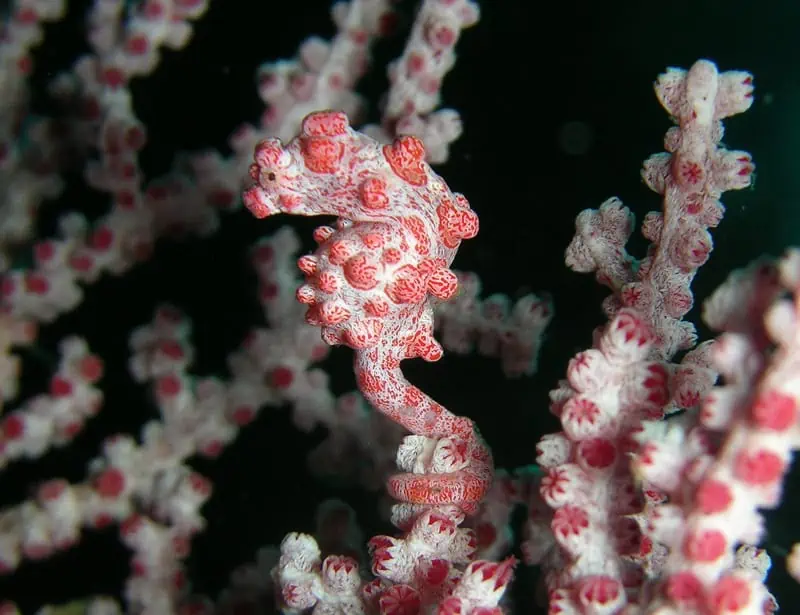
Pygmy seahorses are tiny fish discovered accidentally by George Bargibant in 1969. Found on a piece of gorgonian coral collected for the Noumea Aquarium in New Caledonia, the first pygmy seahorse was aptly named Hippocampus bargibanti before the marine biologist.
It has a rounded spine above its eyes and on each cheek. Its snout is short and rounded like a knob coronet. It also has irregular bulbous tubercules on its body. Bargibanti pygmy seahorse has two colors: pale gray or purple with pink or reddish tubercles and yellow with orange tubercles. They are also challenging to see with our bare eyes since they stop growing once they reach 2 - 2.7 cm.
Post the new millennium, eight other pygmy seahorse species were discovered. They are living in the shallow waters of Australia, Indonesia, and Japan. The latest of which are thriving in flat sandy coral reefs in South Africa. A diving instructor first photographed it in 20171.
3. Pygmy Slow Loris (Nycticebus Pygmaeus)

Next on our list of pygmy animals is the pygmy slow loris. This small animal lives in mixed deciduous and evergreen forests in Vietnam, Laos, eastern Cambodia, and the neighboring regions of southern China.
It is smaller than an average squirrel, growing to a maximum of 25 cm long and weighing an average of 400 g. This small primate prefers to stay on tree branches 10 to 40 ft above ground. They are so small they blend into the forest.
A pygmy slow loris is recognized by its large, round eyes and short, dense, wooly coat. Its coat color varies between brown and deep reddish brown, with a gray or white underside. It is a nocturnal animal with a short tail. Pythons, haws, and eagles are the mortal enemies of low lorises8.
4. Pygmy Hippopotamus (Choeropsis liberiensis)

The Pygmy Hippopotamus is native to four countries in West Africa: Sierra Leone, Liberia, Côte d’Ivoire, and Guinea. Pygmy hippos are smaller versions of the hippopotamus. They have a rounder and narrower head than the big hippos. Also, the pygmy hippopotamus is not as aquatic but has adaptations that help it stay in water for a while.
The pygmy hippo has longer legs and feet that are not as webbed as its bigger counterpart. It also has only a pair of incisors, while its large cousin has up to three. The pygmy hippo has thin but smooth greenish-black skin that helps it stay cool in the forests. However, the skin also dries out quickly in the sun.
The skin produces a pink fluid called blood sweat to combat dryness. This fluid gives the pygmy hippo a wet and shiny appearance, protecting it from sunburn—like a built-in sunscreen. Pygmy hippopotamus are herbivorous. The pygmy hippo eats roots, ferns, leaves, and fruits near rivers and streams.
5. Pygmy Rattlesnake (Sistrurus Miliarius)

This type of rattlesnake is native to the southeastern area of the United States. It is a short and thick snake with various markings on its body. A dark line runs through both eyes, a series of circular dark spots runs down the center of the back, and a thin reddish-orange stripe along the mid-body line and dark spots on its belly.
The nominate subspecies, the Carolina pigmy rattlesnake, has a light red or pink pattern that matches the soil in their habitat, while the western pygmy rattlesnake has gray, light red, and light pink patterns.
The former is native to South Carolina, eastern North Carolina, central Alabama, and Georgia, while the latter lives in Alabama, Mississippi, and Louisiana. The last subspecies, Dusky or Barbour's Pigmy rattlesnake, reside in Florida and southern parts of Alabama and Mississippi9.
6. Pygmy Owl (Glaucidium)

Next on our list of small animals is the pygmy owl. There are 29 species of the pygmy owl distributed across North and South America. Some are also native to some areas in Africa and Southeast Asia.
Some of the pygmy owl species are northern pygmy, Costa Rican pygmy, Andean pygmy, Amazonian pygmy, ferruginous pygmy, Central America pygmy, and Colima pygmy owls.
There isn’t much difference between the pygmy owl and the regular-sized owl species. Pygmy owls are about 8 inches long, and the females tend to be bigger than their male counterparts. They eat insects, rodents, frogs, lizards, earthworms, and small birds.
7. Pygmy Tarsier (Tarsius pumilus)
The pygmy tarsier is native to montane cloud forests in the central Sulawesi mountains. It is a small haplorhine primate with large round eyes, ears, long hind legs, elongated ankles, and toes. It also has a long tail length.
A pygmy tarsier weighs an average of 50 g and grows up to an average length of 96 mm. It is the only primate species that is entirely carnivorous. Pygmy tarsiers eat insects, primarily arthropods with keratinized exoskeletons.
The pygmy tarsier spends most of the day sleeping on vertical tree branches and hunts for insects at night. These primates leap from tree to tree and are about 1.2 to 1.7 m long and 0.6 m high11.
8. Pygmy Shrew

The pygmy shrew is a small mammal with tiny eyes, a large nose, and tiny ears. It has dark brown fur on its back and a gray or silver underbelly. Its tail is about the same length as its body. The body length of a pygmy shrew is between 4 to 6 cm, while the tail length is 3 to 4.5 cm.
The pygmy shrew weighs a maximum of 6 g. The three pygmy shrew species are the Eurasian pygmy shrew, the American pygmy shrew, and the Etruscan pygmy shrew. Eurasian pygmy shrew is native to northern Iberia12, the British Isles, continental Europe, Siberian, and Russia, while the American pygmy shrew is native to the boreal regions of North America13.
9. Pygmy Mongoose (Helogale Parvula)

Pygmy mongoose, commonly known as the dwarf mongoose, is Africa’s smallest carnivore. It has a smooth, glossy coat with varying colors. The dwarf mongoose's average body weight is 326 g, and its body length is about 7 to 10 inches. Its tail is as long as its body, measuring 4.7 to 8 inches long.
The pygmy mongoose lives in woodlands, mountain scrubs, and savannahs across Somalia, Ethiopia, East South Africa, and Namibia. These sociable creatures prefer territories with termite mounds, woody vegetation, and rock crevices.
10. Baluchistan Pygmy Jerboa (Salpingotulus michaelis)
Next on our list of pygmy animals is the Baluchistan or Three-toed pygmy jerboa. The world’s smallest rodent grows about 4.3 cm long and weighs 3.2 g. Its tail is longer than its body, reaching 8 cm.
The Baluchistan pygmy jerboa lives in dunes, hot desert plains, and gravel flats across Pakistan and Afghanistan. This nocturnal species experiences daily facultative hypothermia, which helps it survive on low-nutrient food.
11. Pygmy Nuthatch (Sitta pygmaea)

Pygmy nuthatch is a tiny bird with a large head, barely visible neck, straight and sharp bill, and short legs. It has short but broad wings and a short, square-shaped tail. The bird weighs 9 to 11 grams and grows 9 to 11 centimeters long.
It has bluish-gray plumage with a brown crown and pale nape. Its throat is white, and its underbelly is creamy. These friendly creatures hunt and live in Ponderosa, Monterey, and Jeffery pine trees.
They roost in groups during cold winter nights in western North America. Found along the Pacific coast from Baja to southern British Columbia and Mexico, they live up to 6 years in the wild, mainly surviving on seeds, insects, and nuts. Unfortuntately, pygmy nuthatch species are at risk because of habitat destruction by natural and human causes7.
12. Pygmy Rabbit (Brachylagus idahoensis)

The pygmy rabbit is next on our list of pygmy animals. It is the smallest species of rabbit in North America. Short ears, tiny hind legs, and dusky gray fur characterize its diminutive stature. The pygmy rabbit depends on sagebrush and sagebrush-steppe habitats for food and shelter.
Pygmy rabbits weigh between 398 g and 436 g and grow about 29 cm long. Their tails can grow up to 24 mm long. Female pygmy rabbits are often larger than their male counterparts. Pygmy rabbits are the only rabbits that dig their burrows.
The pygmy rabbit is endangered due to habitat loss and predators like coyotes, foxes, owls, bobcats, badgers, and weasels. When scared or alarmed, pygmy rabbits squeal and make other vocalizations like squeaks and chuckles5.
13. Pygmy Marmoset (Callithrix Pygmaea)

The pygmy marmoset is a New World monkey species native to the Amazon Basin of Brazil, Columbia, Ecuador, and Peru. It is the world’s smallest monkey, with an average weight of 124 g and a body length of 13 cm10. It has a grey coat with yellow, green, or black marks on the head and back.
There are only two species of pygmy marmoset, Callithrix pygmaea niveiventris and Callithrix pygmaea pygamaea. Female marmosets are often larger than their male counterparts. The pygmy marmosets are exudative, eating tree gum, sap, or resin.
Cats, hawks, snakes, and harpy eagles are major predators of the pygmy marmoset. Fortunately, these monkeys can turn their heads backward, enabling them to spot predators faster.
14. African Pygmy Hedgehog (Atelerix albiventris)

The African pygmy hedgehog is a wild, solitary, and nocturnal animal native to Central, East, and West Africa. It is an omnivore that eats spiders, insects, bird eggs, and plants.
Also known as the four-toed hedgehog, this species has an average weight of 600 g. It has a short tail and a round body low to the ground. Like its bigger counterpart, it can contract its muscles and roll into a ball shape, forcing quills out of its back when threatened.
Pygmy hedgehogs are subjected to habitat loss due to illegal pet trade6. To some humans, pygmy hedgehogs make great pets. The United States banned the hedgehog pet trade, ensuring their safety within the confines of their African habitat.
15. Pygmy Blue Whale (Balaenoptera musculus brevicauda)
Even the leviathan blue whale has a mini version: Meet the pygmy blue whale. This subspecies, found in tropical waters stretching from the sub-Antarctic zone to the southern Indian Ocean and the southwestern Pacific, is a sight to behold.
The pygmy blue whale's shorter tail and heavier build distinguish it. This unique structure changes its diving behavior, allowing it to submerge its dorsal fin and tail simultaneously. Aside from their tadpole-shaped body, they also tend to be darker.
16. Pygmy Chameleons (Rhampholeon)

The pygmy chameleon, a resident of East and Central Africa, represents 25 distinct species. The Beraducci's pygmy, the smallest of these, boasts a mere 1.1 inch length from snout to vent. Conversely, the Marshall’s pygmy chameleon is the largest, measuring up to 3 inches.
These hardy reptiles bear a significant burden, facing threats from habitat changes and the international pet trade. One latest comeback story is promising. The mysterious Chapman’s pygmy chameleon, roughly the size of a golf tee, vanished from sightings since its discovery in 1992 until unexpectedly reappearing in 20162.
17. Pygmy goats
Pygmy goats, initially known as the Cameroon Dwarf goat, are from Cameroon in West Africa. They were exported from Africa to Sweden and German zoos in 1959. A pygmy goat has a full coat of slightly long hair, which varies in density according to the seasons.
A pygmy goat depends on hay, grain, fruits, leaves, grass, shrubs, and vegetables for survival. Female pygmy goats weigh between 40 - 70 pounds and are 16 to 22 inches tall, while their male counterparts weigh 50 to 70 pounds and are 16 to 23 inches tall.
Conclusion
There are many unique animals worldwide. Pygmy animals represent a group of significantly smaller and tiny animals. Some of these animals are endangered because of habitat loss and destruction, predation by humans and other animals of prey, and the exotic pet trade.
There are many other pygmy animals, like pygmy mouse lemur, pygmy raccoon, and pygmy possums.
Glossary Terms:
| 1 | Short, G., Claassens, L., Smith, R. E., De Brauwer, M., Hamilton, H., Stat, M., & Harasti, D. (2020). Hippocampus nalu, a new species of pygmy seahorse from South Africa, and the first record of a pygmy seahorse from the Indian Ocean (Teleostei, Syngnathidae). ZooKeys, 934, 141–156. |
| 2 | Tolley, K. A., Tilbury, C. R., da Silva, J. M., Brown, G., Chapeta, Y., & Anderson, C. V. (2022). Clinging to survival: Critically Endangered Chapman’s pygmy chameleon Rhampholeon chapmanorum persists in shrinking forest patches. Oryx, 56(3), 451–456. |
| 3 | Fernando, P., Vidya, T. N. C., Payne, J. C., Stüewe, M., Davison, G., Alfred, R., Andau, P., Bosi, E. J., Kilbourn, A. M., & Melnick, D. J. (2003). DNA analysis indicates that Asian elephants are native to Borneo and are therefore a high priority for conservation. PLOS Biology, 1(1), e6. |
| 4 | McLean, E.A., Goossens, B., Cheah, C., Ancrenaz, M., Othman, N.B., Sukmantoro, W., Fernando, P., Vidya, T.N.C., Menon, V. & Lister, A.M. 2024. Elephas maximus ssp. borneensis. The IUCN Red List of Threatened Species 2024: e.T237597413A237597422. Accessed on 12 September 2024. |
| 5 | Rohde, A. 2006. "Brachylagus idahoensis", Animal Diversity Web. |
| 6 | Nichols, J. 1999. "Atelerix albiventris", Animal Diversity Web. |
| 7 | Kieliszewski, J. 2003. "Sitta pygmaea", Animal Diversity Web. |
| 8 | Gray, M. 2011. "Nycticebus pygmaeus", Animal Diversity Web. |
| 9 | Stamm, R. 2017. "Sistrurus miliarius". Animal Diversity Web. |
| 10 | Wade, E. 2012. "Callithrix pygmaea", Animal Diversity Web. |
| 11 | Ford, T. 2011. "Tarsius pumilus", Animal Diversity Web. |
| 12 | Mutchler, S. 2011. "Sorex minutus", Animal Diversity Web. |
| 13 | Wund, M. 2000. "Sorex hoyi", Animal Diversity Web. |
Jen’s a passionate environmentalist and sustainability expert. With a science degree from Babcock University Jen loves applying her research skills to craft editorial that connects with our global changemaker and readership audiences centered around topics including zero waste, sustainability, climate change, and biodiversity.
Elsewhere Jen’s interests include the role that future technology and data have in helping us solve some of the planet’s biggest challenges.
Fact Checked By:
Isabela Sedano, BEng.
