
17 Monogamous Animals That Mate for Life

In the animal Kingdom, you expect to find males and females mating with multiple partners. However, some animals that mate for life have become the poster face for undying love and loyalty.
More than 90% of avian species are monogamous in some way. In contrast, monogamous mammals are just about 3 to 5%2. Monogamous amphibians and fish also exist but are extremely rare.
Clearly, they are rare. They have also confounded researchers for ages. A common assumption was that a pair bond signified sexual exclusivity. However, that isn't usually the case. Gibbons cheat. Dik-diks have no choice. And Anglerfish are literally attached.
Let's take a look at how monogamy works in the animal kingdom.
List of Monogamous Animals That Mate For Life:
Types of monogamous relationships in the animal kingdom

Monogamy is a pair bond between a male and female adult of the same species. Although pair bonding suggests exclusivity, it's rarely that straightforward.
Behavioral ecology studies over the years have revealed that animals practice many types of monogamy.
Astonishingly, you'll find individuals practicing different types of monogamy in many species.
Genetic monogamy
Genetic monogamy is a situation where an animal takes only one mate. It is also called sexual monogamy.
Although it's extremely rare, some animals mate for life, only seeking a new mate when their companion dies.
Some others are only exclusive during the mating season.
Genetically monogamous animals are often socially monogamous, with a few exceptions.
Genetic evidence has revealed that several species previously assumed to mate with only one partner for life are actually just socially monogamous.
Social monogamy
Social monogamy is when two individuals form a bond to raise young, defend territory, etc., but mate with other partners.
Socially bonded pairs may stay together for life or just for the breeding season.
Social monogamy is the most common type of monogamous relationship in animals.
It is primarily observed in birds. It may have evolved because bird embryos develop externally, making them vulnerable. Both parents participate in hatching and caring for baby birds until they become independent.
Facultative monogamy vs obligate monogamy
Some animals are only monogamous because of low population density or high dispersion of females.
Simply put, they are with one partner because they have no options. That's facultative monogamy.
If the population booms or nearby females become abundant, facultatively monogamous species will likely stop being monogamous.
It's the other way around with obligate monogamy. Here, the parents have to cooperatively protect and provide for their offspring.
Such animals remain monogamous regardless of resource or population abundance.
Serial monogamy vs lifelong monogamy
In serial monogamy, animals take a different mate every mating season.
Animals that practice lifelong monogamy stay together until one dies. That doesn't mean complete sexual exclusivity, as extra-pair copulation may still occur.
Fun fact: Bonded animal pairs may divorce for various reasons, including failure to reproduce.
Why do animals mate for life?

Usually, most animals seek out multiple mates to increase their chances of reproductive success.
A female mates with multiple males to increase her chances of conceiving. The male mates with multiple females to increase his odds of continuing his lineage.
It is easy to see why humans practice it—love, bigamy laws, and morality.
Non-human species are not burdened with love, laws, or morals; therefore, they engage in monogamy for its practicality. Different species do it for various reasons. We see some below:
Efficiency
Monogamy might have evolved in many animals because it guarantees the best chances of reproduction. For example, in solitary species with a high dispersion rate, sticking to a partner is more efficient than seeking out multiple options.
Team effort
Additionally, animals mate for life when male care is critical to raise offspring. For instance, with Emperor penguins, the mother stays to protect the chicks from predators and the harsh climate, while the father goes to bring food.
Neural connections
Another reason for monogamy in the natural world is the release of special hormones during mating. These hormones trigger neural connections that produce positive feelings as certain animals engage in monogamy.
List of animals that practice monogamy
1. Swans (Cygnus)

Swans, with their inclination to lifelong bonds, beautiful swan hearts, and striking white plumage, are well-established as symbols of eternal love in many cultures.
Truly, swans stick with one lifelong mate. Trumpeter swans, for instance, form pair bonds at 20 months, even though they don't mate until they're four to seven years old.
One species, the mute swan, is an exception. They can mate with up to four partners at a time and divorce frequently.
On the other hand, true monogamous swans only replace their partners in cases of death or reproduction failure.
2. Gray wolves (Canis lupus)

Gray wolves are the world's largest canines. They live in packs with a rigid social hierarchy led by an alpha male and his mate.
Only the alpha pair is allowed to mate and produce offspring in the pack, although in large packs, males may sneakily mate with females and abscond.
The breeding pair's lifelong monogamous relationship cements their authority and establishes stability within the pack.
When one dies, the surviving partner will find a replacement quickly. Although rare, pair-bonded gray wolves may divorce.
3. Bald eagles (Haliaeetus leucocephalus)
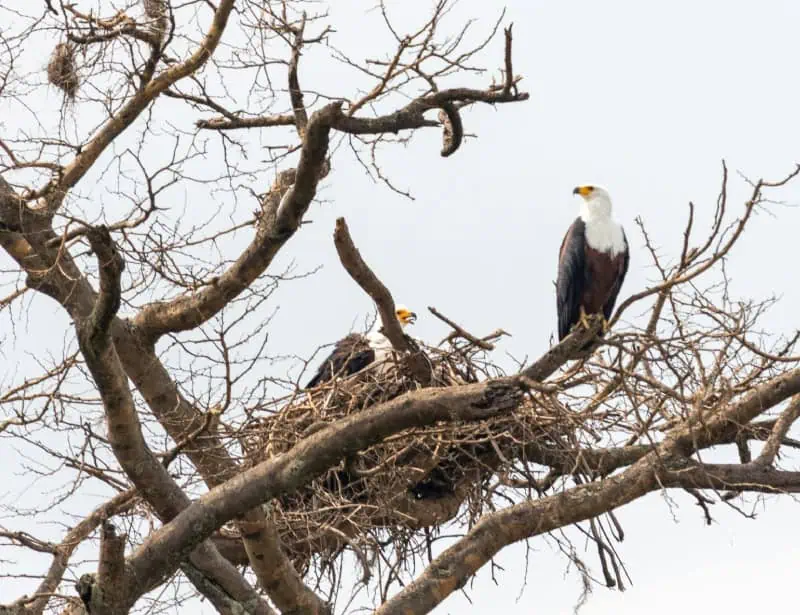
Bald eagles are solitary birds that only seek the company of others during breeding season.
After solitary migration, bald eagles return to the same nesting site, where pairs find each other.
Bald eagles exhibit both social and genetic monogamy. They mate for life, only seeking other mates when their mate dies. Although rare, divorce can occur if reproduction attempts fail.
4. Black vultures (Coragyps atratus)

Despite their ominous look, black vultures are a model example of true monogamy. They exhibit genetic and social monogamy, and their bonds last a lifetime.
Black vultures don't tolerate promiscuity. Individuals caught attempting extra-pair copulation would be attacked.
Male and female black vultures work together to incubate and feed their offspring. Even after leaving the nest, juveniles stay close to their parents, sometimes receiving food.
5. Deep Sea Anglerfish (Ceratioidei)
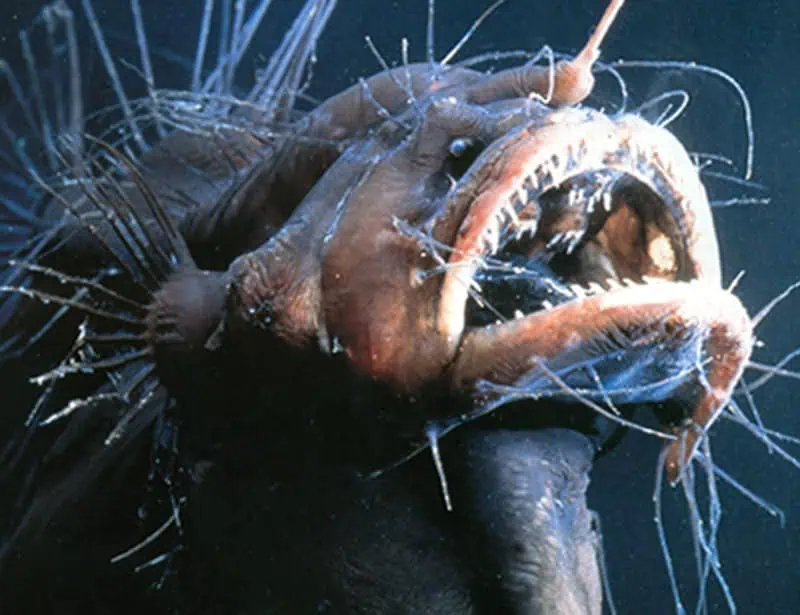
The deep-sea anglerfish provides one of the most unusual forms of monogamy. It's called sexual parasitism.
When the male anglerfish finds a mate, he attaches himself to her with his jaws. Over time, his body fuses completely with hers, and he can fertilize her eggs on demand.
Usually, multiple males, sometimes up to six, will attach to a female. Therefore, the males are monogamous while the females are polygamous.
6. Prairie vole (Microtus ochrogaster)
Male prairie voles end up in a lifelong bond with the first female they mate with.
When males mate at first, their brains release vasopressin, which produces feelings of 'love'. The longer a mating pair stays together, the more hormones are released in prairie vole couples1.
The pair bond is so strong that a male prairie vole will attack other females who try to get close to him. Prairie voles also express grief when their mate dies.
Although prairie voles are mostly sexually monogamous, a few individuals may engage in extra-pair copulation.
7. Sandhill cranes (Grus canadensis)
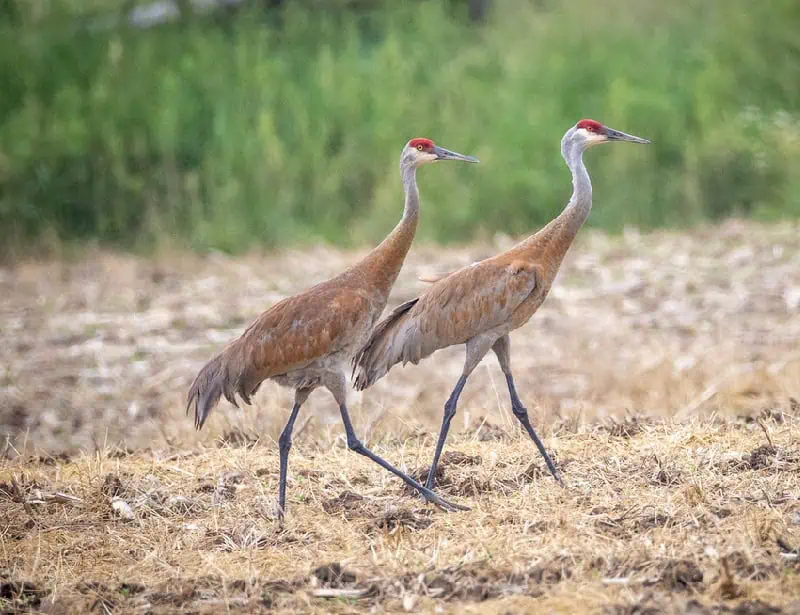
Sandhill cranes are lifelong monogamous birds. They remain together unless one dies or the pair is unable to reproduce.
To attract a partner, single sandhill cranes perform a special courtship dance. However, outside of the breeding season, the birds still do this dance with their partners, strengthening their pair bond.
Sandhill crane couples raise their young together. The female cares for the nest while the male guards against predators. They raise one or two chicks each year and care for them until they are ten months old.
8. Atlantic puffins (Fratercula arctica)

Atlantic puffins are only partially socially monogamous—they spend their winter in solitude. However, during the spring breeding season, they return to the same nest they used last time and nest with the same mate.
Cooperative offspring care is critical as the female puffin lays one egg yearly. The male's primary duty is to guard the nest, but he also takes turns incubating the egg.
The species is typically socially and sexually monogamous. However, some individuals may engage in affairs.
9. Coppery titi monkey (Callicebus cupreus)

The coppery titi or red titi monkeys live in the Amazon rainforest. They practice true monogamy, mating with one individual for life.
These South American monkeys exhibit high social monogamy. They spend most of their free time bonding through grooming, play, and rest.
Mated pairs live and care for their young together. The females nurse the infants, and the males carry them around.
Coppery titi monkeys exhibit mate-guarding behavior. When separated from their mates, they show signs of jealousy or distress.
10. Turtle doves (Streptopelia turtur)

Shy, gentle birds, turtle doves symbolize love and devotion in many cultures. They are genetically monogamous and mate for life.
The male turtle dove attracts a female with an elaborate courtship dance involving chest puffing, head bobbing, and soft purring sounds. Once she joins him in dancing, the pair becomes bonded.
Male and female turtle doves contribute equally to building nests, incubating eggs, and caring for hatchlings.
Fun fact: The 'turtle' in turtle dove comes from the soft "turr turr" sounds they make.
11. Coyotes (Canis latrans)

Coyotes are one of the few mammals that practice strict sexual monogamy. They are entirely faithful to their partners even when cheating opportunities are abundant.
There are no divorces, either. A coyote only finds a new mate when a partner dies.
During estrus, when the female can become pregnant, the male coyote diligently guards his mate, ensuring other males don't come near her.
When his pups are born, he plays an active role in caring for them.
Related Read: Wolf vs Coyote.
12. Dik diks (Madoqua)

Dik-diks are small antelopes native to eastern and southern Africa. They are shy and elusive and live in small groups or in solitude.
Research has shown that dik-diks are facultatively monogamous–their sparse and small population doesn't allow for multiple mates.
Dik-dik couplings happen quickly without much fuss. Partners don't frequently seek each other's company. Male dik-diks take responsibility for protecting the couple's territory but don't actively care for their young.
Related Read: Funniest Animal Names.
13. Gibbons (Hylobatidae)

Gibbons provide a good example of long-term social monogamy without sexual faithfulness.
They usually have a primary partner with whom they raise children and perform their unique musical duets. However, they also seek out at least one secondary sexual partner just because.
Gibbons are opportunistic cheaters and divorcees. A male might leave his partner for a new female if her mate dies or disappears.
14. Eurasian beavers (Castor fiber)

Eurasian beavers are sexually and socially monogamous animals.
They live in small family groups with one breeding pair and their offspring. The offspring include newly born beavers, yearlings, and sub-adults—2-year-olds from another colony. The older family members cooperate to care for the younglings.
When sub-adult Eurasian beavers reach 18 months or two years, they may leave their birth family and join another. They'll help care for younglings until they're mature enough to start their family group.
15. Barn owls (Tyto alba)

Barn owls are the most widespread owl species. They are remarkable nocturnal hunters with sensitive eyes and an acute sense of hearing.
They stay with the same partner throughout their lives. When breeding isn't successful, they divorce. And when a partner dies, the surviving individual will seek a replacement.
Female barn owls incubate their eggs alone, but their partner helps care for the hatchlings. When young barn owls strike out independently, they remain close to their parents for a month to get food and support.
16. Scarlet macaw (Ara macao)
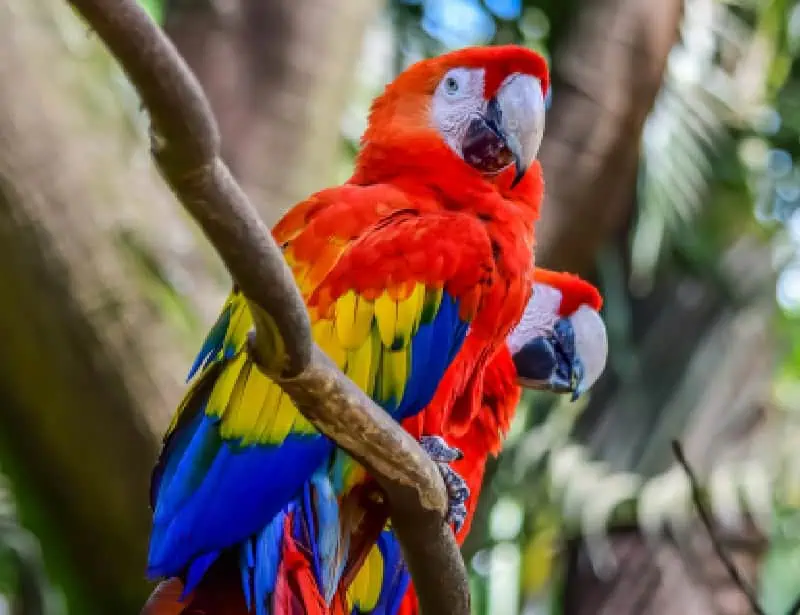
Scarlet macaws are gorgeous birds. Their red, yellow, and blue plumage graces the forests of Central and South America.
They are a genetically monogamous species. Individuals will mate with the same partner for life—that's a long time for a species that can live up to 40 to 50 years in the wild.
Scarlet macaws are not socially monogamous. They freely interact closely with individuals outside their pair bond.
17. Doves and Pigeons (Columbidae)

Doves and pigeons are the ultimate love birds. They stay with the same partner for life, practicing social and genetic monogamy. When one pigeon dies, the surviving partner doesn't seek a new mate quickly.
Parental responsibilities are shared between the bird couples. The males find food and protect the nests while the females nurture the babies.
Conclusion
Although uncommon, some animal species mate for life. Monogamy evolved in response to environmental and biological factors. For them, it is less about morals and more about practicality.
The phenomenon becomes even more interesting when you learn about the different types of monogamy in the animal kingdom.
Glossary Terms:
| 1 | Young, L. J. (2003). The Neural Basis of Pair Bonding in a Monogamous Species: A Model for Understanding the Biological Basis of Human Behavior. In www.ncbi.nlm.nih.gov. National Academies Press (US). |
| 2 | Schuiling G. A. (2003). The benefit and the doubt: why monogamy?. Journal of psychosomatic obstetrics and gynaecology, 24(1), 55–61. |
Jen’s a passionate environmentalist and sustainability expert. With a science degree from Babcock University Jen loves applying her research skills to craft editorial that connects with our global changemaker and readership audiences centered around topics including zero waste, sustainability, climate change, and biodiversity.
Elsewhere Jen’s interests include the role that future technology and data have in helping us solve some of the planet’s biggest challenges.
Fact Checked By:
Isabela Sedano, BEng.
