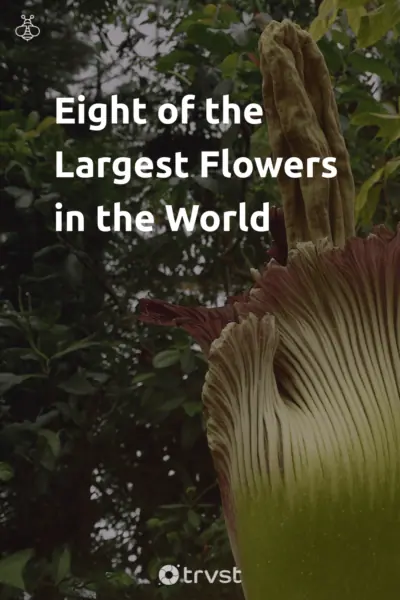
Eight of the Largest Flowers in the World

Flowers have been a significant part of nature since the beginning of time. We all know the beautiful tulips, hyacinths, iris, roses, hydrangea, primroses, and pansies. However, in different parts of the globe, your jaws will drop upon seeing some of the largest flowers in the world. Notable of them all is the stinky rafflesia, which weighs up to 24 pounds.
Join us as we explore not only massive flowers but also humongous flowering plants.
Top Biggest Flower and Flowering Plant Species
Quickly browse these botanical giants below:
1. Stinking Corpse Lily (Rafflesia Arnoldii)

The biggest flower in the world is Rafflesia arnoldii, or stinking corpse lily. It is from the flowering plant family Rafflesiaceae, where the members only exist within the tissues of a host plant as a network of cellular thread-like strands. There are about 42 species of rafflesia flowers, but the stinking corpse lily is the largest of them all.
This parasitic plant has no leaves, stems, or roots. It grows on a woody vine in the genus Tetrastigma as a mass of fleshy strands. Rafflesia arnoldii absorbs nutrients and water from the host plant, which grows from the vines' bark. It is usually undetectable until the flower buds bloom.
It is a thick, fleshy, five-petaled flower weighing about 24 pounds and up to 3.3 feet wide. The stinking corpse lily has a reddish and purplish-brown color with white molted patterns. It also produces berries which contain sticky seeds. It blooms for about 5 to 7 days.
Also known as corpse flower or giant padma, it is native to southeast Asia, including Malaysia and Indonesia. The name comes from its putrid scent that attracts carrion-feeding flies. It smells like rotting meat to attract flies, which helps with its pollination process.
The monster flower can also generate heat in a process called thermogenesis. Thermogenis is rare in plants, except for some species like skunk cabbages. Scientists believe the heat it produces makes its distinctive scent.
The pollen of rafflesia is not like the pollen of typical plants. Pollinators spread the viscous mucous-like pollen, which infects new host plants through the haustorium.
Unfortunately, the International Union for Conservation of Nature listed the rafflesia as endangered due to habitat destruction. They are highly restricted flowering plants and human land use is destroying what's left of their home.
2. Titan Arum (Amorphophallus titanum)

Next on our list of large flowers is Amorphophallus titanum, also known as the corpse flower or titan arum. This herbaceous flowering plant is native to the rainforests of western Sumatra.
It is the largest cluster of flowers that grows on a single stem, reaching over 10 feet tall. It grows from a swollen underground plant stem, which produces a single leaf the size of a small tree.
The underground stem is a food storage structure that helps it reproduce and survive harsh conditions. The leaf grows up to 20 feet tall and has a diameter of 16 feet. Titan arum takes a few years to flower. It goes through several leaf cycles lasting between 8 and 20 years, storing the energy required to produce its first flower.
After the first production of the largest flower, it flowers every three years under the right environmental conditions. Each flower lasts for a maximum of 36 hours. Like rafflesia, the largest flower in the world, Amorphophallus titanum smells like rotting meat for the first 6 to 12 hours. Hence the name Giant Corpse Flower.
The scent of rotting flesh attracts flies and carrion-eating beetles to pollinate the monster flower. The flower also produces heat at the base to volatize the compounds that make the rotting smell. It has a tall, narrow spadix that helps spread the scent into the atmosphere effectively.
3. Common Sunflower (Helianthus annuus)

Sunflower is an herbaceous flower native to North and South America but can be cultivated anywhere under the right conditions. It can grow up to three feet to fifteen feet high. Its rough leaves are about 23 to 12 inches long, and the flower heads are 7.5 to 15 cm wide. In cultivated species, the flowers can be over 30 cm wide.
Its petals appear in stunning shades of yellow, red, and orange. The flower head also has black-brown flowers in the center. These black-brown flowers are known as disk flowers, eventually becoming sunflower seeds.
As one of the most recognizable flowers in the world, sunflower is an ornamental plant and a food crop. Its seeds can be used to make sunflower oil, roasted snacks, and sunflower butter. We can also use sunflower oil to make sunflower oil cakes for poultry feeding, soap making, paints, and lubricants.
4. Amazon Water Lily (Victoria amazonica)

Next on our list of large flowers is the Amazon water lily, also known as the giant or royal water lily. British explorers discovered the flower in 1801. Native to the backwaters of the Amazon River in South America, it is one of nature's most enormous water lilies, measuring about 3 meters wide.
It has large circular leaves with overturned rims, a waxy surface, and a purple-red spiny underside. The aquatic floater blooms a fragrant lily flower only at night, from July to August. Each flower lasts for 2 to 3 days. The lily flowers are white on the first night and pink on the second night.
5. Neptune Grass (Posidonia oceanica)

Diving deep into the waters, we will see the Neptune grass, a seagrass species native to the Mediterranean Sea. It forms underwater prairies in waters less than 40 meters deep because it needs the sun for photosynthesis. Its unique stems enter the sand and create a thick mat of roots to keep the bright green ribbon-like leaves growing toward the surface.
The leaves grow up to 1.5 meters long and 10 millimeters wide. From August to November, it produces small green flowers, which later turn into fruits known as sea olives in March and May.
Neptune grass plays a crucial role in the ecosystem. It provides a habitat for fish, sea horses, and crustaceans. It also serves as a food source for marine mammals, sea turtles, and waterfowl. Neptune grass also makes an excellent nursery station for aquatic animals, especially fish.
Neptune grass indicates excellent water biochemical conditions and a moderate intensity of water currents. Scientists believe Neptune grass is one of the oldest living organisms in the world. In 2006, they found a colony of Neptune grass covering over 8 km off the Ibiza coast. They believe the colony is over 100,000 years old.
6. Queen of Andes (Puya raimondii)

The Queen of the Andes is the world's largest bromeliad, native to the high Andes mountains of Peru and Bolivia. It grows at elevations ranging from 3000 meters to 4800 meters and is the slowest-flowering species in the world. It grows on rocky, nutrient-poor, and slightly acidic soil.
The Queen of Andes flowers just once in 80 to 100 years, blooming for a few weeks before it dies. It is a spherical rosette with hundreds of spiny leaves on a stem that grows up to 2 meters tall. It produces over 100,000 flowers and fruits massive that are about 6 meters tall.
Individual plants can produce up to 6 million seeds with an 80% viability rate, but germination is quite low. The queen of the Andes plays a crucial role in nature. It provides food and shelter for birds like the giant hummingbird, sparkling violetear, shining sunbeam, Andean hillstar, rufous-collared sparrow, and black-winged ground dove.
7. Talipot Palm (Corypha umbraculifera)

Talipot palm is native to southern India and Sri Lanka but grows in China and the Andaman Islands. It grows near the edge of Lake Bund, a pond, and rice fields and can grow up to 80 feet tall. At the end of its life, Talipot palm flowers bud from tiny branches attached to the main stem.
Talipot's lifecycle lasts 80 years. Its flowers are fan-shaped, fluffy, and gold-colored. They can reach up to 26 feet long. It produces the world's largest single bloom of flowers.
8. Campbell's Magnolia (Magnolia campbellii)

Magnolia is a tall tree measuring about 30 meters. Its green leaves measure 25 cm long and 7 cm wide. The flower blooms white and turns dark pink, with each petal thick and curved inwards. Each flower measures about 35 cm wide, with 12-16 petals per bud—Campbell's Magnolia flowers bud in March when the tree is 20 years old.
Naturalist William Griffith discovered it in the early 19th century in central Bhutan's forests. The director of the Royal Botanic Garden Kew, Joseph Hooker, and his colleague, Thomas Thomson, named the plant in 1855. They called it to honor the British East India Company official Archibald Campbell. He helped Joseph Hooker enter Sikkim, India, where he found Campbell's Magnolia.
Conclusion
Now that we know about the largest flowers in the world, we need to advocate for their protection. The International Union for Conservation of Nature listed these flowers as threatened species. Prioritizing their conservation will ensure they don't become extinct in the near future. Do not forget to pay equal attention to rare flowers, which we covered in another article.
Glossary Terms:
Jen’s a passionate environmentalist and sustainability expert. With a science degree from Babcock University Jen loves applying her research skills to craft editorial that connects with our global changemaker and readership audiences centered around topics including zero waste, sustainability, climate change, and biodiversity.
Elsewhere Jen’s interests include the role that future technology and data have in helping us solve some of the planet’s biggest challenges.