Interview: Nicholas Ceolin, Global Head of International Affairs at Compassion in World Farming
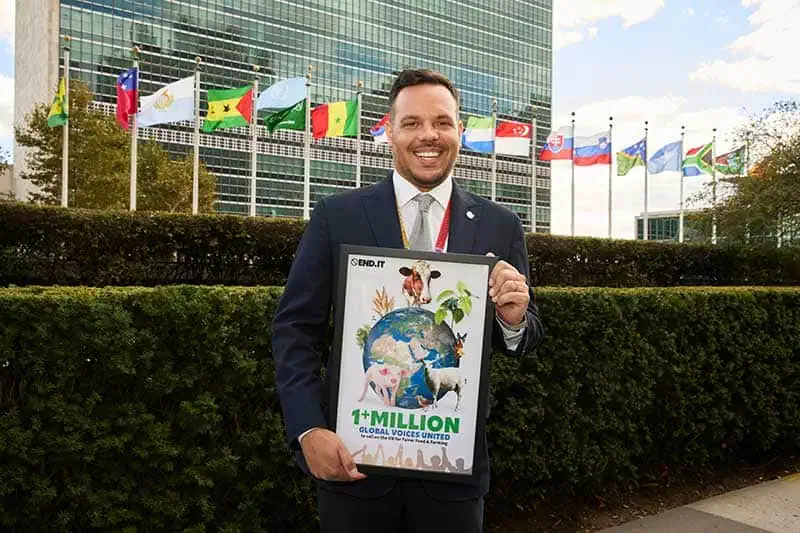
Nicholas Ceolin is an experienced international relations and public affairs professional who has worked extensively with the United Nations and various global non-governmental organizations.
During his time working directly with the United Nations, Ceolin served with the UN-OHRLLS (United Nations Office of the High Representative for the Least Developed Countries, Landlocked Developing Countries and Small Island Developing States). Notably, he managed communications and outreach for major global initiatives, such as the UN #ForgeYourFuture Storytelling Campaign leading up to the 5th United Nations Conference on the Least Developed Countries (LDC5).
Ceolin is currently the Global Head of International Affairs at Compassion in World Farming. In this role, he continues to work closely with the UN to integrate animal welfare and sustainable agriculture into global climate and health policies. Most recently, during the 81st UN General Assembly High-Level Week in September 2026, he represented the organization at high-level UN events to advocate for One Health strategies, focusing on the intersections between farming, sustainable food systems, and sustainable development.
Throughout his career, he has also held prominent advocacy and program management positions at animal welfare and humanitarian organizations, including FOUR PAWS, World Animal Protection, and Save the Children International
1. Tell us about your educational and professional journey
My career in international affairs has always been guided by a very personal goal: to leave the world a better place than I found it, and to leave a positive footprint for people, animals, and the planet alike.
Early in my professional path, I focused on international development, working with Save the Children and spending meaningful time on the ground in Ethiopia with the UN and the Italian Embassy in Addis Ababa. These experiences deeply shaped my understanding of global inequality and grassroots resilience. My journey in the system continued later at the United Nations Headquarters in New York, working with the UN Secretary-General’s Envoy on Youth and serving with UN-OHRLLS to champion global youth participation and amplify the voices of underrepresented nations in global policy.
I have always been convinced that long-term human well-being and environmental health are inextricably linked to how we treat animals and govern our food systems. This led me into the animal protection movement, holding global policy and campaigns positions at World Animal Protection, FOUR PAWS, and today leading international affairs at Compassion in World Farming. My focus is bringing these elements together: advocating for 'One Health' approaches and systemic food transformation that deliver lasting benefits across human health, animal welfare, and nature.
2. Did you have any role models?
My main role model has always been my grandfather, Lucio. He was a diplomat and public servant whose integrity, ethics, consistency, strength, and commitment to international dialogue shaped both my personal values and how I approach my career.
Growing up with his example taught me early on that diplomacy is a responsibility. Today, as a father, his legacy means even more to me. I see my work as a bridge: honouring the standard of service he set while helping build a more sustainable, compassionate world.
Ultimately, what motivates me every day is the desire to leave a positive footprint by helping people, animals, and the environment. Bridging my grandfather’s legacy with the future my daughter will inherit is the benchmark I bring to every coalition I build and every policy discussion I join.
3. Tell us about your work alongside coalitions like the World Federation for Animals to demonstrate how improving animal welfare and adopting a "One Health" approach are critical to achieving the Sustainable Development Goals (SDGs)—particularly climate action, responsible consumption, and human health.
A truly sustainable global food system must operate within planetary boundaries, respecting and enhancing planetary health. This can be achieved by adopting a One Health approach - an integrated framework that recognises the interdependence of human, animal, and environmental health.
Neglecting the One Health principle leads to cascading negative impacts on biodiversity, ecosystem services, environmental health, soil, land, water, food safety, and the overall sustainability of agrifood systems. Development, if not carefully managed, can result in unintended consequences and hidden costs. Integrating One Health into food systems transformation helps identify interconnections, minimise trade-offs, and maximise synergies.
Compassion in World Farming advocates for the One Health approach as a guiding framework for reimagining the global food system.
Working through coalitions such as the World Federation for Animals is particularly important because no single organisation can achieve this transformation alone. We work together to bring animal welfare into wider UN discussions and to demonstrate that it is not a standalone issue, but one that is closely connected to human health, climate, biodiversity and more sustainable patterns of production and consumption.
For example, at the UN High-Level Political Forum, we worked with the World Federation for Animals to engage governments and contribute to discussions around the Ministerial Declaration. Coalition work like this helps us bring evidence and a coordinated voice into spaces where animal welfare has historically received too little attention.
4. Tell us about the most critical ocean sustainability issue - the challenge of feeding the future while protecting ocean biodiversity and your side event at COP17.
Aquaculture is often presented as a way of reducing pressure on wild fish populations and supporting food security - but the farming of carnivorous species does the exact opposite. That is because these species require large quantities of wild-caught fish for feed.
Many vulnerable coastal communities around the world rely on fishing for livelihoods and their diets. As our report, The Growing Threat of Carnivorous Aquaculture shows, the EU imports wild-caught fish from these regions to produce fishmeal and fish oil. Using these fish to produce aquafeeds reduces the affordable protein available to vulnerable communities. The result is that fish once eaten locally are being turned into feed for European farmed carnivorous fish such as seabass and salmon, soon octopus - luxury products mainly consumed in high-income markets. Therefore, this current system is not sustainable and undermines food security rather than improving it.
In addition, intensive aquatic farming systems are linked to chemical use, water pollution, disease outbreaks, escapes of non-native species, and poor welfare standards for farmed aquatic animals. So, under current practices, aquaculture does not automatically improve food security and needs significant reforms to become truly sustainable and equitable.
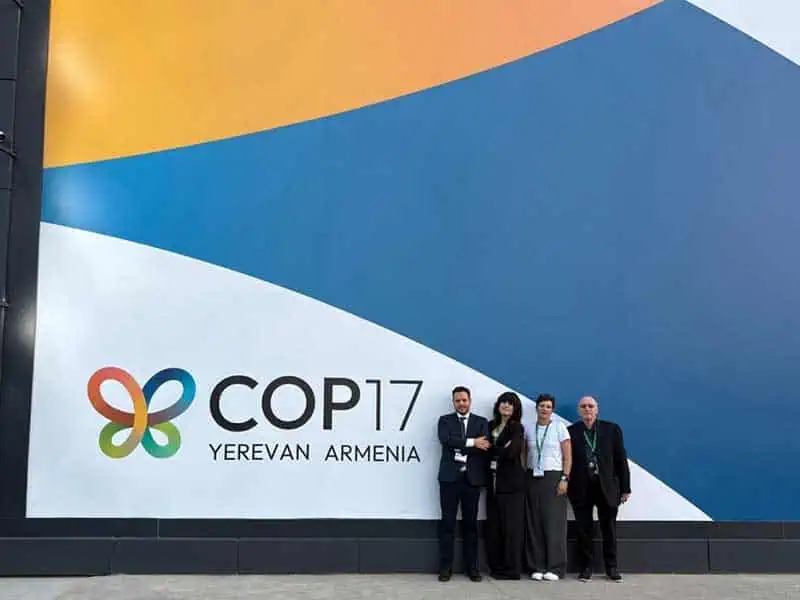
At COP17, we explored the connections between farming high-trophic species in aquaculture and fishing pressure on small pelagic fish populations, highlighting the implications for marine biodiversity and food security. Our speakers outlined the importance of feed fish to ecosystems and presented innovative approaches to biodiversity-friendly aquaculture.
5. Tell us about Sustainable Aquaculture
Sustainable aquaculture should provide nutritious food while protecting marine ecosystems, biodiversity, and animal welfare. Regenerative aquaculture should also aim to improve ecosystem health. I believe the key is moving towards farming species lower in the food chain, such as mussels, oysters and seaweed, which require little or no external feed and can provide important ecological benefits. Aquaculture should work with nature, rather than against it.
6. Tell us about Bivalve Farming of oysters, mussels, and clams, which require no feeding.
Bivalve farming is one of the most promising forms of sustainable aquaculture. Mussels, oysters, and clams feed naturally by filtering plankton and organic particles from the water, so they don't require additional feed, fertilisers or freshwater, and use very little land. They are also highly nutritious, providing protein, omega-3 fatty acids, vitamins and essential minerals. When properly managed, bivalve farms can improve water quality, increase water clarity and provide habitats for marine species. However, careful planning and management are essential to avoid negative impacts on local ecosystems.
7. Tell us about Seaweed Cultivation of Kelp and algae, which absorb carbon dioxide, reduce ocean acidification locally, and provide nutritious food and animal feed without using land, fertilizer, or freshwater.
Seaweed farming is another promising example of sustainable aquaculture. Seaweeds grow through photosynthesis, capturing CO₂ and using sunlight and nutrients from seawater to produce biomass, without requiring agricultural land, freshwater, or additional feed. They provide important ecological benefits, such as carbon capture, removal of excess nutrients, improved water quality, reduced ocean acidification locally and habitat provision for marine species. Seaweed is also a nutritious food, rich in fibre, vitamins and minerals. With proper management, seaweed farming can support marine biodiversity while creating jobs and income for coastal communities.
8. Tell us about Integrated Multi-Trophic Aquaculture (IMTA): This system mimics natural ecosystems by farming fish, seaweed, and shellfish together, where the waste of one species becomes the nutrients for another.
Integrated Multi-Trophic Aquaculture combines different species, such as fish, shellfish and seaweed, in the same farming system. The idea is to mimic natural ecosystems, allowing nutrients and organic waste from one species to be used by others. This can reduce pollution and improve resource efficiency. However, it is important to recognise that if the system includes carnivorous fish fed with wild-caught fish, it does not solve the problem of overfishing for feed. Therefore, the choice of species remains essential.
9. What are the Alternative Feeds for Aquaculture?
Several alternatives to traditional fishmeal and fish oil are being developed to reduce aquaculture's dependence on wild-caught fish. These include by-products from fish processing, algae-based oils, plant proteins, and single-cell proteins produced from microorganisms. Insect meal is another option being explored, although it raises animal welfare and sustainability concerns.
However, these alternatives also have limitations, including production costs, environmental impacts and nutritional suitability. We must also avoid replacing wild fish with ingredients that could be directly consumed by people.
Most importantly, alternative feeds alone are not the solution, as they do not address all the environmental and animal welfare concerns associated with intensive carnivorous aquaculture. We should prioritise farming low-trophic species, which require little or no external feed and at the same time, can provide important ecological benefits. These systems offer an opportunity to produce nutritious food, support coastal livelihoods and work with nature rather than against it.
10. The intersection of feeding the future, protecting ocean biodiversity, and COP31 represents one of the most critical sustainability challenges on the planet. Often dubbed the "Blue COP," COP31 (taking place in Antalya, Türkiye, in November 2026) serves as a historic turning point where governments aim to translate global ocean ambition into concrete national action. Tell us about your side event at COP31.
At COP31 we will intervene in two timely side events, with a focus not on aquaculture, but on the issue of sustainable nitrogen management in on-land farming systems. This is the missing puzzle piece in food systems transformation, as it comes with multiple benefits for the climate, health and biodiversity.
11. How can people reach you?
Media.team@ciwf.org
Glossary Terms:
Selva Ozelli Esq, CPA is a legal and finance executive with diversified experience dealing with highly complex issues in the field of international taxation and related matters within the banking, securities, Fintech, alternative and traditional investment funds. Her first of its kind legal analyses involving tax laws, Foreign Corrupt Practices Act (FCPA), blockchain technology, solar technology and the environment and have been published in journals, books and by the OECD. Her writings have been translated into 15 languages.