
28 Funniest Animal Names

Getting to name a creature is special; sometimes, those who get the opportunity use it to express their sense of humor. Some of the funniest animal names are fried egg jellyfish and Aha ha wasp.
Whether we look at scientific or common names, we'll find animals with literal, funny, silly, or just plain weird names. Get to know the story behind it in this post.
Weirdest and Silliest Animal Names
Let's look at 28 of the funniest animal names in the world.
1. Chicken turtle (Deirochelys reticularia)

The chicken turtle is native to the Southeast United States. It is a semi-aquatic animal that feeds on plants, aquatic insects, tadpoles, and fish. Because of its long striped neck, the chicken turtle is sometimes called the American snake neck.
In many cultures, turtle soup is a delicacy, and chicken turtle soup is particularly tasty. It gets its name because it tastes like chicken. Chicken turtles were a popular meat source in America in the 1800s.
2. Sarcastic fringehead (Neoclinus blanchardi)

Sarcastic fringeheads grow to a maximum of 12 inches but are larger than all other fringeheads. This fish is very aggressive and territorial.
The sarcastic fringehead may get the first part of its name from its amusing fighting style. The sarcastic fringehead will engage in a mouth-off. It will open its alien-like mouth and show its colorful interior and size to its competitor. Two male sarcastic fringeheads might even smack mouths.
Another explanation comes from the Greek word sarkasmós, which means to tear or bite and translates to ‘sarcastic’ in English. The scientist who named it was likely referring to fish’s needle-sharp teeth.
3. Fried egg jellyfish (Phacellophora camtschatica)

The next funniest animal name is, without a doubt, spot on! The fried egg jellyfish looks like a brilliantly cooked sunny-side up floating in the sea. Its tentacles form a colorful bowl-like shape.
The fried egg jellyfish is one of the few that are not harmful to humans. It feeds on zooplankton and other types of jellyfish. This type of jellyfish is also called egg yolk jellyfish since it looks more like an unbeaten raw egg floating in water than a fried egg.
4. Screaming hairy armadillo (Chaetophractus vellerosus)

The screaming hairy armadillo is a burrowing animal endemic to Central and South America. The locals hunt it for its meat and shell. This armadillo species has long, thick, bristly hairs all over its body, even on its shell. It is hairier than most other armadillo species. So we immediately know where the second word of its name comes from.
However, the “screaming” in its name comes from the loud distress cries it produces when caught by predators (humans included). Funny thing: the screaming hairy armadillo is a predator of insects and small animals.
5. Pink fairy armadillo (Chlamyphorus truncates)

The pink fairy armadillo is arguably the cutest in the world. It has a pink dorsal carapace and silky white fur on the rest of its body except its feet and tail. The smallest armadillo species measures just about 13cm and is endemic to the neotropical region of central Argentina.
The pink fairy armadillo's name is not the only unique feature; it also has a double skin1, which is unusual for mammals.
6. Ice cream cone worm (Pectinariidae)

The ice cream cone or trumpet worm is a marine animal stuck to the ocean floor. The odd-looking worm constructs a tube to live in by gluing together sand and shell fragments.
The tube expands as the worm grows and eventually looks like an ice cream cone, hence its name. The weird ice cream cones are about 3 inches long and open on both sides.
Another name for the ice cream cone worm is trumpet worm because of its tube shape.
7. Dik-dik (Madoqua)
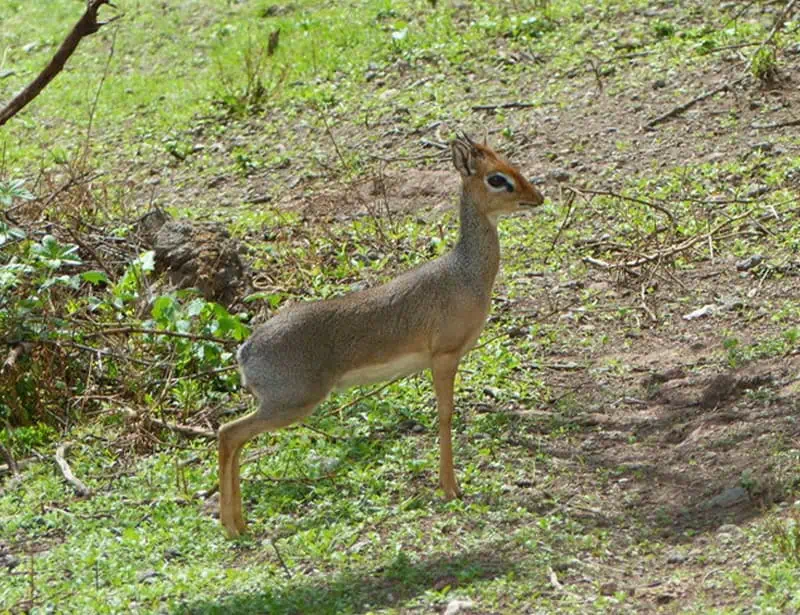
Naming animals after the sounds they make is sure to produce some silly names. For example, a small antelope from Eastern and Southern Africa derives its common name from the “zik-zik” alarm call they make when threatened.
Dik-diks are shy, elusive creatures. They mate for life and live in small family groups. Poaching for hide and bones and agricultural encroachment threaten dik-dik populations.
8. Pleasing fungus beetle (Erotylidae)

The pleasing fungus beetle is any of the 3,500 species of the Erotylidae family. It is easy to recognize by its black and red-orange patterns.
Pleasing fungus beetles feed on fungus, where the middle part of their name comes from. However, some species within the family also extend their diet to include plant matter.
The nocturnal pleasing fungus beetle is not a pest, which is excellent news because you can find it almost anywhere in the world. Perhaps the first word of its name comes from its easy-going nature.
9. Satanic leaf-tailed gecko (Uroplatus phantasticus)

The satanic leaf-tailed gecko camouflages as dead leaves and twigs to evade predators. Endemic to Madagascar, these gecko species' coloration varies according to the trees they live on. Spikes and ridges run along their heads, bodies, and legs. Their flattened tail looks exactly like a dead leaf.
In addition to its strange appearance, the animal likely gets its name from the blood-curdling scream it uses to deter attackers.
10. Rasberry crazy ant (Nylanderia fulva)

Rasberry crazy ants originate from South America and are becoming an invasive species in the United States. These types of ants chew through electrical wires, causing short circuits. They also displace other animals, including ants.
The ants get the first part of their name from Tom Rasberry, a pest exterminator. He was the first to identify the ants in Texas. The “crazy” part of their name comes from their rapid haphazard movement.
11. Goblin shark (Mitsukurina owstoni)

The goblin shark looks like something from a horror movie, but it is a very real animal. It has a long snout, a projectable jaw, and sunken eyes. Its skin is somewhat translucent, allowing its visible veins to complete its otherworldly appearance. The name definitely comes from the appearance.
Goblin sharks are not common. They live about 4,000 feet below sea level. Although scientists believe they are present in oceans worldwide, Japan has the most sightings.
12. Tasselled wobbegong (Eucrossorhinus dasypogon)

The tasselled wobbegong is a type of carpet shark. Its name comes from the dermal lobes that run along its head. The lobes look like tassels, and that's where the first word of its name came from. The word “wobbegong” is thought to come from an Australian aboriginal term meaning shaggy beard, once again referring to the lobes.
Tasselled wobbegongs ambush prey by laying motionless and blending into the sea floor. The colorful blotches on their skin and the coral-like dermal lobes enhance the disguise.
13. Spiny lumpsucker (Eumicrotremus orbis)

The Pacific spiny lumpsuckers are tiny, one-inch bony fish. Their bumpy body is full of spiny tubercles, which provide camouflage. The fish have modified pelvic fins that function as adhesive discs, allowing them to remain attached to rocks, eelgrass, and kelp.
The name of this fish describes its appearance funnily. The “spiny” and “sucker” parts of the name are explained in the paragraph above. The lumpy part refers to how the fish resembles a puffy lump.
14. Strange-tailed tyrant (Alectrurus risora)

The Strange-tailed Tyrant is a flycatcher with an unusual tail. In addition to its regular proportional tail, it has a couple of long outer tail feathers. That's where the strange tail in its name comes from.
However, the reason this bird is called a tyrant has less to do with its behavior and more to do with its classification. The bird is a member of the genus Alectrurus, which belongs to the family Tyrannidae. The family name reflects the aggressive nature of some members, especially the Western Kingbird.
15. Slippery dick (Halichoeres bivittatus)

The next funniest animal name is derived from the creature's slippery body. The fish coats its body in a mucus-like substance so that predators have a hard time grabbing onto it.
The slippery dick has three phases of growth and its appearance changes with each phase. Juveniles are white with a black lateral stripe. In its mid-phase, it becomes white-grey with two red stripes. At the terminal stage, the slippery dick turns green with dark stripes.
16. Moustached puffbird (Malacoptila mystacalis)

Moustached puffbirds are plump, round birds that live in the Andes in Venezuela and Colombia. An adult can be 9 inches long and weigh up to 50 grams.
As with most animals with funny names, the moustached puffbird looks funny. It has small tufts of white feathers around its bill's base, making it look like the bird has a white mustache. The females have darker plumage than males, with a less prominent mustache.
17. Hellbender (Cryptobranchus alleganiensis)

The hellbender is the largest amphibian in North America. It can grow to about 29 inches and weigh up to 5 pounds. It spends its entire life in the swift-running rivers across the eastern United States.
Hellbenders may have gotten their name because of their monstrous size and wrinkly, slippery, splotchy skin. Those features, while unpleasant, serve essential purposes. Hellbenders absorb 95% of their oxygen intake through the folds and wrinkles of their skin. The mucus on the skin protects it from abrasion, parasites, and predators.
18. Frilled-necked lizard (Chlamydosaurus kingii)

Also called a frill neck or frilled lizard, this animal is named for the large frill that encircles its head. When threatened, it stands on its hind legs, unfurls the frill, and opens its yellow mouth. If the intimidation tactic fails, the lizard simply runs away on its hind legs at top speeds.
Frilled lizards are members of the dragon family. They can grow to almost 3 feet, with their tail accounting for two-thirds of the length. They are brown or grey, but their frills usually have an orange or tan tinge.
19. Wunderpus octopus (Wunderpus photogenicus)

The wunderpus octopus got its name just for being cute. Wunderpus is a mix of the German word “Wunder,” which means marvel or wonder, and the English word "octopus.” The "Photogenicus” in its scientific name likely refers to its photogenic nature.
This type of octopus has rusty brown skin with white blotches and stripes, which form beautiful patterns. It can impressively modulate its shape and color to mimic a lethal lionfish or sea snake to deter a predator. Wunderpuses live in the shallow waters of the Indo-Malayan Archipelago.
20. Leafy seadragons (Phycodurus eques)

Leafy seadragons are closely related to seahorses. They are endemic to the waters off south and east Australia.
The leafy seadragon is an excellent example of an animal camouflaging as a plant to escape predation. The fish has leaf-shaped protrusions all over its body, helping it blend in with the kelp and seaweed around it.
Their bodies are usually yellow or brown, while the leafy protrusions have an olive tint. To further sell the disguise, the fins of the leafy seadragon are so thin and almost transparent.
21. Common cockchafer (Melolontha melolontha)

At 3.5 cm, the adult common cockchafer is the United Kingdom’s largest scarab beetle. The rusty brown beetle is also called the May bug because it tends to emerge from its underground home around May.
There are a few stories about how the common cockchafer got its name. One explanation says the word “cock” means familiar, and “chafer” means gnawing beetle. Another explanation says cockchafer is Old English for "big beetle."
Yet another account suggests that the word cock in Old English referred to large size, while chafer meant gnawing insect. Therefore, the cockchafer got its name from its size and tendency to chew leaves and flowers vigorously.
22. Red-lipped batfish (Ogcocephalus darwini)

The fish's face matches its funny name. Its human-like lips look like they're slathered in bright red lipstick. The rest of its body is greyish brown with a white underbelly. It has a pretty odd shape for a fish and a prominent snout at the top of its head.
Another odd thing about the red-lipped batfish is that it prefers to use its fins as pseudo-legs to walk along the seabed rather than swim. This bottom-dweller is endemic to the Galapagos Islands.
23. Shakira wasp (Aleiodes shakirae)
The next funniest animal name came from a superstar. In 2014, Scott Shaw and Eduardo Shimbori, entomologists from the University of Wyoming, had the opportunity to name several newly identified species of insects. They had fun naming them after celebrities.
They named a parasitoid wasp Aleiodes shakirae. The wasp infects caterpillars and causes their abdomen to twist and bend as it feeds. It reminded Shaw and Shimbori of belly dancing, for which Shakira is famous. Many other members of the genus Aleiodes have celebrity-inspired names, too.
Although killing caterpillars from the inside may sound terrible, Shakira wasps play an important role in keeping the population of plant-feeding caterpillars under control.
24. Tufted titmouse (Baeolophus bicolor)

The Tufted Titmouse gets its name from the Old English words "tit," meaning small, and "mase,” meaning bird. The word "mase" eventually became obsolete and was replaced with the word "mouse.”
The quick-moving tiny bird probably reminded people of the house mouse. The tufted part of its name likely comes from the small upward-swept tuft of feathers on its head.
There are five titmice species endemic to North America. The Tufted Titmouse is a sedentary south-based species that seems to be steadily expanding its range northward.
25. Western lowland gorilla (Gorilla gorilla gorilla)

With the same word repeated thrice, its scientific name is effortlessly funny. Western lowland gorillas have lighter coats than other gorilla species. They have the widest range, covering over 700,000 square kilometers of lush rainforests across Central Africa.
Western lowland gorillas are umbrella species that protect other species around them. Unfortunately, logging and poaching threaten their existence.
26. Truthful Round Fungus Beetle (Colon rectum)
A species of the round fungus beetle is scientifically identified as colon rectum Hatch 1933. It is unclear why the poor thing was given this name, but it is funny.
The scientist responsible, Melville H. Hatch, also assigned colon-inspired names to a bunch of round fungus beetles from the Leiodidae family.
27. Conquered lorikeet (Vini vidivici)
This bird is an extant species of parrot that lived in the Polynesian Islands around 700-1300 years ago. In 1987, David Steadman and Marie Zarriello described the species through archeological remains.
The scientific name is clever wordplay, alluding to the popular Latin phrase " Veni, vidi, vici." The authors saw the opportunity in the similarity between the genus name ”Vini” and the word “Veni.” Vini is a Tahitian name for a local bird.
The common name of the Vini vidivici is conquered lorikeet. It is not a funny name but a reminder of how unfortunate species extinction is.
28. Aha ha wasp (Aha ha)
The story behind our funniest animal name will definitely make you laugh. Howard Ensign Evans, an American entomologist, traveled around Australia in the late 1970s, collecting wasps to bring home and study. He mailed some to his friend and colleague, Arnold S. Menke.
Menke looked at the wasps and identified a couple of new species. He exclaimed, “Aha! A new species!” but his colleague, Eric Grissell, responded doubtfully, " Ha!”. Menke turned out to be correct, and the wasps were newly identified species of the Sphecidae family.
He named the first wasp Aha evansi to honor his friend Howard Evans and the second one Aha ha, as a joke.
Glossary Terms:
| 1 | Cecilia Mariana Krmpotic, Alejo Carlos Scarano, Laube, A., Martín Ricardo Ciancio, Cleopatra Mara Loza, Acuña, F., Castro, N., & Claudio Gustavo Barbeito. (2023). The double skin of the pink fairy armadillo, the peculiar integumentary system of Chlamyphorus truncatus Cingulata (Mammalia, Xenarthra). Journal of Zoology. |
Jen’s a passionate environmentalist and sustainability expert. With a science degree from Babcock University Jen loves applying her research skills to craft editorial that connects with our global changemaker and readership audiences centered around topics including zero waste, sustainability, climate change, and biodiversity.
Elsewhere Jen’s interests include the role that future technology and data have in helping us solve some of the planet’s biggest challenges.
Fact Checked By:
Isabela Sedano, BEng.
