
13 Most Common Trees in the United States

Trees are gifts from nature. They provide habitat, filter the air, clean the water, and many other functions. Some may have been threatened, but others have thrived. The most common trees in the United States, like firs and pines, have developed particular characteristics that help them cope with various factors in their regions.
If you frequently hike forests, learn about the key identifying features of these thirteen trees and impress your friends with your tree knowledge.
13 Most Widely Distributed Tree Species in America
Quick links to trees in the United States to look out for:
1. Douglas Fir (Pseudotsuga menziesii)

Douglas fir is an evergreen coniferous tree with an average height of 40 to 80 feet, reaching up to 300 feet in the wild. The tree takes on the name of the botanist David Douglas, who introduced the first seeds to Great Britain from North America.
Many species of Douglas fir are native to western North America and eastern Asia. Douglas fir thrives in various habitats across the west of the United Kingdom because of its high rainfall. We value Douglas fir for its ornamental and quality timber qualities.
These popular trees are in demand during Christmas thanks to their flat, soft, and flexible needle-like green leaves. Douglas fir species usually live for 1,000 years. They thrive in moist, well-drained soils but can also tolerate alkaline soil.
2. Sugar Maple (Acer saccharum)

Sugar maple is a native species from the northeastern United States and Eastern Canada regions. Although the maple leaf is Canada's national symbol, this tree is also popular in the US. Americans mostly grow sugar maple as an ornamental and shade tree. They also find it valuable because it produces maple syrup, maple sugar, and lumber for furniture making.
It grows up to 120 feet tall and has dense leaves that turn shades of gold during the fall. Living up to its name, it can produce 5 to 60 liters of sap per tree annually. It takes 35 to 40 liters of sap to create one liter of maple syrup.
Furthermore, it provides habitats for bird species and insects and is a food source for mammals like chipmunks, squirrels, deer, and porcupines.
3. Flowering Dogwood (Cornus Florida)

Flowering dogwood is a deciduous, woody understory tree in the dogwood family. Native to southeastern Canada, eastern North America, and eastern Mexico, it grows about 15 to 25 feet and has leaves that turn purple and red in the fall.
The flowering dogwood prefers moist and acidic soil. Its white flowers bloom in early spring. The flowers provide nectar for butterflies and bees, while its red fruits are an important food source for many bird species and other animals from fall until winter ends. The flowering dogwood is the state flower of North Carolina.
Dogwood trees are susceptible to pests and diseases like dogwood borer, leafhoppers, Japanese maple scale, dogwood sawfly, and dogwood anthracnose. They are also at risk of bacterial leaf scorch, blight crown cranker, root rot, and powdery mildew.
4. Lodgepole Pine (Pinus contorta)

Lodgepole pine, a common tree in the pine family, is native to western North America and Canada. Its natural range extends from Alaska in the north to California in the south, from the Pacific coast to the east of the Rockies. It can grow up to 50 feet, but some varieties are shrubs that reach only 10 feet.
Lodgepole pine prefers to grow in middle or high elevations. However, you can find it growing at lower elevations with other conifers like Douglas fir and western larch. Its leaves are about 3 inches long needles, accompanied by small brown cones 2 inches long. As its scientific name suggests, it is distinguishable by its contorted trunk.
The cones require heat to open and disperse seeds for new generations. However, lodgepole pine trees are easily affected by fire because they have thin barks. Americans use lodgepole wood for posts, poles, plywood, paper, and lumber. The tree is an important food source in the wild.
Blue and spruce grouse eat the pine needles, while squirrels and chipmunks eat the seeds. Beetles eat burned lodgepole wood after a fire outbreak, while woodpeckers eat the insects living underneath the burned timber.
5. Quaking Aspen (Populus tremuloides)

Quaking aspen is native to North America, starting from northern Alaska to Labrador and south into Mexico. You’ll find it in California, Canada, and Arizona.
It has a smooth, white bark with black markings from where old branches used to be. Its leaves are heart-shaped with saw-toothed edges and glossy green turning gold in fall. The slightest wind causes the leaves to flutter, hence the name quaking aspen.
Scientists call it a pioneer species because it is the primary invader of newly cleared or burned areas. It has a lifespan of 50 years. The quaking aspen is 60 feet tall and has a diameter of 20 inches. About 500 wildlife survive on aspen and its natural resources.
6. Red Maple (Acer rubrum)

Red maple is one of the most common trees in eastern North America, reaching up to 120 feet tall and a 6 feet trunk diameter. It is a fast-growing tree with a dense canopy and shallow roots, making it an excellent option for boulevards and shade trees. Its dense canopy provides shade all year, during spring, fall, and summer.
These beautiful trees grow clusters of tiny red flowers in early spring and are the first to show warm-colored leaves during fall. Bees are attracted to the trees’ nectar, while squirrels and white-tailed deer love the fruits.
Related Read: Most Endangered Trees in the United States.
7. Balsam Fir (Abies balsamea)

Balsam fir, also known as Canada balsam, eastern fir, and balm-of-gilead fir, is a member of the pine family and is often used as a Christmas tree. Despite its shallow roots that can quickly shift from heavy winds, it can reach up to 70 feet. Gardeners value it for its fragrant needles, which grow upright in fall.
It is native to North America and Canada. North America extends from north Minnesota, west of Lake of Woods, southeast to Iowa, east to central Wisconsin, and into New York and central Pennsylvania.
8. White Oak (Quercus alba)

White Oak Is a tree species endemic to the eastern United States, with a staggering population in eastern and central North America. The western slopes of the Appalachian mountains and the Ohio and central Mississippi River valleys have the best environmental conditions for growing white oak. However, the giant trees are on the eastern shore of Delaware and Maryland.
Wherever you find white oak, you will most likely find American basswood, sweetgum, beech, shortleaf pine, and ash trees. These oak trees are massive, growing between 50 to 135 feet. True to its name, it is distinguishable by its light ashy gray scaly barks.
White oak acorns are about 1 in long and become ripe in the fall, littering the environment. The growing leaves appear pink initially before changing to dark green in summer and wine-red in fall. It is a breeding ground for many butterfly and moth species all year round.
9. American Elm (Ulmus americana)

The American elm, also known as white elm and common elm, is next on our list of common trees in the United States. It is the largest species of all native elms, reaching a height of 80 ft and a diameter between 2 and 5 ft. American elms are native to eastern North America.
The tree species adapts easily to dry and wet conditions but grows best in well-drained soil with average moisture content. It can also tolerate an urban environment. American elms provide a habitat and food for wildlife. Tiny green-red, almost invisible flowers bloom from late winter to early spring.
American elm is susceptible to Dutch elm disease, a deadly fungal disease spread by bark beetles. Bark beetles attack the tissue that passes water in the tree, leading to defoliation, wilting, and death. Unfortunately, science has yet to find a cure for it.
10. American Basswood (Tilia Americana)
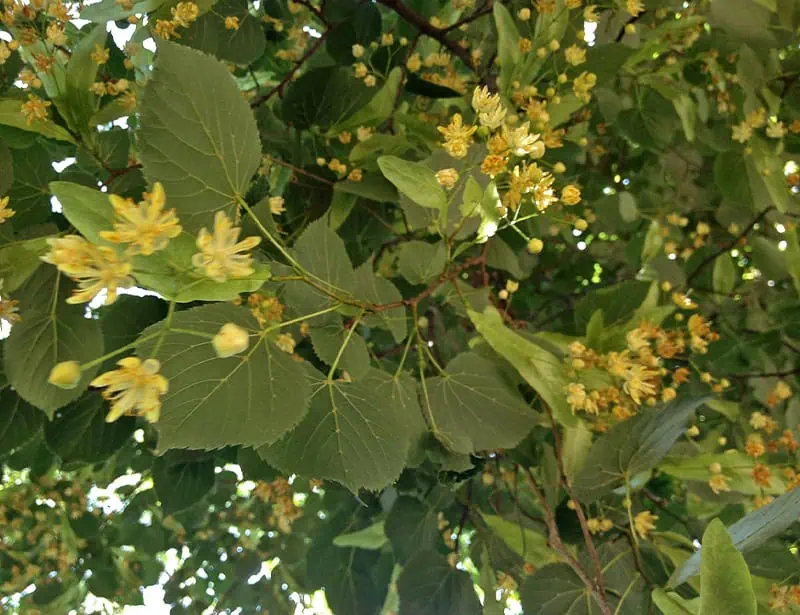
American basswood is native to eastern North America. The large tree species is a well-known honeybee tree. This bee species builds beehives in them, producing basswood honey that is pale in color and has a unique taste. It is also a home for butterflies and a food source for small mammals.
Basswood is a deciduous tree that grows between 60 and 80 feet with straight trunks 2 to 3 feet in diameter. Its heart-shaped, coarse, asymmetrical leaves turn yellow in the fall.
After pollinators pass through, scented cream flowers bloom from June to July. In summer, small fruits hang from leafy bracts. Americans often use wood to create furniture, food boxes, pulpwood, and wood fibers.
11. Eastern Cottonwood (Populus deltoides)

Eastern cottonwood is another widely distributed tree in America. It is a large tree that grows along streams, rivers, and lowland areas. It is the oldest and largest hardwood tree in North America, reaching a height of 100 feet and width of 75 feet. The tree species got its name from its seeds, which resemble cotton.
Manufacturers use it to produce plywood, baskets, pulp, and crates. It makes an excellent shade tree but is not ornamental because it is weedy and brittle. Eastern cottonwood has a thin, smooth bark that turns brown to ash-grey with maturity. Its twigs are yellowish-green, and its leaves range from light green to medium green.
The leaves are also glossy and triangular, about 3-6 inches long and 4 inches wide. Cottonwood’s fruits are green and egg-shaped. The tree’s pests are caterpillars, borers, aphids, and scales.
12. Eastern White Pine (Pinus strobus)
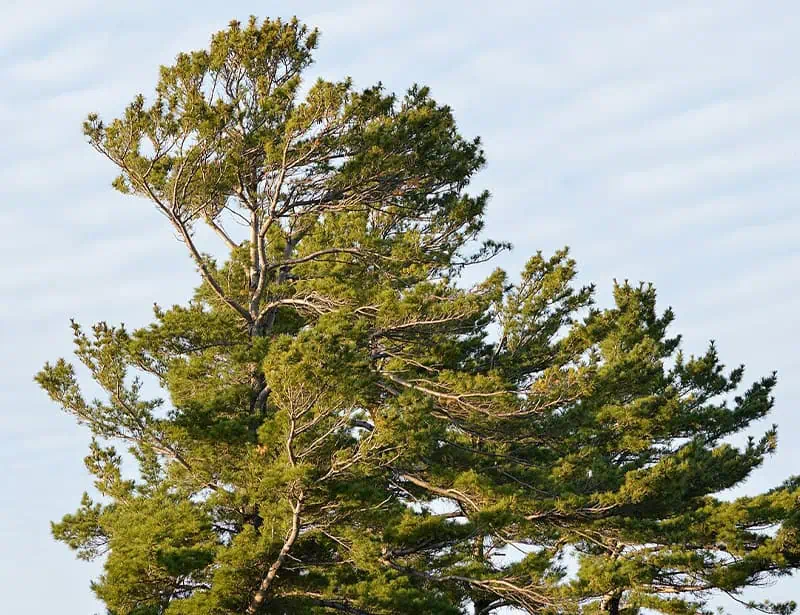
Eastern white pine is a native species of North America. This Maine and Michigan state tree has gray-brown barks, broad ridges, and scaly plates. It can grow between 50 to 80 feet tall.
White pine prefers a colder, humid climate and well-drained soil. The evergreen perennial plant has needle-like leaves, with three or more per node. Its flowers bloom in the autumn season. Male flowers are yellow, while red flowers are female.
Regarding its wildlife value, it is a host of imperial moths. Its bark and seeds are a favorite of some mammals and birds, while others seek refuge.
13. Shagbark Hickory (Carya ovata)

Shagbark hickory is a member of the walnut family. It grows to 60 - 80 feet and is 25 - 35 feet wide. It is endemic to eastern and central America and some regions of Canada. The tree thrives in sandy or clay soils but prefers fertile, deep, and well-drained soil. It is also drought and flood-tolerant.
Because of its prolonged growth rate, shagbark hickory takes 40 years to produce nuts. Shagbark houses songbirds, migrant birds, game birds, and cavity-nesting birds.
Conclusion
There are over 500 tree species in the United States; unfortunately, quite a number of them are at risk. Aside from appreciating the benefits of these common trees, we should also pay attention to endangered trees through awareness and collective action.
The summarized data above is from the North Carolina Extension Gardener Plant Toolbox. Explore their website to learn more about your local flora.
Glossary Terms:
Jen’s a passionate environmentalist and sustainability expert. With a science degree from Babcock University Jen loves applying her research skills to craft editorial that connects with our global changemaker and readership audiences centered around topics including zero waste, sustainability, climate change, and biodiversity.
Elsewhere Jen’s interests include the role that future technology and data have in helping us solve some of the planet’s biggest challenges.
Fact Checked By:
Isabela Sedano, BEng.
