
15 Burrowing Animals from Squirrels to Shrimps

Burrowing animals or fossorial animals live primarily or temporarily underground. They construct burrows as their primary residence or temporary refuge from predators and extreme temperatures. Some use their burrows to store food to keep it away from other animals or during seasons when supply becomes scarce.
Explore the following common animal burrows and discover how and why they live underground:
Animals have different methods of acquiring burrows
Did you know fossil burrows are the preserved remains of burrows? Like other trace fossils, they can indirectly inform scientists about the behavior of ancient animals. Here are the ways animals create their underground homes.
Primary excavators
These animals excavate their own burrows. They usually have strong claws that are adapted to digging any kind of soil. Mammals, especially rodents, are traditionally the primary burrow excavators.
Secondary modifiers
These categories of burrowers take over the burrows of other animals, usually after the former dwellers abandon them. They modify the burrows by digging further or making other changes to better suit their needs.
Simple occupants
These animals find and take over burrows built by other animals. They do not modify them, usually because they are not very good at digging. Snakes typically fall into this category.
15 Examples of Burrowing Animals
1. Ground Squirrels (Marmotini)

There are over sixty-two species of ground squirrels on earth. The thirteen-lined ground squirrel is one of the common species in North America. It has a distinct appearance, with bands and stripes running along its back.
They dig shallow one-entrance holes for emergencies and deeper burrows for hibernation and nesting. They also store food in their burrows for revitalization when they rouse from hibernation.
Their underground homes are in an open area with moist soil, short grass, and even your front lawn. The multiple burrow entrances have no mounds and very small holes about 2 inches wide.
Related Read: What Animals Hibernate.
2. Prairie Dogs (Cynomys)

Prairie dogs are native to North America. There are five species: the black-tailed prairie dog, the white-tailed prairie dog, the Utah prairie dog, the Mexican prairie dog, and the Gunnison’s prairie dog.
The prairie dog forages for plant roots, herbs, and grasses all day and retreats into its burrows at night. Some prairie dog species also hibernate in their burrows in winter.
Prairie dogs live in large colonies with an extensive network of burrows. Black-tailed prairie dogs built the largest colony. At the end of the nineteenth century, a colony in Texas had approximately 400 million inhabitants3.
Their tunnels are about 6 feet deep and 16 feet long, with several round chambers. Their burrow entrances have cone-shaped mounds of earth. The mounds prevent tunnel flooding and serve as lookout posts.
3. Meerkats (Suricata suricatta)

Meerkats are members of the mongoose family. They are social animals that live in family groups of up to 25 members. The ‘mob’s adult members take turns foraging, caring for the young, and watching out for predators.
The meerkat lives in the grasslands and deserts of southern Africa. The burrow provides an escape from the hot afternoon sun and predators. A mob can occupy up to five burrows.
Meerkats usually dig their burrows with their long, sharp claws. However, they sometimes move into the dens of South African ground squirrels.
Meerkat burrows can be 16 feet in diameter and almost 5 feet deep. These extensive burrows contain many entrances, tunnels, and chambers. Meerkats also create emergency hiding spots called boltholes throughout their foraging area.
4. Polar Bears (Ursus maritimus)

Female polar bears are likely the largest burrowing mammals. Their burrows provide shelter as they give birth to and nurture their cubs, so they are called maternity dens.
Polar bears usually construct their dens in ice. However, as the Arctic Sea loses ice due to global warming, they are now forced to dig underground burrows on land.
A typical polar bear den has two to three chambers, an air hole, and a single entrance. The pregnant polar bear simply digs a hole and moves in. However, once the cubs arrive, she'll need more space.
5. Great Gerbils (Rhombomys opimus)

Gerbils live in the arid environments of Africa, western Asia, and India. There are over 110 species, the smallest of which is the pouched gerbil and the largest of which is the great gerbil.
Some gerbils build small, simple burrowing holes, but others, like the great gerbils, construct elaborate networks of burrows.
Great gerbils often live in colonies, with one burrow for each family. Many holes (entrances) in the soil are evidence of their presence. They build a central chamber with long, narrow tunnels connected to storage chambers.
6. Armadillos (Cingulata)
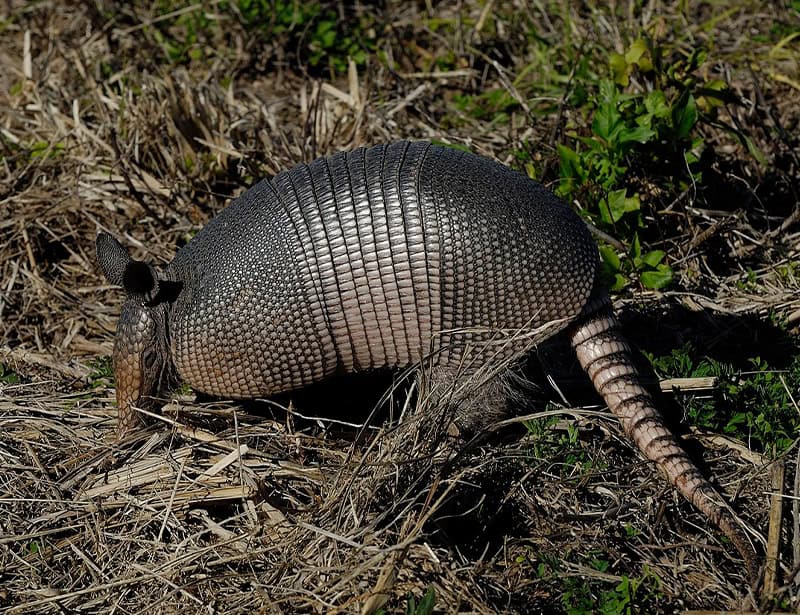
Armadillos look like armored anteaters; bony plates cover their backs and most of their bodies. The nine-banded armadillo is the only species native to the United States.
These armored creatures are experts at digging holes, so much so that other animals use their burrows for shelter. An armadillo spends most of its time in its den, sleeping. It only comes out at dawn and dusk to forage.
Armadillo burrows can be 20 feet long and 5 feet deep, although each species digs dens that accommodate its shape and size. Some armadillos use their back plates to plug the entrance hole of their burrows.
7. Pocket Gophers (Geomyidae)

Pocket gophers spend most of their time underground, feeding primarily on roots, stems, and tubers. Occasionally, they may come out to forage but stay close to their burrow entrance. They have external cheek pouches with which they transport food.
Pocket gophers excavate distinct tunnels called gopher holes near the ground surface to reach food sources. They also create deeper burrows for storage and nesting. Gopher holes are usually sealed with soil or rocks to keep intruders out.
It uses its chisel-like front teeth and strong foreclaws to create its underground homes. While digging, it closes its lips so the sand doesn't get into its mouth.
The pocket gopher burrow is generally 4 to 18 inches below the ground, but some parts can be 5 to 6 feet deep. The burrow diameter is usually about 3 inches, but larger pocket gophers can build wider burrows.
8. Wombats (Vombatidae)

Wombats are the largest, primarily burrowing mammals. On average, they are 3.3 feet long and weigh 55 to 88 pounds. The wombat looks like a short bear but is a marsupial related to kangaroos.
With their strong, lengthy claws, wombats are prolific diggers. Moreover, their gestation pouch opens rearwards so dirt doesn't get into it while digging holes. They eat only plants so other small mammals can safely share their burrows.
Wombats create complex chamber-and-tunnel burrows with sleeping chambers and many entrances. The burrows can be 100 feet long and 11.5 feet deep.
9. Magellanic Penguins (Magellanic Penguins)

Magellanic penguins live in the Neotropical region of the southern coast of South America2. Their habitats include coastal grasslands, forests, offshore islands, and rocky headlands.
These birds build their nests in the ground. During the breeding season, their shallow burrows provide adequate protection for their young. However, some burrows may flood or collapse during heavy rains, endangering the young offspring.
When they are not breeding, Magellanic penguins may burrow within cliff faces. Their burrows are simple shallow holes dug into the ground. They pick areas with enough vegetation to provide a roof.
10. Puffins (Fratercula)

A puffin is a black-and-white seabird with a large, colorful bill. It is also known as the clown of the sea, bottlenose, or sea parrot. They spend most of their lives on the open sea, resting on the waves when not swimming.
When breeding season comes, puffins dig holes to nest on sea and island cliffs. A mating pair will work together to refurbish an old burrow or build a new one. Puffins nest in large colonies, so there's usually some fighting for the best burrows.
Puffin nests are about three to six feet deep and have several chambers. They use grass and other plant materials to create a soft, comfy layer on the ground.
11. Kangaroo Mice (Microdipodops)

The kangaroo mouse is any two species of bipedal rodent that lives in the desert terrains of the western United States. Like kangaroos, they move by hopping on their hind legs. They have short forelimbs but long hind limbs and a strong, flexible tail for balancing.
Kangaroo mice rarely drink water; they get their water needs from the food they eat. They have external cheek pouches for transporting seeds.
A burrow shelters the kangaroo mouse from the desert heat in summer and serves as a hibernation chamber during winter. Simple tunnels are dug in areas with fine sand or gravelly soil. The entrance, a simple open hole, is usually situated near shrubs.
12. Voles (Arvicolinae)

Voles are small rodents, sometimes called meadow mice or field mice, but they are not mice. They have plump, stocky bodies, short legs, small ears, and short tails.
A vole spends much time scurrying about on the ground to forage but stays in its burrow most of the time.
The most straightforward sign of their burrowing activity is vole runways. These runways are inch-wide shallow tunnels on the ground surface. They connect burrow entrances and are usually hidden under some ground cover. Other signs include the entrance hole or plant damage.
Vole burrows are shallow and have at least a couple of chambers. They use grass, leaves, and stems to make their underground nests. The burrow openings are 1½ to 2 inches in diameter, and you may find more than one hole in the same area.
13. Insects (Insecta)

Many insects burrow underground, but their burrowing strategies are different. Insects are among the few burrowing animals that are not harmful to plants.
Some insects, like beetles and butterflies, spend only a portion of their lifecycle underground, while others primarily live underground. Ant and termite colonies live in complex underground tunnels housing thousands of individuals. Termites may also burrow in wood.
You may observe tiny mounds of dirt or spongy soil surrounding the entrance holes of insect burrows. Sometimes termites and ants build high mounds right on their underground burrow. The depth of an ant burrow depends on the soil type1. Moist clay or fine-grained soils allow for extensive burrows.
14. Groundhogs (Marmota monax)
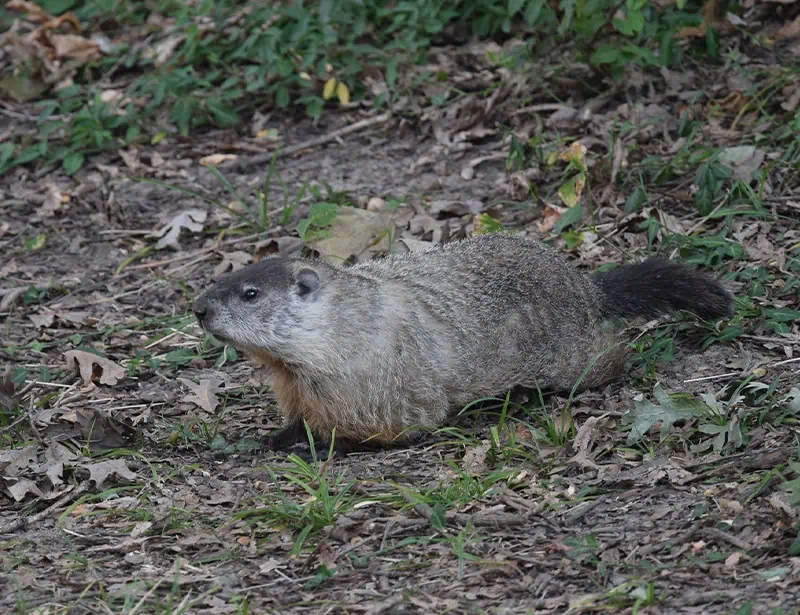
Groundhogs or woodchucks are one of the largest members of the squirrel family. They create burrows with multiple entrances and chambers. They have chambers for sleeping/hibernation, a nursery, a bathroom, and storage. Some groundhogs may build numerous burrows.
Groundhogs usually remain isolated but come together during mating season. In winter, foxes, rabbits, raccoons, and possums also typically live in groundhog burrows.
According to the Groundhog Day lore, whether or not a groundhog sees its shadow upon emerging from hibernation determines how soon spring will come.
Groundhog burrows consist of extensive networks of chambers and tunnels. One burrow can stretch out for up to sixty-six feet. Their burrows usually have a massive pile of excavated soil at the main entrance.
15. Ghost Shrimp (Palaemonetes paludosus)
Ghost shrimp are fragile crustaceans with translucent exoskeletons. They burrow at the water's edge into the sea floor, collecting food from the sediment and water running through the burrow. The burrows also protect the shrimp's soft, delicate shell.
Other small invertebrates, such as scale worms, pea crabs, and snapping shrimp, join a ghost shrimp in its hole. The burrow protects them from predators and allows them to feed on the ghost shrimp’s leftovers.
Ghost shrimps are only about 4 inches long but can dig tunnels up to 4 feet deep. When the tide is low, the openings of ghost shrimp burrows are visible. They are small holes with dome-shaped edges.
Impact of Burrowing Animals
Burrowers have positive and negative impacts on the environment.
On the positive side
Burrowing activity can improve soil health through aeration, organic waste deposits, and mixing of organic matter. It can also help plants with root penetration, as with earthworms.
Burrowing marine species help drive oxygen deeper into the seabed. In a forest fire, burrows can provide a haven for small animals.
They are essential members of the food chain and sustain biodiversity. Many burrowing species are prey for small predators like weasels, raptors, hawks, and snakes.
On the flip side
A burrowing animal can leave unsightly mounds of dirt in your yard and cause significant structural damage to buildings, irrigation lines, dams, and other structures.
Burrowers like ground squirrels, prairie dogs, and pocket gophers destroy plants in gardens and farms by consuming roots, stems, bark, etc. Some insects, like termites, can move from burrowing underground to wooden structures and cause severe structural damage.
Prairie dogs create burrows in short grasses where the holes are less visible. However, a hidden hole presents injury risks to livestock and humans.
If you are disturbed by burrowing animals like gophers on your property, the best course of action is to contact your local animal control unit to have them safely removed.
Conclusion
Some animals live in sophisticated burrows or simple holes underground to hide from predators and intense temperatures. Many animals live primarily in burrows, but some only stay to breed or hibernate.
Glossary Terms:
| 1 | Monaenkova, D., Gravish, N., Rodriguez, G., Kutner, R., Goodisman, M. a. D., & Goldman, D. I. (2015). Behavioral and mechanical determinants of collective subsurface nest excavation. Journal of Experimental Biology, 218(9), 1295–1305. |
| 2 | LaMarre, V. 2011. "Spheniscus magellanicus" (On-line), Animal Diversity Web. |
| 3 | Schmidly, D. J., & Bradley, R. D. (2016). The Mammals of Texas. University of Texas Press. |
Jen’s a passionate environmentalist and sustainability expert. With a science degree from Babcock University Jen loves applying her research skills to craft editorial that connects with our global changemaker and readership audiences centered around topics including zero waste, sustainability, climate change, and biodiversity.
Elsewhere Jen’s interests include the role that future technology and data have in helping us solve some of the planet’s biggest challenges.
