
12 Blue Animals From Birds To Butterflies

Some colors, like black and brown, are more common in nature because animals produce melanin, while others absorb it (red and orange pigments) from their food. Some colors, like blue, are unusual in the wild.
Most animals cannot produce blue pigments, except in rare cases. This article examines 12 rare cases of blue animals in the wild. Some of these animals include the blue jay, the blue lobster, the blue dacnis, and the blue poison dart frog.
12 Blue Animals In The Animal Kingdom
Quick links to animals with different shades of blue:
1. Blue Poison Dart Frog (Dendrobates tinctorius azureus)
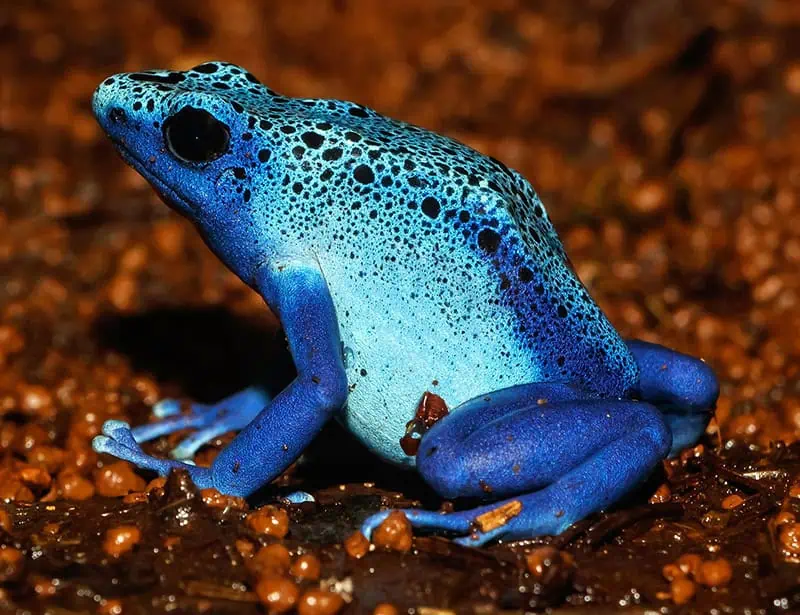
The first animal on our list of animals with blue coloration is the blue poison dart frog. It has a bright blue body, dark blue limbs, and a belly with irregular black spots. Blue poison dart frogs are native to the rainforest islands in the Sipaliwini savanna of southern Suriname.
This type of frog is about 1.8 inches long and weighs up to 3 grams. It is called a poison dart frog because of the poison glands underneath its skin. These glands secrete alkaloid poisons that paralyze and kill predators. The frog’s bright coloration serves as a warning to potential predators about its poisonous qualities.
You can distinguish between male and female poison dart frogs by the shape of their toes. Females have flattened toe tips, while males have heart-shaped toe tips. Their diet comprises ants, beetles, caterpillars, flies, maggots, mites, termites, and spiders.
2. Blue Jays (Cyanocitta cristata)
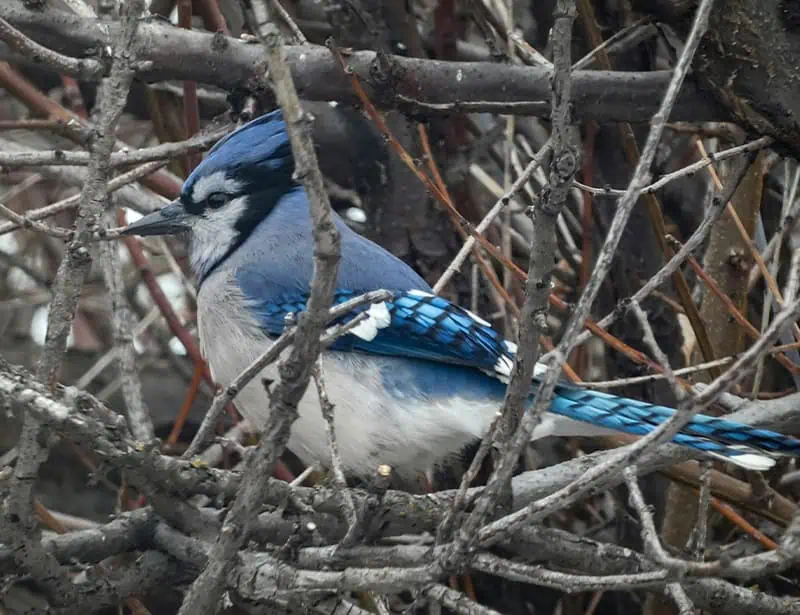
Next on our list of blue animals in nature are blue jays. Blue jay is a large songbird with blue, white, and black plumage. However, the blue jay’s feathers don’t have blue pigments. Blue jays’s feathers have a dull brown color.
They appear to have a blue pigment because they have modified prismatic cells that scatter light waves on their feathers. The scattered light waves reflect blue light waves to those looking at blue jays.
The blue jay is a species that lives in coniferous and deciduous forests in the United States and southern Canada. It is about 11.8 inches long and weighs 65 to 109 grams. Female blue jays are smaller than their male counterparts.
The blue jay mimics the call of other birds, such as the red-shouldered hawk, red-tailed hawk, eastern screech owl, and bald eagle. They mimic these birds to startle other birds into dropping their food, making it easy for them to still it.
3. Carpathian Blue Slug (Bielzia coerulans)

We know little about the Carpathian blue slug, except that it is native to the Carpathian mountains in Central and Eastern Europe. The slug doesn’t get its blue color until it enters adulthood. As a juvenile, the Carpathian blue slug is yellowish-brown. They grow to 149 mm long, feeding on mushrooms, strawberries, and lichens.
Each slug dies after each breeding season. From July to August, they lay about 30 to 80 eggs. The eggs hatch after a maximum of 25 days, and half-grown juveniles enter hibernation. They appear as fully grown adults in May.
4. Blue Whale (Balaenoptera musculus)
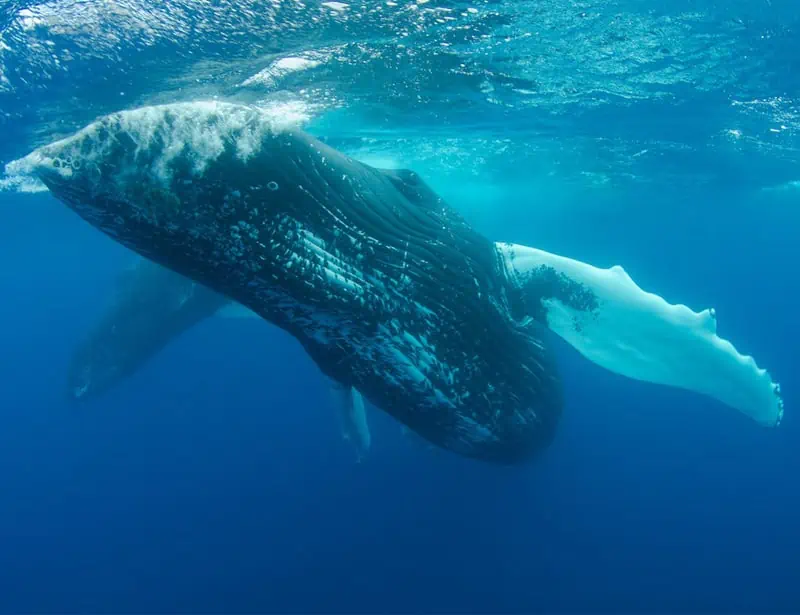
Blue whales, the largest animals on earth, are next on our list of blue animals. This whale species is classified as baleen. It weighs about 200 tons, which is as heavy as 23 elephants. Its tongue alone can weigh as much as an elephant. The heart of a blue whale weighs almost 1,500 pounds.
A blue whale looks blue underwater but looks blue-gray on the surface. You can see blue whales in all oceans except in the Arctic Ocean. A blue whale has a huge, long, and slender body shape. However, the Antarctic blue whale is bigger than other blue whale subspecies. Antarctic blue whales weigh over 330,000 pounds and reach up to 110 feet long.
The blue whale feeds primarily on krill but eats fish and tiny crustaceans. They are also one of the loudest animals on earth. They emit a series of moans, pulses, and groans that other whales can hear up to 1,000 miles away. Their sounds help them communicate with each other during migration to temperate oceans in the mating season.
The blue whale is an endangered species in the animal kingdom. Threats it faces include habitat destruction, marine pollution, climate change, entanglement in fishing gear, and vessel strikes.
5. Blue Morpho Butterfly (Morpho menelaus)

Blue morpho is one of the biggest butterflies in the world. Its bright blue wings with black edges are about 5 to 8 inches wide. Its wings have a blue color because of the reflection of the microscopic structure on the backs of the wings when light hits them.
The wings have up to 5,400 microscopic scales per square centimeter that reflect blue light. Male butterflies have wider and brighter wings than their female counterparts. However, the underside of the blue morpho’s wings is dull brown with many black eyespots.
This color combination makes the butterfly species appear to disappear and then appear whenever it flies in the sky. Blue morpho butterflies are native to the tropical forests of Latin America, from Mexico to Colombia.
6. Blue Carpenter Bee (Xylocopa caerulea)

Next on our list of blue animals is the blue carpenter bee. Only the female blue carpenter bees have a blue color. They have deep blue pigments in the hair on the head, thorax, and abdomen, and the female thorax also has yellow pigments.
Scientists have yet to discover the cause of blue coloration, but they do know that bilin shapes the shape of its light absorption spectrum. Blue carpenter bees look similar to yellow bumblebees but do not have hairy abdomens.
Also, only the female blue carpenter bee has a stinger; the males are incapable of stinging. These solitary bees are native to Southeast Asia, India, and southern China and can grow to 28 mm in size.
7. Blue Gray Tanager (Thraupis episcopus)

The blue-gray tanager is a two-colored songbird native to southeastern Mexico and central South America. You will find them in northeast Bolivia and northern Brazil. Adult tanagers are light blue-gray: gray or light blue color on their head and chest, and bright blue on their tail feathers and wings.
Blue-gray tanagers are about 6 inches long and weigh 27 to 45 grams. They prefer semi-open areas like forest edges and clearings. Furthermore, they have adapted to human settlements, and you’ll find them regularly visiting bird feeders in people’s yards. Their diet includes fruits, insects, and nectar.
8. Blue Dacnis (Dacnis cayana)

Blue dacnis, also known as turquoise honeycreeper, is another bird with a blue appearance. It is 12 cm long and weighs about 15 grams. Blue dacnis is a small passerine bird native to South America, Nicaragua, Panama, Bolivia, and Northern Argentina.
Similar to the blue carpenter bee, only one sex is blue in color. The male blue dacnis is turquoise blue with black streaks on its eyes and the bird’s feathers. Female dacnis aren’t entirely blue. They have blue heads, green plumage, and green-brown wings. Immature birds are also green but with duller black areas around the eyes, throat, and back.
There are eight subspecies of the blue dacnis that appear blue in various shades. Some have rich cobalt blue, dark blue, bluish-violet, and light blue colors. Blue dacinis vocal call is tsip. They build their nests in tree branches in forests, gardens, and parks. Blue dacnis birds feed on small insects.
9. Sinai Agama (Pseudotrapelus sinaitus)
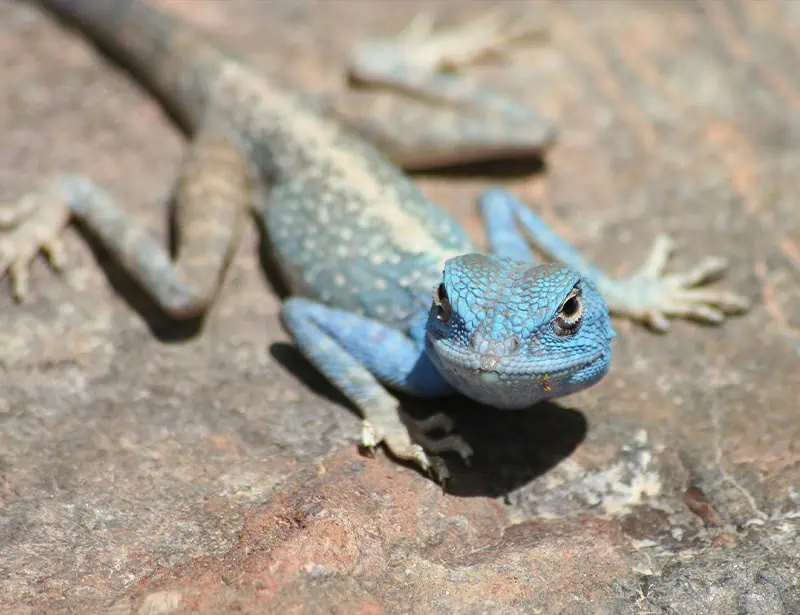
Next on our list of blue animals is the Sinai agama. You do not see these blue reptiles daily unless you are in the arid areas of the United Arab Emirates, North Africa, and the Middle East. They live in dry and rocky areas in eastern Egypt, Jordan, eastern Sudan, southeastern Libya, Syria, Oman, Ethiopia, Djibouti, Palestine, and Eritrea.
Sinai Agama is a small lizard about 7 inches long. It has long legs and a tail one and a half times longer than the length of its body. One of this lizard’s unique features is its third hind toe, which is longer than the fourth.
Also, the Agama lizards aren’t blue all year round. Female agama lizards are greyish-brown with crescent-shaped red markings right behind the forelimbs. Males tend to have a dull brown skin color but appear blue during the mating season.
During some seasons, their whole bodies don’t appear blue. Only the neck and head turn blue, while the rest of the body maintains a dull brown coloration. They feed on plants, ants, and arthropods.
10. Blue Lobster (Nephropidae)

Next on our list of blue animals is the blue lobster. Blue lobsters are extremely rare—one in two million are blue lobsters. In June 2013, a fisherman caught a blue lobster in Antogonish’s waters.
Blue lobsters exist because of a genetic defect that produces an excessive amount of protein, which causes a unique blue appearance. Many fishermen have caught blue lobsters in France, Massachusetts, and Canada. Most are given to aquariums or returned to the ocean.
11. Indian Peafowl (Pavo cristatus)

Indian peafowls are next on our list of blue animals in nature. They are a species from the bird group called pheasants. We are more familiar with peacocks, which are male peafowls. The females are called peahens, but the group name is peafowl.
Indian peafowls are one of the largest birds that can fly. They are native to Bangladesh, India, Nepal, and Sri Lanka. Male peafowls have bright blue necks and breasts, with gold feathers lining their sides and backs. Females are brown, grey, and cream-colored.
The males have long tail trains measuring an average of 1.2 meters. They use their elaborate tail trains to attract females. When picking mates, peahens consider the number of eyespots and the length of the tail.
12. Grand Cayman Iguana (Cyclura lewisi)
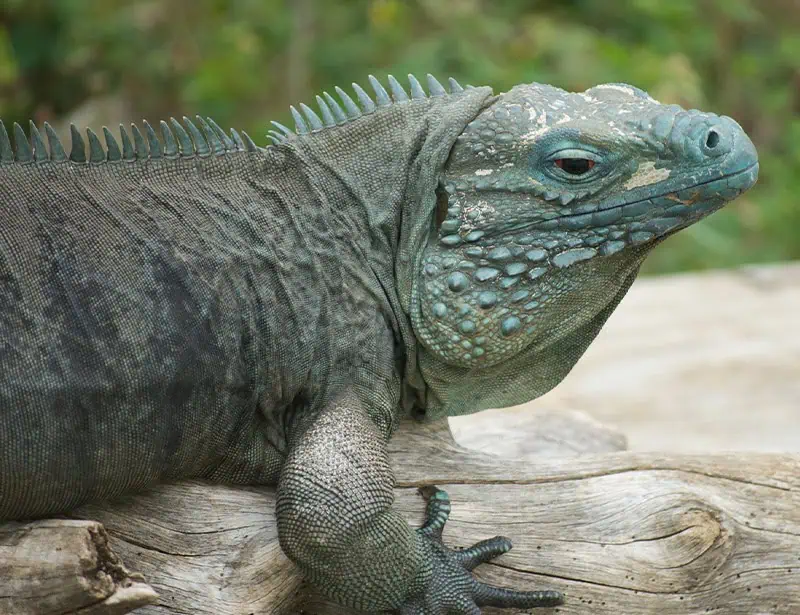
Next on our list of blue animals are blue iguanas. The Grand Cayman iguana is endemic to the Grand Cayman Islands. It weighs over 11 kg and grows over 1.5 meters long. The species has stiff spines on its dorsal side and a spineless dewlap.
They prefer to live in caves and crevices of eroded rocks in grasslands, forests, and coastal areas. During the mating season, the males' structural coloration becomes brighter. Cayman iguanas have a long lifespan, living up to 40 years in the wild.
Conclusion
Wildlife is full of unique wonders. There are many more blue animals like the blue tang, eastern bluebird, Ulysses butterfly, and blue tit. You can find these animals in Eastern Europe, South America, Papua New Guinea, the Solomon Islands, and the Indian subcontinent. You can plan your next trip to zoos and conservation centers in these areas to get a magnificent view of these blue beauties.
Glossary Terms:
Jen’s a passionate environmentalist and sustainability expert. With a science degree from Babcock University Jen loves applying her research skills to craft editorial that connects with our global changemaker and readership audiences centered around topics including zero waste, sustainability, climate change, and biodiversity.
Elsewhere Jen’s interests include the role that future technology and data have in helping us solve some of the planet’s biggest challenges.
