Biggest Crab in the World And Other Gigantic Relatives

Giving you the answer right off the bat. The biggest crab in the world is the Japanese spider crab. Other humongous cousins deserve some spotlight too. To name a few, there are the coconut crab, the Dungeness crab, and the Atlantic blue crab. Learn more about these massive arthropods inhabiting our oceans in this post.
10 Biggest Crabs in The World
Here are the heavyweight crab species you might not have seen yet:
1. Japanese Spider Crab (Macrocheira kaempferi)

Starting with the champion, the Japanese spider crab is about 12.5 feet long, measuring from one front claw to another. It inhabits deep-sea environments in the Japanese Pacific Ocean, varying from 164 feet to 1,968 feet.
The carapace of this crab species measures up to 12 inches across. Its weight varies between 16 kg and 20 kg. You’re most likely to see these large edible crabs in the Sagami, Suruga, and Tosa bays, off the coast of the Kii Peninsula, and as far as Su-ao, Taiwan.
The Japanese spider crab has a mottled orange and white body, a cream underbelly, and an oval-shaped carapace. The male Japanese spider is often larger than its female counterpart. The female Japanese spider crab has a smaller but broader abdomen, while the males are bigger.
Japanese spider crabs scavenge leftover fish scraps from other sea creatures or decaying edible matter. Although these large crabs inhabit the sandy bottoms of the Pacific, they move to shallower waters of about 50 m during the mating season.
2. Tasmanian Giant Crab (Pseudocarcinus gigas)

The Tasmanian giant crab is a species native to South and Western Australia. The second largest crab weighs an average of 9 kg but can grow up to 18 kg.
Tasmanian giant crabs have stouter claws, with the primary claw measuring up to 17 inches long. The crab’s carapace width is up to 18 inches across. Its shell is often triangular-shaped with an orange-red color and cream spots.
This species has a lifespan of up to 30 years in the wild. More research is necessary because there is barely any information on Tasmanian crabs. However, scientists speculate that a Tasmanian giant crab feeds on starfish species, hermit crabs, mollusks, bird carrion, finfish, and true crabs.
3. Coconut Crab (Birgus latro)

The coconut crab, closely related to decapod crustaceans, is next on our list. Other decapods include the King and Hermit crabs.
Coconut crab is the world’s biggest crab on land. The enormous crustacean has a wide leg span, measuring 40 inches/ 1 foot from one claw to the other. The coconut crab species has an average weight of 4.5 kg.
You can find them on islands and coastal mainlands in the southwest Pacific and Indian Oceans. Coconut crabs feed primarily on carrion, coconut, fruit, seeds, and nuts. They also eat dead animals and the molted skeletons of other crustaceans.
The largest land crab got its name from its particular skill, opening coconuts. Coconut crabs can crack open coconuts with their massive chelae, also known as pincers. A giant coconut crab can produce a 742-pound force with their chelae, quickly splitting coconuts.
They will also climb coconut trees to strike coconuts repeatedly with their pincers until they fall to the ground. Young and adult coconut crabs have unique and different colors. Adult coconut crabs have varying colors, ranging from brown to deep purple to light violet, while the juvenile crabs have brown colors with black stripes on their legs.
4. Red King Crab (Paralithodes camtschaticus)

The red king crab, also known as the Alaskan king crab, is a member of the stone crab family. It is related to brown king and blue king crabs. It is native to the Bering Sea, especially Bristol Bay, Pribilof Islands, Norton Sound, and Western Aleutian Islands.
These large crabs inhabit sandy bottoms up to 1,100 feet deep. An Alaskan king crab has a leg span measuring up to 5 feet long and grows up to 24 pounds. It has a spiny carapace in brown, dark red, or burgundy colors. The crab’s distinctive spiky shell is up to 11 inches wide. Red king crabs are the largest commercially harvested crabs in the seafood industry.
The red king crab has five pairs of legs and a fan-shaped tail or abdomen tucked beneath the end of the shell. Records show male crabs are bigger than female crabs. You can easily recognize a male red king crab from the shape of its abdomen. Females have a rounded abdominal flap, while male king crabs have a triangular flap.
Alaskan king crabs eat clams, mussels, worms, tiny fish, sea stars, algae, barnacles, and brittle stars. Juvenile red king crabs are vulnerable to other red king crabs, octopuses, sea otters, and groundfish. However, the species generally live up to 30 years.
5. Dungeness Crab (Metacarcinus magister)
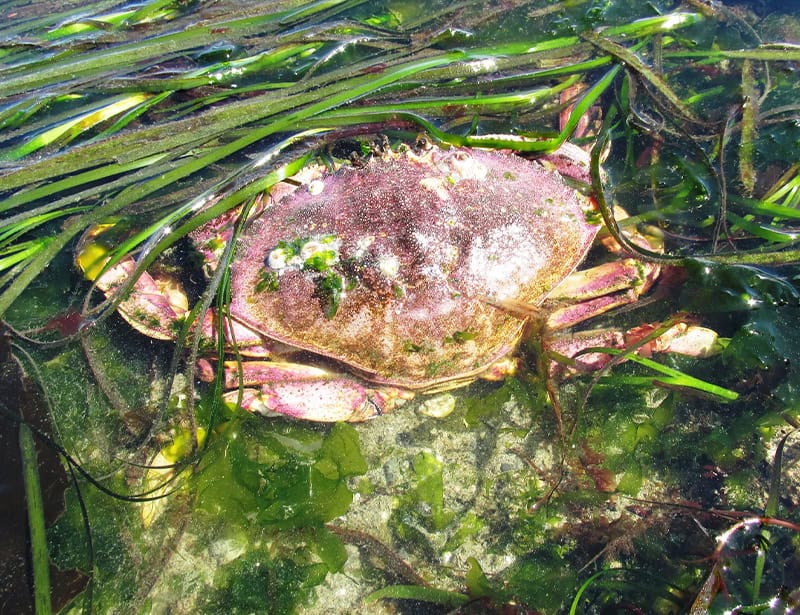
Dungeness crabs are a species native to the Aleutian Islands, Alaska, to Point Conception, near Santa Barbara, California. They also live in Magdalena Bay, Baja California Sur, Mexico. These crabs are native to these areas because they prefer sandy or muddy bottoms.
They have legal measurement standards in Alaska. They measure the Dungeness crab’s shoulder width by measuring across the back of the carapace, from notch to notch. Alaska’s legal measurement is 6.5 inches, notch to notch. However, a Dungeness crab can reach up to 10 inches.
Also, the fishing industry can only harvest male Dungeness crabs from the sea. They check for the crab’s sex by looking at its abdomen. Male Dungeness crabs have a triangular-shaped abdomen, while the females have a rounded abdomen. The female abdomen becomes more rounded in an egg-bearing developmental stage.
6. Atlantic Blue Crab (Callinectes sapidus)

The Atlantic blue crab, or the Chesapeake blue crab, is next on our list of large crabs. It can be found in various habitats in many locations. The blue crab lives in the western Atlantic, Nova Scotia, and Argentina. You’ll also see the species in Hawaii, Japan, Cape Cod, Uruguay, and Massachusetts Bay.
The blue crab is a unique crab species. Its frontal area, along the pincer claws, is bright blue, and the rest of the body is olive-brown. Its carapace can grow up to 25 cm long. However, the carapace width is twice the carapace’s length.
Blue crabs feed on dead plants and animals on the ocean floor, as well as small crustaceans, oysters, mussels, aquatic worms, and other invertebrates. Unfortunately, the Chesapeake blue crab is a prey species. Its predators are sea turtles, Atlantic croaker, red drums, and humans.
Atlantic blue crabs are fast swimmers. They have three pairs of legs and a powerful pincer set. The last pair of blue crab’s walking legs looks like a paddle. It helps them travel 215 meters a day. Blue crabs move an average of 15.5 meters per hour. Unfortunately, the Chesapeake blue crab has a short lifespan. It typically lives up to 1-3 years.
7. Giant Mud Crab (Scylla serrata)

The giant mud crab, also known as black crab, mangrove crab, and green crab, is native to the Indian and tropical Western Pacific Ocean, from the Red Sea, South Africa, and Southern Japan to New Zealand and Tahiti. The Indo-Pacific mud crab prefers marine and freshwater estuaries and mangrove swamps.
You will also find the giant mud crab in the Hawaiian Islands because it was introduced to the waters of Hawaii and the Gulf coast of Florida from 1926 to 1935 in an attempt to start fishery. Its deep green to dark brown carapace is about 17 cm wide but can reach 28 cm.
The giant mud crab weighs an average of 1 kg but can grow up to 3 kg. Because of its delicious meat, it is a delicacy in the culinary industry. Mud crabs feed on algae, small fish, crustaceans, mollusks, dead animals, and decaying plants.
8. Red Rock Crab (Cancer productus)
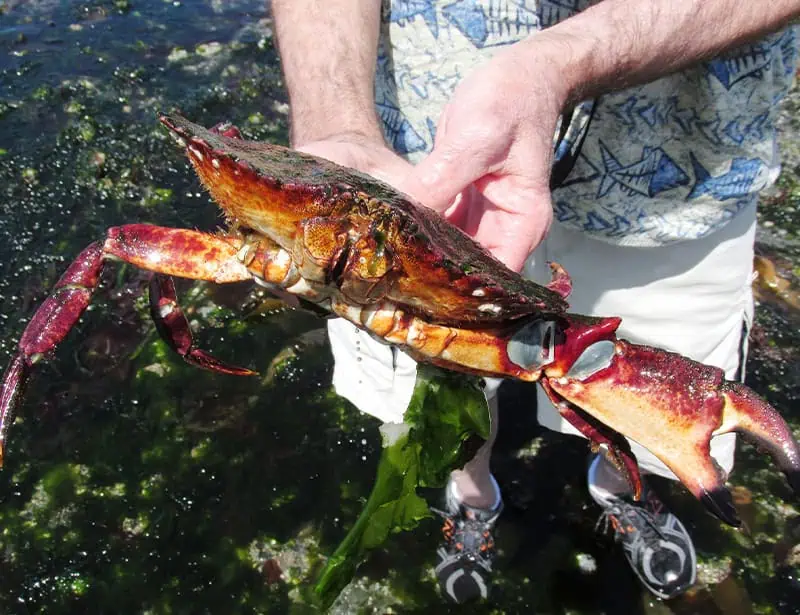
The red rock crab is native to southern Australia, Victoria, West Australia, New South Wales, New Zealand, Tasmania, South Africa, and Chile. People also call it the red crab or rock crab. It is about 6 inches wide, with large claws. You can easily mistake the rock crab for Dungeness crab.
However, you can differentiate them by the black tips on the red rock crab’s claws. Red rock crabs prefer rocky ocean floors, but they also live in shellfish beds or eelgrass at depths of 260 feet. Red crabs eat bryozoans, clams, snails, small seaweeds, and spongs.
9. Snow Crabs (Chionoecetes opilio)

The snow crab is next on our list of giant crabs worldwide. Snow crabs have a reddish-brown carapace, greenish-blue eyes, four pairs of walking legs, and claws. The snow crab species native to the North Atlantic Oceans and Arctic Ocean has a carapace width of 5-6 inches. However, female shells mostly never grow past 3 inches.
Its spindly legs span up to 35 inches. Male snow crabs have a more extensive leg span than their female counterpart. Its bright orange succulent meat is a favorite among culinary experts. The crab’s color is bright when young but dulls as the crabs grow older.
Also, the underbelly of the crab is lighter in color than its shell. You can recognize snow crabs by the dull colors of their shell and dull yellowish underbelly. Snow crabs live up to 20 years, feeding on shrimps, worms, fish, sea urchins, snails, and clams.
10. European Spider Crab (Maja squinado)

Last on our list is the European spider crab, also known as the spiny spider crab. This species is native to the eastern Atlantic Ocean and the Mediterranean Sea. The spiny spider crab has a bright orange spiky shell and slender legs covered with thin hair.
Their shells are usually covered in algae, giving them a hairy appearance. The European spider crab’s shell is about 20 cm wide. Male European spider crabs can have a leg span of up to 50 cm.
Conservation Status of the World’s Largest Crab
Crabs are a staple in the seafood industry because of their delicate meat. However, overfishing makes some of the largest edible crabs vulnerable to extinction. Unchecked, the increasing demand for crabs could have dire consequences for the species and their environment.
The government and its organizations are encouraging sustainable fishing practices to maintain healthy crab populations. Some examples include:
- The Japanese government bans fishing for Japanese spider crabs during their mating season1, from January to April.
- The Tasmanian government released a rule to protect their own giant species. One of the orders says that fishermen cannot keep female Tasmanian giant crabs with eggs.
- The largest terrestrial arthropod, the coconut crab, received a vulnerable status assessment after years of being data deficient2. Unfortuntately, some of its populations are already extirpated or locally extinct, possibly due to overhunting. To prevent extinction, local authorities and conservationists employ strategies such as bans, protected breeding periods, and establishing sanctuaries.
Conclusion: Biggest Crabs in the World
Crabs are unique life forms with their eight-jointed legs. The Japanese spider crab is the largest, while the coconut crab is the third largest and the most giant terrestrial crab. Even though these not-so-ordinary crab species are tipping scales, their continued existence is still dependent on sustainable fishing and habitat preservation.
Glossary Terms:
| 1 | Riebel, W. 2011. Macrocheira kaempferi, Animal Diversity Web. |
| 2 | Cumberlidge, N. 2020. Birgus latro. The IUCN Red List of Threatened Species 2020: e.T2811A126813586. |
Jen’s a passionate environmentalist and sustainability expert. With a science degree from Babcock University Jen loves applying her research skills to craft editorial that connects with our global changemaker and readership audiences centered around topics including zero waste, sustainability, climate change, and biodiversity.
Elsewhere Jen’s interests include the role that future technology and data have in helping us solve some of the planet’s biggest challenges.
Fact Checked By:
Isabela Sedano, BEng.