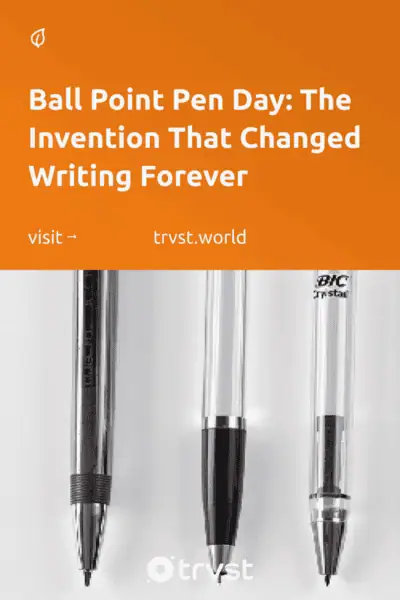
Ball Point Pen Day: The Invention That Changed Writing Forever

June 10th marks Ball Point Pen Day around the world. This date celebrates when László and György Bíró filed their game-changing patent back in 1943. Their solution fixed the constant headaches people had with fountain pens that leaked everywhere. What writing tool touches more lives daily yet gets so little credit? The simple ballpoint changed how billions write through basic reliability. This yearly occasion recognizes a true breakthrough in writing tech. Nothing fancy—just affordable pens that actually work.
The date connects directly to innovation history. Hungarian-Argentine brothers László and György Bíró submitted their patent on June 10, 1943[1]. László worked as a journalist and got fed up with constant ink problems. He noticed newspaper ink dried quickly without smudging, while his fountain pens made a mess.
The brothers developed a rotating ball that let ink flow smoothly, no more leaky disasters. Their move to Argentina during World War II turned out to be essential. They fled Nazi-occupied Europe in 1941 after President Agustín Justo personally invited them. The day remains unofficial, without corporate backing. This suggests that sometimes fixing an everyday annoyance creates something revolutionary.
Key Info: Ball Point Pen Day
- When is Ball Point Pen Day?
Occurs annually on the 10th of June - This Year (2026):
Wednesday, June 10, 2026 (date has passed) -
Future Dates
- Thursday, June 10, 2027
- Saturday, June 10, 2028
- Sunday, June 10, 2029
- Monday, June 10, 2030
-
Additional Details
- Observed By: Educational institutions, writing enthusiasts, pen collectors, and stationery aficionados
- Where Is It Observed: International
- Primary Theme: Writing Technology Innovation
- Hashtags: #BallPointPenDay #BiroBrothers #WritingHistory #PenHistory #StationeryDay
Quick Links: Ball Point Pen Day
From Frustration to Standard Tool

Ballpoints completely changed writing culture. Before this, you needed expensive fountain pens or dealt with messy inkwells. Students battled smudges. Office workers watched documents get ruined daily. The ballpoint fixed all that through pure practicality.
Writing became possible anywhere—no special care needed. Since their introduction, over 100 billion Bic pens alone have been sold worldwide. And that's just one brand. Schools finally had tools that worked without breaking budgets. Personal letters became simpler to write. For once, progress came through something getting less complicated.
Here's a short timeline of how the writing tool came to what we know today.
John J. Loud patents first ballpoint design—went nowhere commercially
László Bíró sees newspaper ink drying fast—clicks in his mind
First prototypes built with brother György. They obtained its first patent in Hungary.
Patent filed in Argentina—why we celebrate this date
First "Biro" pens hit stores—cost a fortune initially. The company latered named into EterpenCo. Patent was also obtained in the United States.
Mass production makes them affordable
Marcel Bich improved Bíró's pens and launched the BIC Cristal pen in France.
Ways to Mark Ball Point Pen Day
- Write actual letters to friends—imagine their surprise
- Hold a handwriting session to practice your forgotten penmanship
- Try creative writing using only ballpoints
- Experiment with ballpoint art techniques—surprisingly versatile
- Learn the physics behind how that tiny ball actually works
- Start collecting different pen styles—some people have thousands
- Check out writing instrument exhibits at local museums
- Post handwritten notes online with #BallPointPenDay
- Discuss everyday inventions we take for granted
- Attempt calligraphy with ballpoints instead of fancy pens
What Sets Ball Point Pen Day Apart From Other Holidays
Ball Point Pen Day stands apart from other writing holidays. National Fountain Pen Day happens each November, focusing on traditional techniques. Handwriting Day falls January 23rd, covering the broader skill regardless of tool used.
This June celebration specifically honors practical innovation—solving real problems through design thinking. Writing enthusiasts track multiple pen-related observances throughout the year, each highlighting different aspects of how we communicate. But Ball Point Pen Day uniquely celebrates engineering that fixed everyday hassles.
An Innovation Story Worth Celebrating

Photo by Artem Podrez on Pexels.
Today's educators can share rich teaching moments from this day's history. It shows persistence through thousands of failed experiments before success. Students learn how spotting daily frustrations can lead to solutions with a global effect. The pen's mechanism introduces basic physics principles naturally—no forced curriculum tie-ins needed.
Engineering classes examine the precision manufacturing required; history lessons explore how World War II shaped invention paths. The Royal Air Force adopted the Eterpen (Bíró's company name) in 1944 because traditional fountain pens leaked at high altitudes while ballpoints worked perfectly.
Design curator Gemma Curtin explains Bíró's motivation simply: "He was used to the fountain pen, which was very leaky and left ink on your hands and smudged, and he was very frustrated by it." This connects writing, science, and history through a single object that most students have in their backpack.
June 10th gives us a moment to notice writing innovation. The Bíró brothers never imagined their solution would reach billions—they just wanted pens that didn't make a mess. Take a second this June to appreciate your trusty ballpoint. Maybe try writing something by hand. We rarely do that anymore.
Which other everyday objects deserve similar recognition for their impact? Ball Point Pen Day reminds us to see the extraordinary in ordinary tools. Not everything important arrives with fanfare or marketing campaigns. Sometimes it just works.
Resources:
FAQs (Frequently Asked Questions)
The global ballpoint pen market hit $4.5 billion in 2024, according to Market Research Intellect. From these numbers, we can determine that factories churn out tens of billions of pens yearly. They make this many to keep up with schools, offices and everyday users who need something to write with. The actual production count isn't something companies share openly.
Thrown-away pens mostly end up in landfills or oceans. There they break into tiny plastic bits and release methane. This creates real problems. Most city recycling programs can't handle pens because they contain mixed materials – plastic bodies, metal tips, and chemical inks all stuck together. Environmental researchers from Sri Lanka point to refillable models as better choices. Using pens with simpler designs also helps cut down this waste stream.
Today's pens use machine precision and automatic quality checks that the Bíró brothers couldn't dream of. Better ball-socket fit means ink flows without problems. Brass or steel points don't rust like early models did. And special ink formulas dry fast but don't leak or clog. The basic idea remains the same since the 1940s, but these changes make modern pens much more reliable for everyday writing.
Since 2020, pen makers have focused on both technical improvement and green materials. Market studies show tungsten carbide tips now create smoother writing experiences. Beyond this, recycled metal alloys reduce the effect on our environment. Researchers at Illinois Tech work on tiny fluid systems to stop skipping when you write. This suggests we'll see more comfortable designs soon. But what happens when these innovations meet consumer expectations? Some manufacturers already test pressure-sensitive grips that feel better during long writing sessions.
Barbara is a former journalist who is passionate about translating important causes into engaging narratives. She combines communication expertise with an environmental science background to create accessible, fact-driven content.
Fact Checked By:
Isabela Sedano, BEng.